CAESAR
Summary
| Origin country | 🇫🇷 France |
| Category | Self-Propelled Artillery |
| Sub-type | 155mm Wheeled Self-Propelled Howitzer |
| Manufacturer | Nexter Systems (now KNDS France) |
Technical specifications
| Crew | 5 (3 in emergency) personnels |
| Mass | 17.7 tons |
| Height | 3.7 m (12.1 ft) |
| Width | 2.55 m (8.4 ft) |
| Length | 10.0 m (32.8 ft) |
| Max. speed | 100 km/h (62 mph) |
| Engine | Diesel |
| Weapon 1 | 155 mm L/52 caliber gun |
Historical operators
Profile of CAESAR
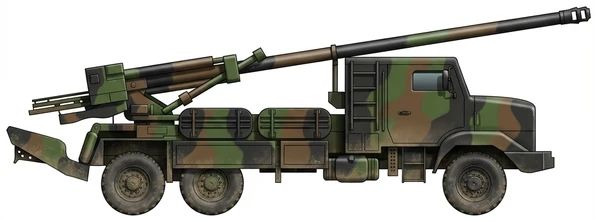
Description
The Camion Équipé d'un Système d'Artillerie (CAESAR) is a French 155 mm self-propelled gun developed by GIAT Industries, now KNDS France. Development began in the early 1990s as a self-funded project to maintain industrial artillery capabilities during a period of limited domestic procurement. The design objective was to integrate a 52-caliber barrel onto a truck chassis to meet NATO standards for range and accuracy while maintaining air-transportability. A prototype on a Unimog chassis was first exhibited in 1994, followed by pre-production models that underwent trials in France and Malaysia. In 2004, the French Direction Générale de l'Armement contracted for the production of the system on a Renault Sherpa 5 6×6 chassis to replace the AuF1 tracked howitzer.
The CAESAR utilizes an autonomous weapon network comprising an inertial navigation system and ballistic computer. The system is designed for high mobility and shoot-and-scoot tactics, capable of entering a firing position in approximately 60 seconds and departing in 40 seconds. It features a rate of fire of six rounds per minute and is compatible with NATO-standard 155 mm ammunition. Using Extended Range, Full Bore (ERFB) shells, the system achieves ranges beyond 40 kilometers, while rocket-assisted or smart ammunition can extend this range further. Variants include an 8×8 version integrated on a Tatra 817 chassis with increased ammunition capacity and an optional armored cabin. The CAESAR Mark II, or New Generation (NG), introduces a more powerful engine, an automatic gearbox, and an armored cabin with enhanced protection against mines and ballistic threats. It also incorporates updated electronics, including the Geonyx navigation system and fire control software utilizing artificial intelligence for refined accuracy.
The CAESAR is operated by several nations across Europe, Asia, and Africa. French forces first deployed the system to Afghanistan in 2009 and subsequently used it in Lebanon under UNIFIL and in Mali during Operation Serval. In 2011, the Royal Thai Army employed the CAESAR in cross-border engagements with Cambodia. Between 2016 and 2019, French artillery units operated the system in Iraq and Syria to support the Battle of Mosul and operations in Baghuz Fawqani. Saudi Arabia has reportedly utilized the system during interventions along the Yemeni border. Since 2022, both 6×6 and 8×8 variants have been deployed in the Russo-Ukrainian War following donations and orders. Additional nations, including Belgium, Lithuania, Estonia, and the Czech Republic, have placed orders for various generations of the system.