CAESAR vs PzH 2000
CAESAR vs PzH 2000 at a glance — weight 17,700 vs 55,800 kg, top speed 100 vs 60 km/h, crew 5 (3 in emergency) vs 5 (commander, driver, gunner, and two loaders).
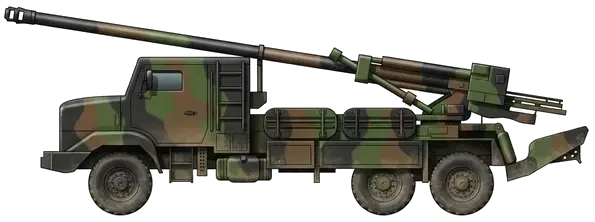
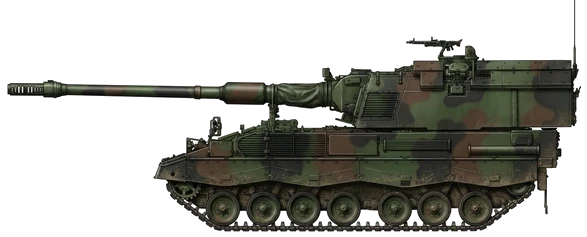
| CAESAR | PzH 2000 | |
|---|---|---|
| Origin country | 🇫🇷 France | 🇩🇪 Germany |
| Category | Self-Propelled Artillery | Self-Propelled Artillery |
| Type | 155mm Wheeled Self-Propelled Howitzer | Self-Propelled Howitzer |
| Manufacturer | Nexter Systems (now KNDS France) | Krauss-Maffei Wegmann / Rheinmetall |
| Number produced | 650 units | 362 units |
| Estimated unit price | $3.8 million | $4.5 million |
| Combat weight | 17.7 tons | 55.8 tons |
| Maximum speed | 100 km/h | 60 km/h |
| Operational range | -- km | 420 km |
| Length | 10.00 m | 11.67 m |
| Width | 2.55 m | 3.58 m |
| Height | 3.70 m | 3.06 m |
| Crew | 5 (3 in emergency) | 5 (commander, driver, gunner, and two loaders) |
Detailed Comparison
France’s CAESAR and Germany’s Panzerhaubitze (PzH) 2000 dictate the current European 155mm L/52 artillery market, yet they diverge entirely in mass, logistics, and crew survivability. At 17.7 tons, the wheeled CAESAR trades armored volume for strategic mobility and reduced operating costs. In contrast, the 55.8-ton tracked PzH 2000 functions as a heavily armored, automated firing platform built for sustained barrage.
Development and Design
The PzH 2000 emerged in the late 1990s following the failed trinational SP70 project, built to JBMOU standards by KNDS Deutschland and Rheinmetall. Germany engineered it around a Leopard 2-derived tracked chassis and an automated ammunition handling system. The CAESAR, developed in the 1990s by GIAT (now KNDS France), originated as a self-funded initiative to mount a 52-caliber gun on a commercial truck chassis to replace the tracked AuF1. France prioritized a system light enough for C-130 airlift and cheap enough to sustain domestic production.
Protection and Firepower
Both platforms utilize a 155mm L/52 barrel capable of firing Excalibur and base-bleed shells beyond 40 kilometers, but their delivery mechanisms differ.
- The PzH 2000 uses a fully automated autoloader, achieving a burst rate of three rounds in nine seconds and supporting five-round Multiple Rounds Simultaneous Impact (MRSI). It carries 60 rounds under a steel hull that resists counter-battery shrapnel.
- The CAESAR relies on manual loading with a mechanical rammer, limiting its sustained rate to six rounds per minute. It carries 18 rounds in the standard 6x6 variant.
The initial CAESAR leaves crews physically exposed to counter-fire and drone fragmentation during operation, though the Mark II update introduces an armored cabin. The PzH 2000 protects its five-man crew entirely inside its armored envelope.
Mobility and Logistics
Operating at 55.8 tons, the PzH 2000 requires heavy equipment transporters for operational movement and a complex supply chain for its MTU 881 diesel engine. Its continuous tracks provide superior mud and snow mobility but consume fuel and track pads at a high rate. The CAESAR reaches 100 km/h on paved roads under its own power. Its truck chassis simplifies maintenance, though it struggles in severe mud compared to tracked counterparts.
Deployment and Combat Record
France deployed the CAESAR in Afghanistan, Mali, and Iraq. The PzH 2000 saw combat with Dutch and German forces in Afghanistan. In Ukraine, high-intensity warfare exposed the technical limits of both systems. Ukrainian forces fired up to 20,000 rounds through single PzH 2000 barrels—far exceeding the manufacturer's 4,500-round rating—causing mechanical stress on the autoloader and forcing withdrawals to Lithuania for repair. The CAESAR mitigated counter-battery fire via its 40-second displacement time, but unarmored variants suffered losses from loitering munitions and nearby fragmentation.
Conclusion
The CAESAR possesses the advantage in expeditionary operations where strategic airlift, ease of maintenance, and lower procurement costs are the primary metrics. However, in symmetric conflicts against near-peer artillery, the PzH 2000 is the superior platform. The German howitzer's armored hull, 60-round internal magazine, and automated burst-fire capabilities allow it to execute MRSI missions and survive counter-battery fragmentation that disables the exposed CAESAR.