M101 Howitzer
Summary
| Origin country | 🇺🇸 United States |
| Category | Towed Artillery |
| Sub-type | Artillery piece |
| Manufacturer | Rock Island Arsenal |
| Number built | 10202 units |
| Est. avg unit price | $0.0 million |
Technical specifications
| Crew | 8 personnels |
| Range | 18 km |
| Mass | 2.0 tons |
| Height | 1.73 m (5.7 ft) |
| Width | 2.21 m (7.3 ft) |
| Length | 5.94 m (19.5 ft) |
| Weapon 1 | 105 mm high explosive (HE) semi-fixed ammunition |
| Weapon 2 | HEAT M67 Shell |
| Weapon 3 | M1 HE rounds |
| Weapon 4 | Blank ammunition |
Historical operators
Profile of M101 Howitzer
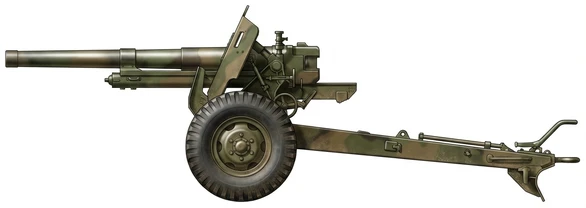
Description
The M101 howitzer, originally designated the M2A1, was developed by the U.S. Army Ordnance Department following studies of German artillery designs after World War I. Early development included the M1920 prototype and various carriage trials, leading to the standardization of the M1 howitzer in 1927. Budgetary constraints limited production until 1939, when the design was modified to use semi-fixed ammunition and a carriage suitable for vehicle towing. This version was standardized as the M2 in 1940, with the M2A1 variant featuring a modified breech ring entering mass production in 1941.
The M101 is a light field howitzer designed for infantry support. It fires 105 mm high explosive semi-fixed ammunition using a propelling charge with seven total increments. Anti-armor capability is provided by HEAT M67 shells. To address muzzle cracking identified during World War II, later production barrels were counterbored at the muzzle. The M2A2 variant, standardized in 1953, incorporated a higher strength breech ring and deeper rifling grooves to increase barrel life. The carriage uses a split trail design with pneumatic tires. In 1960, the U.S. military redesignated the M2A1 and M2A2 models as the M101 and M101A1 based on the carriage type used.
The U.S. military deployed the howitzer during World War II in both European and Pacific theaters, the Korean War, and the Vietnam War. While replaced in front-line service by the M102 and M119, the U.S. retains the piece for ceremonial purposes and avalanche control. The howitzer has been widely exported and produced internationally under license. South Korea is a major operator and developed domestic versions, including truck-mounted self-propelled variants. Canada operates a modified version designated the C3, featuring a longer barrel and reinforced trails, for reserve forces and avalanche control.
The howitzer saw service with French forces in the Algerian War and Chad, and was used by multiple factions during the First Indochina War and the Vietnam War. It remains in use with several nations, including the Philippines, where it has been employed in internal security operations and urban combat. Other operators have included Australia, Germany, and Croatia. In some instances, such as in Vietnam and South Korea, the M101 has been integrated into truck-mounted systems to provide mobile artillery support.