Rwanda Military Forces
Rwanda ranks #117 of 169 militaries worldwide in 2026, with 33,000 active troops. The Rwandan Army fields 24 main battle tanks; the Air Force flies 21 aircraft. Landlocked, Rwanda has no navy and no nuclear weapons.

Armed Forces in 2026
| Domain | Strength | Composition |
|---|---|---|
| Air Force | 21 aircraft | 17 helicopters |
| Ground Forces | 24 tanks | |
| Personnel | 33,000 active | 2,000 paramilitary |
ATLAS Index (Aggregate Total of Land, Air and Sea strength)
Full ranking →| Pillar | Weight | Score | Basis |
|---|---|---|---|
| Manpower | 10% | 30.4 | Active, reserve & paramilitary personnel |
| Ground forces | 20% | 19.9 | ARMS inventory power: armour & artillery by type and era, attack helicopters, armament |
| Naval power | 20% | 0.0 | SEAS inventory power: hulls by type, size and era, air wing, sustainment, armament |
| Air power | 25% | 12.6 | AIRS inventory power: aircraft by type and generation, enablers, armament |
| Nuclear deterrent | 10% | 0.0 | No declared nuclear capability |
| Defense budget | 15% | 11.9 | Annual spending, purchasing-power adjusted |
| Availability | modifier | ground ×0.80 · naval ×1.00 · air ×0.96 | Budget per point of each force, from the branch indexes |
Country File
| Population | 14.6M (2025) |
| GDP | $16.4 billion (2025) |
| GDP per capita | $1,124 |
| Military budget | $185M (2024) |
| Share of GDP | 1.3% (2024) |
| Military spending per capita | $13 (2024) |
| Inflation rate | 5.91% (2025) |
| Capital | Kigali |
| Region | Africa |
| Land area | 24,668 km² |
| Land borders | 893 km |
| Bordering countries | 4 |
| Currency | RWF |
Strategic Overview in 2026
Strategic Position
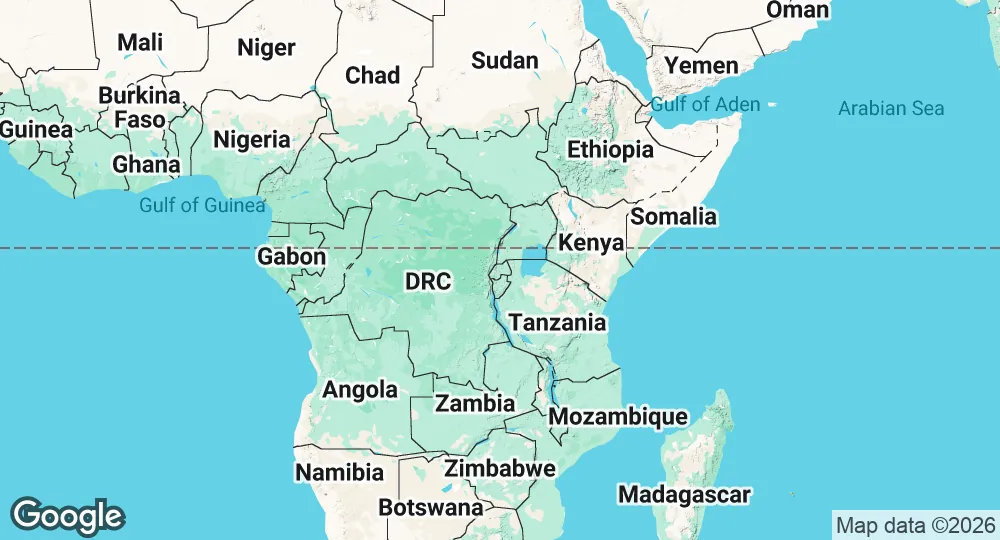
Rwanda occupies a landlocked position in the African Great Lakes region, bordered by the Democratic Republic of the Congo (DRC), Uganda, Tanzania, and Burundi. Primary security concerns center on the instability in eastern DRC and the activities of the Democratic Forces for the Liberation of Rwanda (FDLR), an insurgent group operating across the western border. While Rwanda has historically focused on domestic and border security, its contemporary doctrine emphasizes an expeditionary posture, providing security assistance to regional partners.
Rwanda maintains security relationships through both multilateral and bilateral frameworks. It is a major contributor to United Nations peacekeeping operations, particularly in the Central African Republic (CAR) and South Sudan. Outside of UN mandates, the Rwanda Defence Force (RDF) maintains a large-scale bilateral deployment in Mozambique’s Cabo Delgado province to combat Islamic State-linked insurgents. A Status of Force Agreement signed in August 2025 formalized the continued presence of Rwandan security forces in Mozambique. In April 2025, Rwanda launched a Strategic Bilateral Dialogue with the United States, focusing on security cooperation and regional stability.
Relations with the DRC remain a primary strategic challenge. In 2025, Rwanda signed the Washington Accords for Peace and Prosperity, a mediated agreement intended to de-escalate tensions and formalize the withdrawal of foreign forces from eastern DRC. However, implementation has faced obstacles due to the continued activity of non-state armed groups and ceasefire violations.
Military Forces
The Rwanda Defence Force underwent a comprehensive structural reorganization in August 2025. The current framework consists of four service branches: the Rwanda Land Force, the Rwanda Air Force, the Rwanda Reserve Force, and the newly established Military Health Service. The latter was formalized as a distinct branch to manage medical readiness and support international peacekeeping commitments.
The RDF maintains an active personnel strength of approximately 35,000. Command is centralized under the President as Commander-in-Chief, with a Joint Headquarters overseeing the various service chiefs and specialized commands. Specialized units include the Republican Guard, the Special Operations Force (SOF), and dedicated brigades for logistics, engineering, communication, and military police.
The Land Force is the primary component of the RDF and is organized into regional divisions and brigades. Its armored capability includes T-54/55 and T-72 main battle tanks. Mechanized units operate armored personnel carriers and infantry fighting vehicles, including BTR-60, BTR-70, Ratel, and Cobra variants. The artillery inventory comprises D-30 howitzers and RM-70 multiple rocket launchers.
The Air Force provides transport, reconnaissance, and strike capabilities. The combat fleet consists of Mi-24 and Mi-35 attack helicopters. Transport and utility requirements are met by Mi-8 and Mi-17 helicopters, alongside Cessna 208 Caravan and Diamond DA42 fixed-wing aircraft. The RDF has integrated unmanned aerial vehicles (UAVs) into its inventory, including the Bayraktar TB2 for intelligence, surveillance, and reconnaissance (ISR) and strike roles.
Defense Industry
The Rwandan defense industry is largely managed through state-linked entities, most notably the Horizon Group. While Rwanda relies on foreign suppliers for heavy platforms and advanced electronics, domestic efforts focus on construction, logistics, and infrastructure support for the military. In 2025, the definition of military classified assets was legally expanded to include military industries and raw materials, indicating a move toward securing and regulating domestic defense production and maintenance capabilities.
Strategic Trends
The primary strategic trend for the RDF is professionalization and the refinement of its expeditionary model. This is reflected in the 2025 military promotions, which affected over 21,000 personnel and aimed to institutionalize leadership continuity. The defense budget is estimated at approximately 1.2% of GDP, with spending priorities shifted toward modernization and the maintenance of overseas deployments.
Procurement priorities emphasize ISR capabilities, UAV integration, and the sustainment of armored fleets for border defense and regional interventions. A 2025 military cooperation agreement with Morocco signifies a broader trend of "military diplomacy," where Rwanda establishes technical and training exchanges with a wider range of international partners. Constraints include the high cost of sustaining long-term regional deployments and the diplomatic pressure associated with the ongoing conflict in the Great Lakes region.
Military Expenditure: CIA World Factbook. Last updated on 25 September 2026. Suggest a change
Frequently Asked Questions
How large is Rwanda's military?
What is Rwanda's defense budget?
How does Rwanda rank militarily in the world?
Does Rwanda have nuclear weapons?
How many aircraft does Rwanda's air force have?
How many tanks does Rwanda have?
What percentage of GDP does Rwanda spend on defense?
What is Rwanda's military personnel per capita?
Does Rwanda have paramilitary forces?
- SEP 252026 Updated Population, GDP and inflation added for 2025; GDP series revised
- AUG 42026 Updated Global Military Index updated in a site-wide editorial pass
- JUL 162026 Updated Global Military Index updated in a site-wide editorial pass
- JUN 162026 Updated Yearly statistics, military spending and 2 more fields updated
- JAN 172026 Updated Main battle tank count and Global Military Index updated
- JAN 132026 Updated Description added