M6 Heavy Tank
American heavy tank, never entered service, with very few prototypes produced during World War II. Key figures: weight 57.4 t, top speed 35 km/h, range 160 km, unit cost $0.172M, built 40. In service with 1 army — United States.
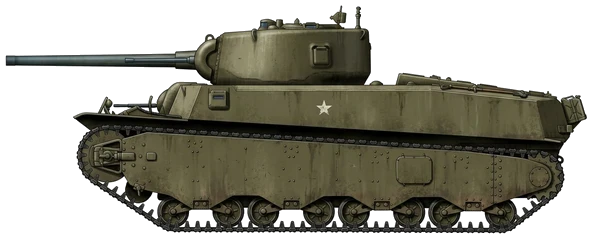
| Sub-type | Heavy Main Battle Tank |
| Crew | 5 personnels |
| Range | 160 km |
| Mass | 57.4 tons |
| Height | 3.23 m (10.6 ft) |
| Width | 3.1 m (10.2 ft) |
| Length | 8.44 m (27.7 ft) |
| Max. speed | 35 km/h (22 mph) |
| Engine | Wright-Whirlwind G-200 Diesel Engine with 925 hp |
| Weapon 1 | 1 M6 76mm gun |
| Weapon 2 | 1 M6 37mm gun |
| Weapon 3 | 3 12.7mm M2 machine guns |
| Weapon 4 | 2 7.62mm machine guns |
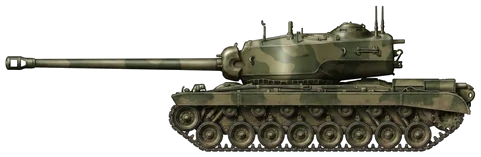
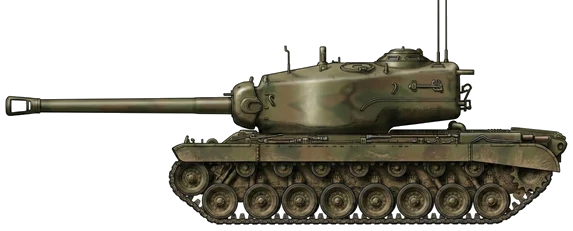
Description
The US Army Ordnance Corps initiated development of the Heavy Tank T1 in June 1940 following recommendations from the Chief of Infantry. The project was prompted by the successful employment of armored units in Europe and a perceived requirement for a heavy breakthrough vehicle. Baldwin Locomotive Works received a production contract in August 1940, and the first prototype was delivered in December 1941. During 1941 and 1942, developers produced three prototypes to test different transmission systems and hull construction methods, including cast and welded designs. The US Army standardized the cast-hull version as the M6 and the welded-hull version as the M6A1 in May 1942.
The M6 featured a single three-man turret equipped with a vertically stabilized 3-inch M7 gun and a coaxial 37 mm M6 gun. Armor protection ranged from 25 mm to 101 mm. Secondary armament consisted of two .50 caliber machine guns in a bow mount, two .30 caliber machine guns in the front plate, and additional machine guns on the turret roof for anti-aircraft and commander use. The vehicle was powered by a Wright G-200 9-cylinder air-cooled radial gasoline engine. Transmission options included a Timken mechanical model, a torque converter, or an electric transmission. The crew consisted of six personnel: commander, gunner, loader, driver, assistant driver, and an ammunition passer. Evaluation at Fort Knox and Aberdeen Proving Ground identified design deficiencies, including an awkward internal layout, a high silhouette, and reliability concerns.
Production began in December 1942, but the US Armored Corps ultimately favored the M4 Sherman due to its superior reliability, lower cost, and easier transportability. Consequently, the M6 production target was reduced from several thousand to 40 units. The M6 never saw combat and was restricted to service within the United States. Several units were used for propaganda purposes and performance displays during war bond drives. In 1944, a variant designated M6A2E1 was developed with a 105 mm gun and increased armor protection for specialized assault roles, but the proposal was rejected for operational use. The M6 was declared obsolete in December 1944. The British Army utilized the M6 horizontal volute spring suspension system for the Excelsior prototype tank, and one T1E1 prototype remains preserved at the United States Army Ordnance Museum.
Frequently Asked Questions
What type of vehicle is the M6 Heavy Tank?
What is the weight of the M6 Heavy Tank?
What is the maximum speed of the M6 Heavy Tank?
What is the operational range of the M6 Heavy Tank?
How many crew members does the M6 Heavy Tank require?
How many M6 Heavy Tank have been built?
What weapons does the M6 Heavy Tank carry?
- SEP 42026 Verified Weight verified against the published specifications
- JUL 272026 Updated Number built, cost and service status added
- APR 72026 Updated Description added
- JAN 252026 Updated Weight updated
- JAN 172026 Updated Description added