T30 Super Heavy Tank
American heavy tank, never entered service, designed to counter heavily armored threats. Key figures: weight 75.8 t, top speed 26 km/h, range 160 km, built 6. In service with 2 armies — Canada, United States.
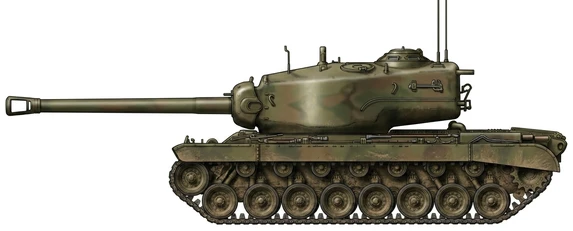
| Sub-type | Heavy Main Battle Tank |
| Crew | 6 personnels |
| Range | 160 km |
| Mass | 75.8 tons |
| Height | 3.2 m (10.5 ft) |
| Width | 3.8 m (12.5 ft) |
| Length | 11.57 m (38.0 ft) |
| Max. speed | 27 km/h (16 mph) |
| Engine | Continental AV1790-3 Diesel Engine with 700 hp |
| Weapon 1 | 1 T7 L/40 155mm gun |
| Weapon 2 | 1 7.62mm coaxial machine gun |
| Weapon 3 | 1 12.7mm M2 machine gun |
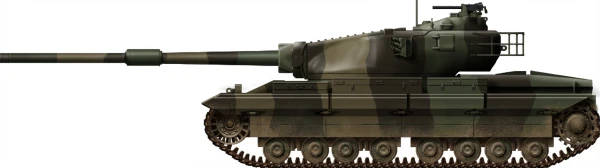
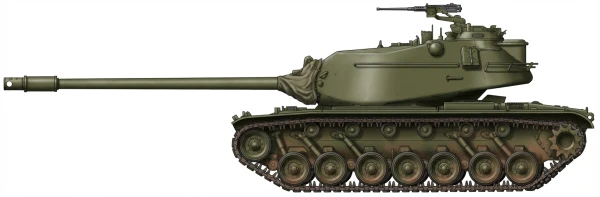
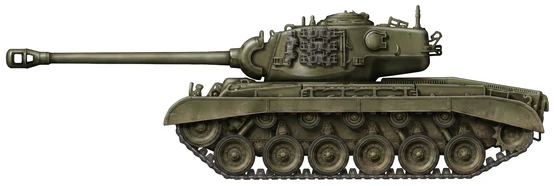
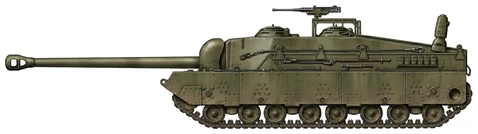
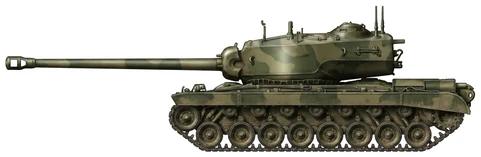
Description
The T30 Heavy Tank was an American project developed to counter German heavy armor, including the Tiger I, Tiger II, and Jagdtiger, as well as Soviet IS-series tanks. Initiated in late 1944, the T30 was designed alongside the T29 Heavy Tank by the Pressed Steel Car Company and the Detroit Arsenal. While the T29 was intended for potential large-scale production, the T30 served as a backup plan and a platform for testing the T7 rifled gun. Development officially began in September 1944, with prototypes completed between 1945 and 1947.
The T30 utilized a chassis and turret design shared with the T29. The turret featured a high, rounded profile to accommodate the gun mount and allow loaders to stand while operating the weapon. The hull was protected by a sloped front glacis plate and heavy turret armor. The primary armament is the T7 rifled gun, which was adapted from the M1A1 Long Tom field gun. This weapon used separate loading ammunition, requiring two loaders and a spring rammer. Secondary armament included an M2HB machine gun and Browning M1919A4 machine guns.
Propulsion was provided by the Continental AV-1790 air-cooled engine, paired with a General Motors crossdrive transmission and a torsion-bar suspension. The engine was selected for its reliability during comparative trials against other powerplants, such as the Ford GAC. The T30E1 variant featured a semi-automatic loading system to assist the crew, a raised commander’s cupola, and a rear turret hatch for the automatic ejection of shell casings.
The T30 was used exclusively for testing and was never deployed in combat. Prototypes underwent evaluation at the Aberdeen Proving Grounds, Fort Knox, and the Yuma Proving Ground. One prototype was also dispatched to Fort Churchill in Canada for winter trials. These tests focused on the performance of the engine and transmission, a combination that was later adopted for the M46 and M103 tanks. Six prototypes were produced in total. Four vehicles survive as museum pieces at locations including Fort Jackson, the Detroit Arsenal, and the U.S. Army Armor & Cavalry Collection.
Frequently Asked Questions
What type of vehicle is the T30 Super Heavy Tank?
What is the weight of the T30 Super Heavy Tank?
What is the maximum speed of the T30 Super Heavy Tank?
What is the operational range of the T30 Super Heavy Tank?
How many crew members does the T30 Super Heavy Tank require?
How many T30 Super Heavy Tank have been built?
What weapons does the T30 Super Heavy Tank carry?
- SEP 42026 Verified Weight verified against the published specifications
- AUG 42026 Updated Service entry year added
- JUL 272026 Updated Number built and service status added
- APR 72026 Updated Description added
- JAN 252026 Updated Weight updated
- JAN 172026 Updated Description added