Airbus A350
Multi-national long-range wide-body twin-engine airliner, developed in the early 2010s, used for commercial passenger and cargo air transport. Key figures: top speed 950 km/h, range 15,750 km, service ceiling 13,137 m, max takeoff weight 283,000 kg, unit price $317M, built 731. In service with 1 air force as of 2026 — Germany (3).
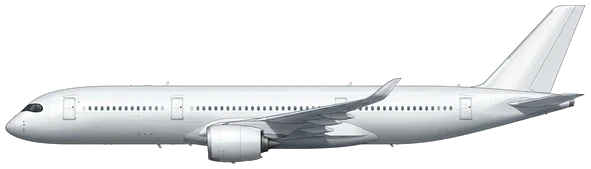
| Crew | 2 |
| Length | 66.8 m (219.2 ft) |
| Wingspan | 64.8 m (212.4 ft) |
| Wing area | 442 m² (4757.6 sqft) |
| Empty weight | 115,700 kg (255,075 lbs) |
| Max. takeoff weight | 283,000 kg (623,907 lbs) |
| Powerplant | 2 × turbofans Rolls-Royce Trent XWB-84 38,160 kgf each |
| Maximum speed | 950 km/h (590 mph) |
| Operational range | 15,750 km (9,787 mi) |
| Service ceiling | 13,137 m (43,100 ft) |

Description
The Airbus A350 is a long-range, wide-body twin-engine airliner developed and produced by Airbus, with final assembly in Toulouse, France. It entered service on 15 January 2015 with launch operator Qatar Airways and is the first Airbus aircraft largely built from carbon-fibre-reinforced polymers. Powered exclusively by Rolls-Royce Trent XWB turbofans, it succeeds the A340 and competes with the Boeing 777, 777X and 787. As of July 2026, 1,601 had been ordered and 731 delivered.
Development
Airbus proposed the initial A350 in 2004 as an A330 derivative with composite wings and new engines, receiving authorisation to offer on 10 December 2004 and an industrial launch on 6 October 2005. Criticism from ILFC, GECAS and Singapore Airlines led Airbus to adopt a clean-sheet design designated A350 XWB (Xtra-Wide-Body) at the July 2006 Farnborough Airshow; the board approved the -800, -900 and -1000 on 1 December 2006. The redesign added two years and raised development costs from about US$5.5 billion to roughly US$15 billion. The first structural component was produced in December 2009, with first flight from Toulouse–Blagnac on 14 June 2013. EASA certification followed on 30 September 2014, FAA certification on 12 November 2014, and ETOPS 370 approval on 15 October 2014. The A350-1000 first flew on 24 November 2016 and was certified on 21 November 2017. The A350-800 was cancelled in September 2014 in favour of the A330neo. Production reached 10 aircraft per month in 2019; Airbus planned 12 per month by 2028.
Design
The airframe is 53% composites, 19% aluminium and aluminium–lithium, 14% titanium, 6% steel and 8% other materials. The double-lobe fuselage has a 5.97 m maximum outer diameter and a 5.61 m cabin width, allowing nine-across 3-3-3 economy seating, with ten-across 3-4-3 on some aircraft. The nose section is aluminium with a six-panel windscreen derived from the A380. The composite wing spans 64.75 m with 31.9° sweep, a 442 m² area on the -900, dropped-hinge flaps and variable camber for load control; the -1000 wing is 22.3 m² larger. The -900 uses four-wheel main bogies, the -1000 six-wheel bogies. Thales supplies the avionics under a US$2.9 billion contract; the cockpit has six 38 cm LCDs and integrated modular avionics managing 40 functions over an AFDX network. Honeywell provides the HGT1700 APU and air management system, Parker Hannifin the fuel and hydraulic systems. The A350 has a common type rating with the A330.
Operational History
Qatar Airways flew the first commercial service from Doha to Frankfurt on 15 January 2015 and introduced the A350-1000 on 24 February 2018. Early issues included galley insert leaks and spurious bleed-air overheat warnings; dispatch reliability rose from 97.2% in 2015 to 99.3% by February 2018. Singapore Airlines began non-stop Singapore–Newark flights with the -900ULR on 12 October 2018, lasting 17 hours 52 minutes. In August 2021 Qatar Airways grounded 13 aircraft over paint degradation and litigated against Airbus; the parties settled on 1 February 2023. The type has one hull loss, Japan Airlines Flight 516 at Haneda on 2 January 2024, with no fatalities aboard. As of July 2026, 730 aircraft serve 38 operators, the largest being Singapore Airlines with 65.
Variants
- A350-800: Shortened 276-seat variant developed as a -900 shrink, cancelled in September 2014.
- A350-900: Baseline model, 66.8 m long, 283 t MTOW, seating about 325 with 8,500 nmi range.
- A350-900ULR: Weight variant 13 with 280 t MTOW and 165,000 L fuel capacity for 9,700 nmi.
- A350-1000: Stretched 73.79 m variant with six-wheel bogies, 97,000 lbf engines and 322 t MTOW.
- A350F: Freighter based on the -1000, 70.8 m long, 111 t payload, entry into service delayed to 2027.
Frequently Asked Questions
What type of aircraft is the Airbus A350?
What is the maximum speed of the Airbus A350?
What is the range of the Airbus A350?
When did the Airbus A350 first fly?
How many Airbus A350 have been built?
Which countries operate the Airbus A350?
How much does a Airbus A350 cost?
What is the service ceiling of the Airbus A350?
- AUG 212026 Created Added the aircraft page with its specifications and description