Airbus A330
European wide-body twin-engine jet airliner, recognized for extensive global service since the early 1990s, including both civilian and military roles. Key figures: top speed 871 km/h, range 13,400 km, service ceiling 13,000 m, max takeoff weight 242,000 kg, unit price $260M, built 1,577. In service with 5 air forces as of 2026 — France (5), Brazil (2), Canada (2) and 2 others.
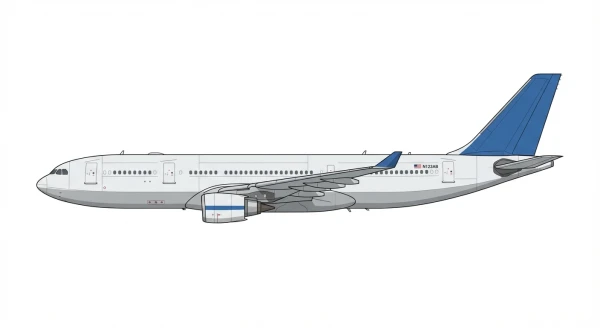
| Length | 59 m (193.6 ft) |
| Wingspan | 60.3 m (197.8 ft) |
| Height | 17.4 m (57.1 ft) |
| Wing area | 362 m² (3896.5 sqft) |
| Empty weight | 119,600 kg (263,673 lbs) |
| Max. takeoff weight | 242,000 kg (533,518 lbs) |
| Powerplant | 2 × turbofans General Electric CF6-80E1A4 32,659 kgf each |
| Maximum speed | 871 km/h (541 mph) |
| Operational range | 13,400 km (8,326 mi) |
| Service ceiling | 13,000 m (42,651 ft) |


Description
The Airbus A330 is a wide-body twin-engine airliner developed and produced by Airbus, a European consortium with final assembly at Colomiers near Toulouse-Blagnac Airport. It entered service with Air Inter on 17 January 1994 on the Paris-Orly to Marseille route. Military derivatives include the A330 MRTT multi-role tanker transport and the proposed EADS/Northrop Grumman KC-45. It is the second most delivered wide-body airliner after the Boeing 777.
Development
Airbus studied A300 derivatives from the early 1970s, designating variants B1 through B9. The A300B9, a lengthened A300 with the same wing, was aimed at high-capacity medium-range routes as a replacement for the DC-10 and L-1011 TriStar, offering 25 per cent better fuel efficiency. Redesignated TA9, it was developed alongside the four-engined TA11 (later the A340), sharing fuselage and wing for projected savings of US$500 million. The Airbus Supervisory Board approved development on 27 January 1986, and the programmes were launched on 5 June 1987 with 130 orders from ten customers, 41 of them A330s. Air Inter and Thai Airways International placed the first orders on 12 March 1987. BAe received £450 million from the UK government for wing design and construction; subcontracts went to firms in twelve countries. The first aircraft was rolled out on 14 October 1992 and flew on 2 November, receiving simultaneous JAA and FAA certification on 21 October 1993 after 1,114 test hours and 426 flights. A test aircraft crashed near Toulouse on 30 June 1994, killing seven. The shortened A330-200 first flew on 13 August 1997. The re-engined A330neo was launched in July 2014. As of July 2026, 2,005 had been ordered and 1,671 delivered, with 1,402 in service with 150 operators.
Design
The A330 is a low-wing cantilever monoplane with two underwing engines, twin-wheel nose gear and two four-wheel main bogies by Messier-Dowty. The wing, designed and built by BAe, is swept 30 degrees with a 60.3 m span, thickness-to-chord ratio of 11.8 or 12.8 per cent, 2.74 m winglets and a maximum operating Mach number of 0.86. The fuselage derives from the A300-600, with 5.64 m external and 5.26 m cabin width. Composites account for 10 per cent of structural weight. Maximum takeoff weight rose from 212 to 242 tonnes. Engine options are the General Electric CF6-80E1, Pratt & Whitney PW4168 and Rolls-Royce Trent 700, the last making the A330 the first Airbus type with Rolls-Royce power. The glass cockpit is shared with the A320 and A340, using side-sticks, six displays, EFIS, ECAM, digital fly-by-wire and flight envelope protection. The Honeywell 331-350C APU supplies pneumatic and electrical power.
Operational History
Airbus built up ETOPS clearance incrementally from 90 to 180 minutes, with Aer Lingus and Cathay Pacific accumulating over-ocean hours. In November 2009 the type became the first to receive ETOPS-240 approval. Delta Air Lines is the largest operator with 81 aircraft, followed by Turkish Airlines (60), China Eastern (56), Air China (43) and Cathay Pacific (43). The fleet has logged over 72 million flight hours at 99.0 per cent operational reliability. As of November 2020, around 60 A330 MRTTs had been ordered by thirteen air forces. The USAF selected the KC-45 in February 2008, but after protests awarded KC-X to the Boeing KC-46 on 24 February 2011. As of June 2024, 46 accidents and incidents had occurred, with 14 hull losses and 339 fatalities; the deadliest was Air France Flight 447 on 1 June 2009.
Variants
- A330-200: Shortened long-range variant, 58.82 m long, in service from 1998 with Canada 3000, range 13,400 km with 253 passengers.
- A330-300: Original 63.69 m variant, certified 21 October 1993, range 11,750 km with 277 passengers.
- A330-200F: Dedicated freighter with revised nose gear and blister fairing, carrying 65 t over 7,400 km; 38 delivered.
- A330 MRTT: Tanker and strategic transport derivative of the A330-200, ordered by thirteen countries.
- A330-900: A330neo variant with Trent 7000 engines, first flown 19 October 2017, in service with TAP Air Portugal from 15 December 2018.
Frequently Asked Questions
What type of aircraft is the Airbus A330?
What is the maximum speed of the Airbus A330?
What is the range of the Airbus A330?
When did the Airbus A330 first fly?
How many Airbus A330 have been built?
Which countries operate the Airbus A330?
How much does a Airbus A330 cost?
What is the service ceiling of the Airbus A330?
- AUG 302026 Updated Description updated
- AUG 52026 Updated Powerplant updated in a site-wide editorial pass
- JUL 272026 Updated Name updated
- APR 72026 Updated Sources and cross-references refreshed
- FEB 72026 Updated Top speed added
- JAN 202026 Updated Range added