Mi-10
Soviet military transport helicopter of flying crane configuration, developed in the early 1960s and used for carrying bulky or heavy loads. Key figures: top speed 335 km/h, range 430 km, service ceiling 3,000 m, max takeoff weight 43,700 kg, built 55.
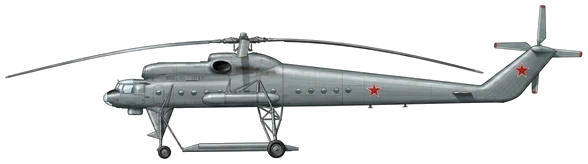
| Crew | 3 (pilot, co-pilot, flight engineer) |
| Length | 32.9 m (107.8 ft) |
| Wingspan | 35 m (114.8 ft) |
| Wing area | 962 m² (10354.9 sqft) |
| Empty weight | 27,100 kg (59,745 lbs) |
| Max. takeoff weight | 43,700 kg (96,342 lbs) |
| Powerplant | 2 × Soloviev D-25V 4,100 kW each |
| Maximum speed | 335 km/h (208 mph) |
| Operational range | 430 km (267 mi) |
| Service ceiling | 3,000 m (9,843 ft) |
Description
The Mil Mi-10 (NATO reporting name Harke) is a Soviet military transport helicopter of flying crane configuration developed from the Mi-6. Following a 20 February 1958 directive, OKB-329 (OKB Mil) designed the aircraft to transport bulky loads. The first prototype, designated V-10, completed its first flight on 15 June 1960. State acceptance trials were passed in 1961, and serial production began on 5 March 1964 at the Rostov-on-Don factory. Between 1964 and 1969, the factory built 40 long-legged Mi-10 helicopters. The Mi-10 entered Soviet military service in 1963.
Design
The helicopter utilizes the dynamic components and two 4,100 kW Soloviev D-25V turboshaft engines of the Mi-6. Its design features a slim fuselage mounted on four tall, strut-braced undercarriage legs with a wide track that allows the aircraft to taxi over cargo. The cabin accommodates 28 passengers or 3 tonnes of internal cargo loaded through a side door. Externally, the Mi-10 can transport loads up to 15 tonnes on an 8.5 m by 3.6 m pallet, or up to 8 tonnes via an external sling system under the center fuselage. The aircraft's flight characteristics without a load were unstable, requiring a rolling take-off that often induced nose-wheel shimmy.
Operational History
Due to shifts in ballistic missile technology, the Soviet Air Force converted most long-legged Mi-10s into Mi-10PP airborne electronic countermeasures helicopters. These units carried a fuselage-mounted ST-900 Step electronic countermeasures pod on a pallet. Operational users of the Mi-10 included the Soviet Air Force, Aeroflot, and later Russia's UTair. Most versions were retired by 2009, though the short-legged Mi-10K remained in service as of 2014.
Variants
- Mi-10: The initial standard long-legged production helicopter.
- Mi-10K: A short-legged flying crane variant featuring a ventral gondola with auxiliary flying controls.
- Mi-10PP: An electronic countermeasures variant equipped with a fuselage-mounted jamming pod.
- Mi-10GR: A single production helicopter configured for electronic intelligence duties with direction-finding equipment.
- Mi-10RVK: A prototype heliborne missile system variant designed to carry tactical missiles and launcher vehicles.
Frequently Asked Questions
What type of aircraft is the Mi-10?
What is the maximum speed of the Mi-10?
What is the range of the Mi-10?
When did the Mi-10 first fly?
How many Mi-10 have been built?
Which countries operate the Mi-10?
What is the service ceiling of the Mi-10?
- JUL 12026 Created Page created: Mi-10