AS 202 Bravo
Swiss-Italian light trainer and utility aircraft, developed in the late 1960s, used primarily for military and civil pilot training. Key figures: top speed 211 km/h, range 890 km, service ceiling 4,265 m, max takeoff weight 999 kg, built 214.
| Crew | 1–2 |
| Length | 7.5 m (24.6 ft) |
| Wingspan | 9.8 m (32.0 ft) |
| Height | 2.8 m (9.2 ft) |
| Wing area | 13.9 m² (149.2 sqft) |
| Empty weight | 630 kg (1,389 lbs) |
| Max. takeoff weight | 999 kg (2,202 lbs) |
| Powerplant | 1 × Lycoming O-320-E2A 112 kW each |
| Maximum speed | 211 km/h (131 mph) |
| Operational range | 890 km (553 mi) |
| Service ceiling | 4,265 m (13,993 ft) |
| Climb rate | 3.22 m/s (10.6 ft/s) |
Description
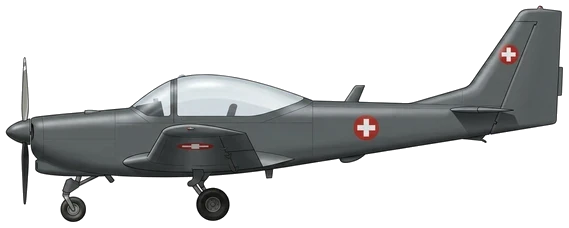
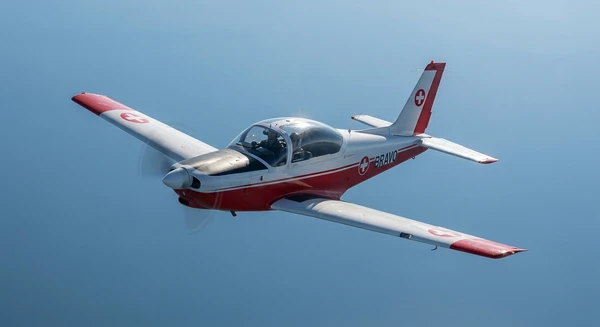
The AS 202 Bravo is a two- to three-seat light aircraft designed and built jointly by Flug- und Fahrzeugwerke Altenrhein (FFA) of Switzerland and Savoia-Marchetti of Italy. Designated AS 202 in Switzerland and SA 202 in Italy, it was used mainly as a basic and aerobatic trainer, with most airframes delivered to military customers. It first flew in 1969 and served with air arms in Indonesia, Morocco, Oman, Jordan, Iraq and Uganda.
Development
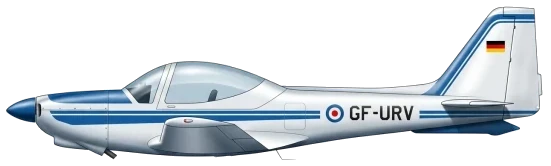
Work was divided between the two partners: Savoia-Marchetti produced the wings, undercarriage and engine installation, while FFA produced the fuselage, tail and control system. Both companies operated assembly lines capable of completing whole aircraft. The first Swiss-built example flew on 9 March 1969, followed by the first Italian-built aircraft on 8 May 1969. Production totalled 34 of the /15 model and 180 of the /18 model. Later developments included the composite FFA 2000 / FFT 2000 Eurotrainer 2000 and, from 2020, the Gomolzig AS-202 Bravo NG.
Design
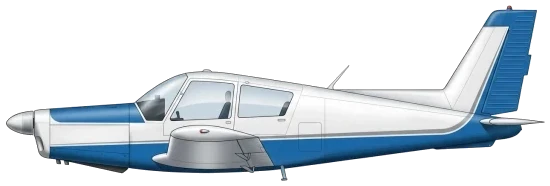
The Bravo is an all-metal low-wing monoplane with a full-vision canopy and fixed tricycle landing gear. The wing uses a modified NACA 632618 section at the root and a modified NACA 632415 section at the tip, with an area of 13.86 m² and a span of 9.75 m. The 202/15 has a length of 7.5 m, an empty weight of 630 kg and a maximum take-off weight of 885 kg in the aerobatic category or 999 kg in the utility category. Fuel capacity is 140 litres carried in two wing leading-edge tanks. Power for that variant comes from a 112 kW (150 hp) Lycoming O-320-E2A driving a two-bladed fixed-pitch McCauley 1C172 MGM propeller of 1.88 m diameter. Maximum and maximum cruise speed is 211 km/h at sea level, stall speed 89 km/h with flaps down, never-exceed speed 322 km/h, range 890 km without reserves, service ceiling 4,265 m and climb rate 3.22 m/s.
Operational History
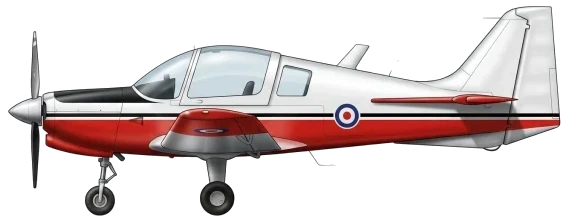
The Indonesian Air Force was the largest operator with 40 aircraft, replaced by the Grob G 120TP in 2013–2014. The Royal Moroccan Air Force took 10 and Royal Air Maroc five; the Royal Flight of Oman operated four alongside the Royal Air Force of Oman. The Iraqi Air Force and Royal Jordanian Air Force also used the type, and the Ugandan Air Force still listed one aircraft in 2012, with eight more at the Uganda Central Flying School. The British Aerospace Flying College operated 11, one of which was lost in Scotland with two fatalities; the remaining 10 were sold to the Finnish school Pilot Factory, which merged with Patria in 2004–2005. Patria Pilot Training flew seven Bravos from Helsinki-Malmi between 2000 and 2011, losing one to a night-time accident in 2002 and another to a runway excursion in August 2010, before replacing them with the Tecnam P2002JF.
Variants
- AS/SA 202/10: Initial version with a 115 hp Lycoming O-235-C2A.
- AS/SA 202/15: 150 hp Lycoming O-320-E2A with fixed-pitch propeller and optional third aft seat.
- AS/SA 202/18A: 180 hp Lycoming AEIO-360-B1F with constant-speed propeller, third aft seat and full aerobatic clearance.
- AS/SA 202/26A: 195 kW (260 hp) Lycoming AEIO-540; one aircraft built.
- AS 32T Turbo Trainer: Two-seat tandem trainer with a 268 kW (360 hp) Allison 250-B17C turboprop; one aircraft built.
Frequently Asked Questions
What type of aircraft is the AS 202 Bravo?
What is the maximum speed of the AS 202 Bravo?
What is the range of the AS 202 Bravo?
When did the AS 202 Bravo first fly?
How many AS 202 Bravo have been built?
Which countries operate the AS 202 Bravo?
What is the service ceiling of the AS 202 Bravo?
- AUG 302026 Updated Description updated
- JUL 232026 Updated Sources and cross-references refreshed
- JUL 12026 Created Page created: AS 202 Bravo