B-1B Lancer
Summary
| Category | Bombers |
| Origin country | 🇺🇸 United States |
| Manufacturer | Rockwell |
| First flight | 23 March 1983 |
| Year introduced | 1986 |
| Number produced | 104 units |
| Average unit price | $283 million |
Technical specifications
| Version: B-1B | |
|---|---|
| Crew | 4 members |
| Operational range | 9,400 km (5,841 mi) |
| Maximum speed | 1448 km/h (900 mph) |
| Wing area | 181.2 m² (1950.4 sqft) |
| Wingspan | 41.8 m (137.1 ft) |
| Height | 10.4 m (34.1 ft) |
| Length | 44.5 m (146.0 ft) |
| Service ceiling | 18,000 m (59,055 ft) |
| Empty weight | 87,100 kg (192,022 lbs) |
| Max. takeoff weight | 216,400 kg (477,080 lbs) |
| Powerplant | 4 x turbojets General Electric F101-GE-102 delivering 6577 kgf each |
| Ejection seat | McDonnell Douglas ACES II |
Current operating countries
| Country | Units | ||
|---|---|---|---|

|
United States | 45 | |
All operators
Armament
Missiles payload:
- Air-to-Surface AGM-158 JASSM
- Air-to-Surface Raytheon AGM-154 JSOW
Bombs payload:
- Cluster Aerojet CBU-87/B CEM
- Thermonuclear B61
- Guided Boeing GBU-31/B JDAM
- Guided Boeing GBU-39/B SDB
- Cluster CBU-89/B Gator
- Thermonuclear Livermore B83
- Cluster Lockheed-Martin CBU-103/B WCMD
- Cluster Lockheed-Martin CBU-104/B WCMD
- Low-Drag Mk 82
- Low-Drag Mk 84
- Cluster Textron CBU-97/B SFW
- Cluster Textron CBU-105/B WCMD
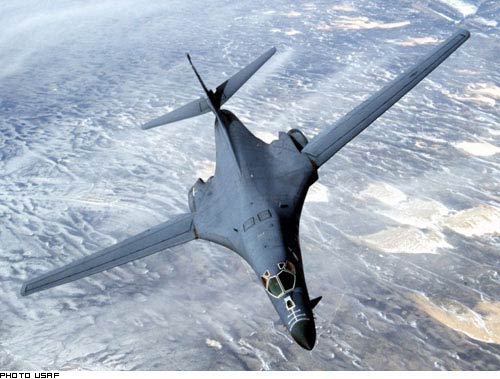
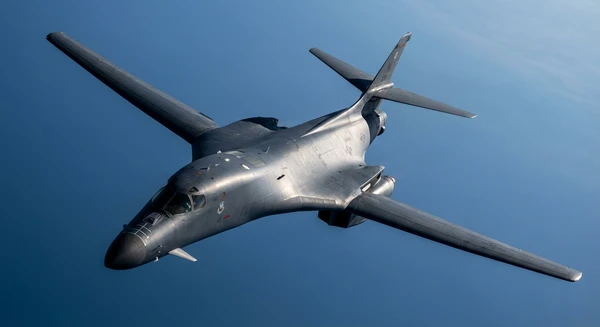
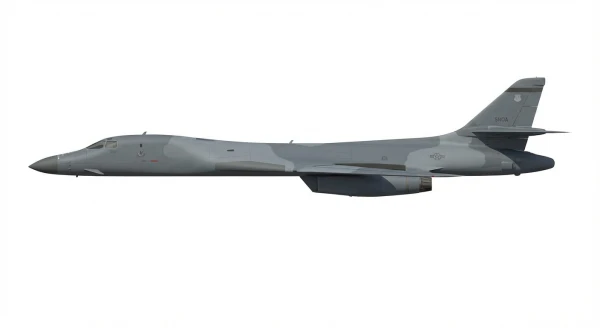
Description
The B-1 was first envisioned in the 1960s as a bomber intended to combine the Mach 2 speed of the B-58 Hustler with the range and payload of the B-52. After a series of studies, North American Rockwell won the design contest for what would become the B-1A. Prototypes of this version were capable of flying at Mach 2.2 at high altitude and Mach 0.85 at very low altitudes. The program was canceled in 1977 due to its high cost, the introduction of the AGM-86 cruise missile, and early work on the B-2 stealth bomber. The program was restarted in 1981, largely as an interim measure resulting from delays in the B-2 stealth bomber program. The B-1A design was altered, reducing its top speed to Mach 1.25 at high altitude and increasing low-altitude speed to Mach 0.92, while extensively improving electronic components and upgrading the airframe to carry more fuel and weapons. Redesignated as the B-1B, deliveries of the new variant commenced in 1985, and the plane formally entered service with Strategic Air Command (SAC) as a nuclear bomber the following year. By 1988, all 100 aircraft had been delivered. In 1996, Rockwell International sold most of its space and defense operations to Boeing, which continues as the primary contractor for the B‑1 as of 2024.
The B-1 has a blended wing body configuration, with variable-sweep wings that can sweep from 15 degrees to 67.5 degrees. Forward-swept wing settings are used for takeoff, landings and high-altitude economical cruise, while aft-swept wing settings are used in high subsonic and supersonic flight. The aircraft also features four turbofan engines, triangular ride-control fins and a cruciform tail. Small triangular fin control surfaces or vanes near the nose alleviate flexing caused by air turbulence at low altitude; the B-1's Structural Mode Control System moves the vanes, and lower rudder, to counteract the effects of turbulence. Unlike the B-1A, the B-1B cannot reach Mach 2+ speeds; its maximum speed is Mach 1.25, but its low-level speed increased to Mach 0.92. To help lower its radar cross-section, the B-1B uses serpentine air intake ducts and fixed intake ramps, which limit its speed compared to the B-1A. Vanes in the intake ducts serve to deflect and shield radar returns from the engine compressor blades.
The B-1B Lancer boasts a payload capacity of up to 75,000 pounds (34,000 kg) of ordnance, distributed internally across three bomb bays. The B-1B also features six external hardpoints that can be utilized for carrying an additional 50,000 pounds (23,000 kg) of conventional munitions or other stores. The aircraft is capable of carrying a diverse range of weaponry, including the AGM-154 Joint Standoff Weapon (JSOW), AGM-158C Long Range Anti-Ship Missile (LRASM), AGM-158 Joint Air to Surface Standoff Missile (JASSM), and the AGM-183 Air-Launched Rapid Response Weapon (ARRW). In terms of bombs, the B-1B can deploy Mk-82 air inflatable retarder (AIR) general-purpose (GP) bombs, Mk-82 low drag general-purpose (LDGP) bombs, Mk-62 Quickstrike sea mines, Mk-84 general-purpose bombs, Mk-65 naval mines, CBU-87/89/CBU-97 Cluster Bomb Units (CBU), CBU-103/104/105 Wind Corrected Munitions Dispenser (WCMD) CBUs, GBU-31 JDAM GPS-guided bombs (with either Mk-84 GP or BLU-109 warheads), GBU-38 JDAM GPS-guided bombs (with Mk-82 GP warheads), and GBU-54 Laser JDAMs. The GBU-39 Small Diameter Bomb GPS-guided bomb is a potential future addition to its arsenal. Previously B61 or B83 nuclear bombs could be carried.
The B-1B's operational history began with its formal entry into service with Strategic Air Command (SAC) as a nuclear bomber in 1986, and by 1988, all 100 aircraft had been delivered. Following the disestablishment of SAC in 1992, the B-1B was converted for conventional bombing roles. It first saw combat during Operation Desert Fox in 1998 and NATO's action in Kosovo in 1999. Subsequently, the B-1B played a significant role supporting U.S. and NATO military forces in Afghanistan and Iraq. As of 2025, the Air Force operates 45 B-1B bombers. The B-1B is slated to be replaced by the Northrop Grumman B-21 Raider, with all B-1s planned for retirement by 2036.
Main Variants:
-
B-1A: The original design with variable engine intakes and a top speed of Mach 2.2, of which four prototypes were built but no production units.
-
B-1B: A revised design with reduced radar signature and a top speed of Mach 1.25, optimized for low-level penetration, with a total of 100 units produced.
-
B-1R: A 2004 proposed upgrade of existing B-1B aircraft with advanced radars, air-to-air missiles, and new Pratt & Whitney F119 engines, increasing the top speed to Mach 2.2 but reducing range by 20%.