B-1A
American strategic bomber, conceived during the Cold War, canceled after four prototypes, resurrected in the advanced B-1B version. Key figures: top speed 2,124 km/h, range 9,800 km, service ceiling 18,900 m, max takeoff weight 179,169 kg, unit price $70M, built 4.
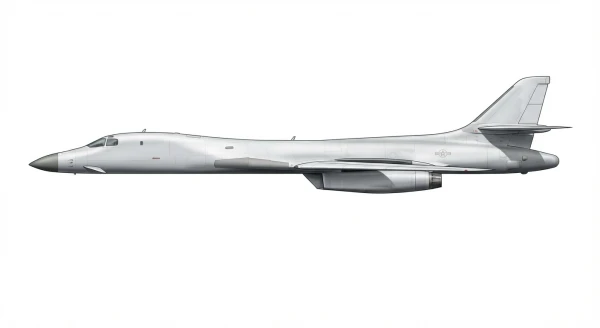
| Crew | 4 |
| Length | 52 m (170.6 ft) |
| Wingspan | 41.7 m (136.7 ft) |
| Height | 10.4 m (34.1 ft) |
| Wing area | 594 m² (6393.8 sqft) |
| Empty weight | 86,183 kg (190,001 lbs) |
| Max. takeoff weight | 179,169 kg (395,000 lbs) |
| Powerplant | 4 × turbofans General Electric F101-GE-100 13,608 kgf each |
| Maximum speed | 2124 km/h (Mach 2.12) |
| Operational range | 9,800 km (6,089 mi) |
| Service ceiling | 18,900 m (62,008 ft) |
| Climb rate | 28.8 m/s (94.5 ft/s) |
Description
The Rockwell B-1A was an American supersonic variable-sweep wing heavy bomber prototype developed by North American Rockwell for the United States Air Force. Designed as a strategic nuclear bomber, it was intended to combine the Mach 2 speed of the Convair B-58 Hustler with the range and payload of the Boeing B-52 Stratofortress. The program was canceled prior to production, and the aircraft never entered operational service.
Development
The B-1A originated from the Advanced Manned Strategic Aircraft (AMSA) study and was officially designated in April 1969. North American Rockwell was awarded the development contract in June 1970, with initial plans calling for five flight test aircraft and 240 production units, which was later reduced to four flight prototypes. The first B-1A prototype made its flight on 23 December 1974, and the second prototype subsequently reached a maximum speed of Mach 2.22. On 30 June 1977, President Jimmy Carter canceled the program due to high unit costs, the availability of the AGM-86 Air-Launched Cruise Missile, and ongoing research into stealth technology. Flight testing of the four constructed prototypes continued through April 1981, logging 70 flights and 378 hours before two airframes were modified for the B-1B program.
Design
The B-1A featured a blended wing-body design with variable-sweep wings capable of moving between 15 and 67.5 degrees. Propulsion was provided by four General Electric YF101 turbofan engines fitted with variable air intake ramps and exhaust nozzles to enable high-altitude supersonic flight. The airframe incorporated titanium in structural areas to support Mach 2 speeds, alongside nose-mounted control vanes attached to a Structural Mode Control System to dampen low-altitude turbulence. The first three prototypes contained a crew escape capsule that ejected the cockpit unit, whereas the fourth prototype substituted individual ejection seats.
Armament
The B-1A was configured with three internal weapons bays capable of carrying a total payload of 75,000 pounds (34,000 kg). Its armament suite was planned to mirror the capabilities of the B-52, focusing on nuclear and conventional gravity ordnance.
Variants
-
B-1A: The original prototype variant featuring variable engine intakes, titanium structural elements, and a top speed of Mach 2.22.
-
B-1B: A modified production bomber featuring fixed intake ramps, reduced radar cross-section, an increased maximum takeoff weight, and a top speed of Mach 1.25.
-
B-1R: A proposed 2004 regional upgrade concept featuring Pratt & Whitney F119 engines, active electronically scanned array radar, and air-to-air missile capability.
Frequently Asked Questions
What type of aircraft is the B-1A?
What is the maximum speed of the B-1A?
What is the range of the B-1A?
When did the B-1A first fly?
How many B-1A have been built?
How much does a B-1A cost?
What is the service ceiling of the B-1A?
- AUG 62026 Updated Description and number built updated; service entry year removed
- AUG 52026 Updated Climb rate added; powerplant and thrust updated
- APR 82026 Updated Empty weight added
- APR 72026 Updated Sources and cross-references refreshed
- JAN 242026 Updated Price updated