B-58 Hustler
American supersonic jet bomber, introduced during the Cold War, noted for its service with the Strategic Air Command. Key figures: top speed 2,123 km/h, range 7,600 km, service ceiling 19,324 m, max takeoff weight 80,240 kg, unit price $18M, built 116.
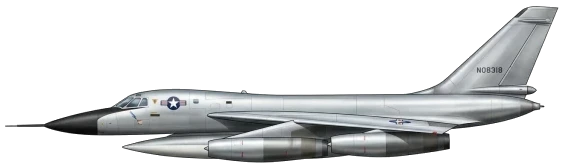
| Crew | 3 |
| Length | 29.5 m (96.8 ft) |
| Wingspan | 17.3 m (56.8 ft) |
| Height | 8.9 m (29.2 ft) |
| Wing area | 143.3 m² (1542.5 sqft) |
| Empty weight | 25,200 kg (55,556 lbs) |
| Max. takeoff weight | 80,240 kg (176,899 lbs) |
| Powerplant | 4 × turbojets General Electric J79-GE-5A 4,400 kgf each |
| Maximum speed | 2123 km/h (Mach 2.0) |
| Operational range | 7,600 km (4,722 mi) |
| Service ceiling | 19,324 m (63,399 ft) |
| Climb rate | 88.0 m/s (288.7 ft/s) |
Description
The Convair B-58 Hustler was a supersonic strategic bomber built by Convair, a division of General Dynamics, for the United States Air Force Strategic Air Command. It was the first bomber capable of sustained Mach 2 flight, entering service in March 1960 and serving with two SAC bomb wings until January 1970. It is known for its delta wing, its three-man crew, its centreline weapons/fuel pod, its 19 speed records, and its high accident rate.
Development
The programme originated with the Generalized Bomber Study (GEBO II), issued in February 1949 by the Air Research and Development Command at Wright-Patterson AFB. Convair submitted the FZP-110 proposal in January 1951, a two-seat delta bomber with three General Electric J53 turbojets, revised in December 1951 as the FZP-016. The USAF advanced Boeing's MX-1712 and Convair's MX-1626 to phase 1 study; Convair substituted four smaller J79 engines and applied area rule, resubmitting as MX-1964. Convair's design was judged superior in August 1952 and designated B-58 on 10 December 1952, with a contract issued in February 1953. It was the first weapon-system contract, making Convair responsible for engines, manuals, spares and software totalling over one million items. The first prototype, 55-660, rolled out on 31 August 1956 and flew on 11 November 1956, exceeding Mach 1 on 30 December. Flight testing with 30 aircraft ran to April 1959. Total production was 116 aircraft: 30 trial aircraft and 86 B-58As. The final aircraft was delivered in October 1962.
Design
The B-58 used a delta wing with 60° leading-edge sweep and four General Electric J79-GE-5A afterburning turbojets in underwing pods, each rated at 15,000 lbf with afterburner. Maximum speed was Mach 2 at 40,000 ft, service ceiling 63,400 ft. The crew compartment, wheel wells and electronics bay were pressurized and air conditioned against kinetic heating; the airframe was one of the first extensive applications of aluminium honeycomb panels, structure accounting for 13.8% of gross weight. Inlets used automatically actuated moving conical spikes. Crew comprised pilot, radar navigator/bombardier and defense systems operator in separated tandem cockpits; later aircraft had individual ejection capsules qualified in 1963 for use up to 70,000 ft and Mach 2. The Sperry AN/ASQ-42 system combined inertial navigation, the KS-39 star tracker, AN/APN-113 Doppler radar, search radar and radar altimeter. Handling was demanding, with pitch-up above 17° angle of attack and "fuel stacking" centre-of-gravity shifts during acceleration.
Armament
Defensive armament was a single 20 mm T-171E-3 rotary cannon with 1,200 rounds in a tail barbette controlled by the Emerson MD-7 radar fire-control system. Offensive load was normally one nuclear weapon with fuel in the MB-1C centreline pod, later replaced by the two-component pod after fuel leakage problems. From 1961 to 1963 two tandem stub pylons were fitted under each wing root for B43 or B61 weapons, allowing five nuclear weapons per aircraft; maximum weapons load was 19,450 lb. The LA-331 photo reconnaissance pod was fielded, and four High Virgo air-launched ballistic missile test launches were flown. The aircraft was never equipped to carry conventional bombs.
Operational History
Declared operational on 1 August 1960, the B-58 took first place in high- and low-level radar bombing at the September 1960 SAC Combat Competition at Bergstrom AFB. The 43rd Bombardment Wing operated it from Carswell AFB (1960–1964) and Little Rock AFB (1964–1970); the 305th Bombardment Wing flew it from Bunker Hill (later Grissom) AFB, Indiana, from 1961 to 1970. Unit cost was $12.44 million and maintenance cost $1,440 per flying hour against $1,025 for the B-52. Soviet deployment of the S-75 Dvina forced a low-altitude penetration role that eliminated supersonic speed and cut range. TB-58A 55-0668 flew the only B-58 combat mission, a reconnaissance sortie over Cuba on 30 October 1962. Twenty-four to 26 aircraft were lost in accidents. Secretary of Defense Robert McNamara ordered retirement by 1970; withdrawal was announced on 29 October 1969 and completed in January 1970, the type being replaced by the FB-111A. A B-58 flew Tokyo to London, 8,028 miles with five refuellings, in 8 hours 35 minutes on 1963.
Variants
- XB-58: Prototype; two built.
- YB-58A: Pre-production aircraft; 11 built, eight later converted to TB-58A trainers.
- B-58A: Three-seat medium-range strategic bomber; 86 built.
- RB-58A: Variant with ventral reconnaissance pod carrying AN/APQ-69 side-looking and AN/APS-73 synthetic aperture radars; 17 built.
- B-58C: Unbuilt enlarged version with J58 engines, estimated top speed approaching Mach 3 and 5,200 nmi range; cancelled in early 1961.
Frequently Asked Questions
What type of aircraft is the B-58 Hustler?
What is the maximum speed of the B-58 Hustler?
What is the range of the B-58 Hustler?
When did the B-58 Hustler first fly?
How many B-58 Hustler have been built?
Which countries operate the B-58 Hustler?
How much does a B-58 Hustler cost?
What is the service ceiling of the B-58 Hustler?
- AUG 302026 Updated Description updated
- JUL 232026 Updated Sources and cross-references refreshed
- APR 72026 Updated Sources and cross-references refreshed
- JAN 122026 Updated Range updated in a site-wide editorial pass