B-45 Tornado
American four-jet bomber that entered service in 1948 as the first US production jet bomber, also flown as the RB-45C reconnaissance aircraft until 1959. Key figures: top speed 911 km/h, range 1,918 km, service ceiling 14,000 m, max takeoff weight 41,628 kg, built 142.
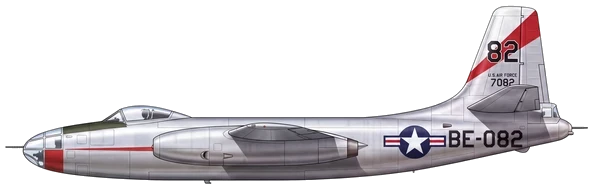
| Crew | 4 (pilot, co-pilot, bombardier-navigator, tail gunner) |
| Length | 23.0 m (75.3 ft) |
| Wingspan | 27.1 m (89.0 ft) |
| Height | 7.7 m (25.2 ft) |
| Wing area | 109.2 m² (1175.4 sqft) |
| Empty weight | 20,726 kg (45,693 lbs) |
| Max. takeoff weight | 41,628 kg (91,774 lbs) |
| Powerplant | 4 × turbojets General Electric J47-GE-13 2,359 kgf each |
| Maximum speed | 911 km/h (566 mph) |
| Operational range | 1,918 km (1,192 mi) |
| Service ceiling | 14,000 m (45,932 ft) |
| Climb rate | 26.0 m/s (85.3 ft/s) |
- Unguided Bomb up to 22,000 lb (10,000 kg) of free-fall bombs
- Nuclear Free-fall nuclear bomb (modified B-45A)
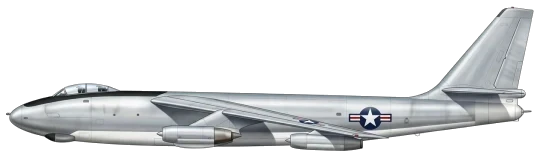
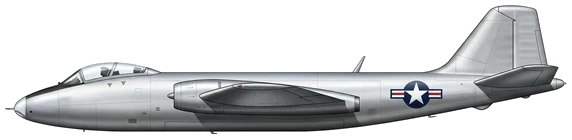
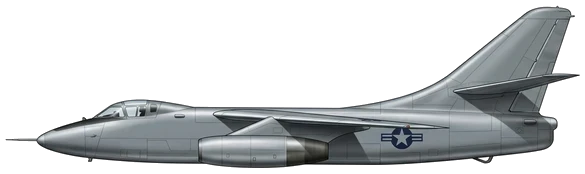
Description
The North American B-45 Tornado is a four-engined jet bomber and reconnaissance aircraft built by North American Aviation for the United States Air Force (USAF). It entered service in 1948 as the first operational jet bomber in the USAF and the first multiengine jet bomber to be refuelled in midair. It flew bombing and reconnaissance missions in the Korean War, served as a nuclear-armed deterrent in Europe, and was flown by Royal Air Force (RAF) crews on covert overflights of the Soviet Union.
Development
The programme began with a Second World War request from the U.S. War Department, prompted by the German Arado Ar 234 jet bomber. The U.S. Army Air Forces issued a formal requirement on 17 November 1944 for a jet bomber with a gross weight of 80,000–200,000 lb (36,287–90,718 kg). North American's NA-130 was one of four proposals ordered, with three prototypes. After postwar delays, rising tension with the Soviet Union raised the programme's priority in 1946. In an evaluation against the Convair XB-46, the B-45 was further along in development and cheaper, and a production contract was signed on 2 January 1947. The XB-45 first flew on 17 March 1947 from Muroc Army Air Field. One prototype was destroyed during testing, killing two pilots. Budget cuts led to the cancellation of 51 aircraft, announced on 7 January 1949. Production comprised 96 B-45As, 10 B-45Cs and 33 RB-45Cs. The type was regarded as an interim design pending the Boeing B-47 Stratojet.
Design
The B-45 carried a crew of four: pilot, co-pilot, bombardier-navigator and tail gunner. The B-45A was powered by four General Electric J47-GE-13 turbojets of 5,200 lbf (23 kN) each. The first 22 aircraft used J35 engines and were assigned to training and test work. The B-45A introduced ejection seats, an E-4 autopilot and bombing-navigation radar. The AN/APQ-24 radar required heavy maintenance. Early aircraft suffered gyrocompass failures, engine fires and pressurization faults that limited operating altitude. Maximum speed was 566 mph (911 km/h), service ceiling 46,000 ft (14,000 m) and range 1,192 mi (1,918 km).
Armament
Defensive armament was two 0.50 in (13 mm) M3 machine guns in a tail turret. The bomb load was up to 22,000 lb (10,000 kg) of conventional or nuclear weapons. Under Operation Fandango (also called Backbreaker), 40 B-45s received a new defensive system and additional fuel tankage, including a 1,200 gal (4,542 L) tank in the aft bomb bay, for the nuclear strike role.
Operational History
The B-45 flew bombing and reconnaissance missions in Korea. On 4 December 1950, a MiG-15 shot down an RB-45C over China, the first interception of a jet bomber by a jet fighter. RB-45Cs moved to night operations in early 1952. The nuclear-capable B-45s deployed to the United Kingdom between May and mid-June 1952. On 29 July 1952, an RB-45C flew non-stop from Alaska to Japan in 9 hours 50 minutes, refuelled twice by KB-29s, and its crew received the MacKay Trophy. Under Operation Ju-jitsu, four RB-45Cs were leased to an RAF Special Duties Flight at RAF Sculthorpe in July 1951. They remained U.S. property but carried RAF markings and flew overflights of the Soviet Union from 1952 to 1954. These missions were disclosed in 1994. B-45s remained in USAF service until 1959, and a few remained test aircraft into the early 1970s.
Variants
- XB-45: Three prototypes, which completed 131 test flights.
- B-45A: Initial production bomber with ejection seats, autopilot and bombing radar; 96 built.
- B-45B: Proposed variant with improved radar and fire control; none built.
- B-45C: Wingtip fuel tanks, strengthened canopy and inflight refuelling receptacle; 10 built.
- RB-45C: Reconnaissance variant carrying up to 12 cameras in four positions; 33 built.
Frequently Asked Questions
What type of aircraft is the B-45 Tornado?
What is the maximum speed of the B-45 Tornado?
What is the range of the B-45 Tornado?
When did the B-45 Tornado first fly?
How many B-45 Tornado have been built?
Which countries operate the B-45 Tornado?
What is the service ceiling of the B-45 Tornado?
- OCT 202026 Created Page created: B-45 Tornado