Canberra
British twin-jet medium bomber introduced by the Royal Air Force in 1951 as its first jet bomber, later widely exported and flown for reconnaissance until 2006. Key figures: top speed 933 km/h, range 5,440 km, service ceiling 14,630 m, max takeoff weight 24,948 kg, built 949.
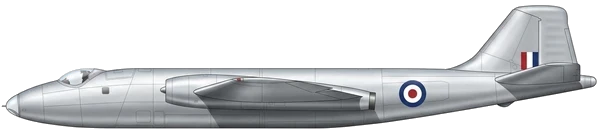
| Crew | 3 |
| Length | 20.0 m (65.5 ft) |
| Wingspan | 19.5 m (64.0 ft) |
| Height | 4.8 m (15.7 ft) |
| Wing area | 89.2 m² (960.1 sqft) |
| Empty weight | 9,820 kg (21,649 lbs) |
| Max. takeoff weight | 24,948 kg (55,001 lbs) |
| Powerplant | 2 × turbojets Rolls-Royce Avon 109 3,357 kgf each |
| Maximum speed | 933 km/h (580 mph) |
| Operational range | 5,440 km (3,380 mi) |
| Service ceiling | 14,630 m (47,999 ft) |
| Climb rate | 17.3 m/s (56.8 ft/s) |
- Air-to-Surface Nord AS.30
- Unguided Bomb 250 lb bomb
- Unguided Bomb 500 lb bomb
- Unguided Bomb 1000 lb bomb
- Unguided Bomb 4000 lb bomb
- Rocket Pod 37 x 2-inch unguided rocket pod
- Rocket Pod Matra rocket pod with 18 SNEB 68 mm rockets
- Nuclear Mk 7
- Nuclear B28
- Nuclear B43
- Nuclear B57
- Nuclear Red Beard
- Nuclear WE.177A
Description
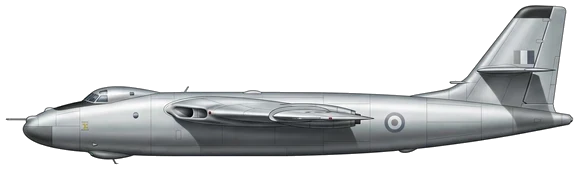
The English Electric Canberra is a British first-generation, jet-powered medium bomber built by English Electric in response to a 1944 Air Ministry requirement for a successor to the de Havilland Mosquito. It entered Royal Air Force service in May 1951 as the RAF's first jet bomber. It also served in nuclear strike, photographic reconnaissance and electronic reconnaissance roles. The Canberra is known for its high-altitude performance, including a 1957 world altitude record of 70,310 ft (21,430 m). The RAF retired its last examples in June 2006.
Development
The design originated in the P.1056 study prepared at Westland by its chief designer, who joined English Electric in December 1944 to form a design team. The requirement passed through specifications E.3/45, B.3/45 and B.5/47. In late 1945 a single central turbojet gave way to two mid-wing engines, which cut weight by 13% and improved the centre of gravity. The Ministry of Supply contracted four A.1 prototypes in January 1946. Delays in the radar bombing system forced a 1947 redesign that added a glazed nose for a bomb aimer.
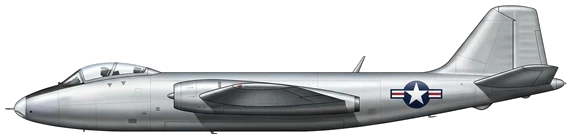
The first prototype, VN799, flew on 13 May 1949. The type was named Canberra in January 1950 after Australia became its first export customer, and the first production B.2 flew on 21 April 1950. The Korean War brought additional production by Avro, Handley Page and Short Brothers. UK manufacturers built 901 aircraft, and licence production by Government Aircraft Factories in Australia and Martin in the US (as the B-57) raised the total to 1,352. The Canberra was built in 27 versions and equipped 35 RAF squadrons.
Design
The Canberra has a circular-section, semi-monocoque fuselage with a pressurised nose, and a bomb bay occupies the lower fuselage. Its low-aspect-ratio wing uses single-spar construction. Wingspan and length are both just under 65 ft (20 m). Flight controls are manual, using push rods. The airbrakes consist of 40 hydraulically raised fingers on the upper and lower wing surfaces. Power came from two Rolls-Royce Avon axial-flow turbojets of 6,700 lbf (30 kN) each. Avionics included Gee-H, Rebecca, a radar altimeter, IFF, the Orange Putter radar warning receiver and a T.2 optical bombsight, fitted because the H2S radar bombsight was delayed.
Armament
Standard loads were 250 lb, 500 lb and 1,000 lb bombs, with a total bomb load of up to 10,000 lb (4,500 kg). Underwing pylons could carry up to 2,000 lb (900 kg) of additional stores. The B(I).6 and B(I).8 carried a ventral pack of four 20 mm Hispano Mk.V cannon. B.15s of Nos. 32 and 73 Squadrons were fitted with Nord AS.30 missiles. Nuclear weapons approved for the type included the Mk 7, B28, B43, B57, Red Beard and WE.177A, all carried internally and delivered using the Low Altitude Bombing System.
Operational History
In the Suez Crisis, RAF Canberras flew 278 sorties and dropped 1,439 bombs of 1,000 lb each. RAF Germany Canberra squadrons held the nuclear strike role until 1972. The PR.9 served with No. 39 (1 PRU) Squadron until July 2006, including operations over Iraq in 2003 and Afghanistan.
The RAAF's No. 2 Squadron flew about 12,000 sorties in Vietnam and dropped 76,389 bombs, losing two aircraft. Indian Canberras attacked the Badin radar in 1965 and the Karachi oil tanks in 1971. India retired the type on 11 May 2007. During the Falklands War, Argentine Canberras flew 54 sorties and lost two aircraft, one to a Sea Harrier and one to a Sea Dart. Rhodesia and South Africa used the type in their Bush Wars, and Peru flew it in the 1995 Cenepa War. Other export customers included Chile, Ecuador, Ethiopia, France, New Zealand, Sweden, Venezuela and West Germany.
Variants
- Canberra B.2: First production bomber, with a three-man crew, Avon R.A.3 engines and wingtip tanks; 418 were built by four manufacturers.
- Canberra T.4: Dual-control trainer with side-by-side seating and a solid nose.
- Canberra B.6: Production bomber based on the B.5, with Avon R.A.7 engines and leading-edge fuel tanks; 106 were built.
- Canberra B(I).8: Interdictor with an offset fighter-style canopy, a cannon pack, underwing hardpoints and LABS; 72 were built.
- Canberra PR.9: Stretched photo-reconnaissance version with a wingspan increased by 4 ft and Avon 206 engines; Short Brothers & Harland built 23.
Frequently Asked Questions
What type of aircraft is the Canberra?
What is the maximum speed of the Canberra?
What is the range of the Canberra?
When did the Canberra first fly?
How many Canberra have been built?
Which countries operate the Canberra?
What is the service ceiling of the Canberra?
- SEP 302026 Created Page created: Canberra