B-57 Canberra
American licence-built version of the British Canberra, introduced by the US Air Force in 1954 as a tactical bomber and reconnaissance aircraft and used extensively in the Vietnam War. Key figures: top speed 960 km/h, range 4,380 km, service ceiling 13,745 m, max takeoff weight 24,365 kg, built 403.
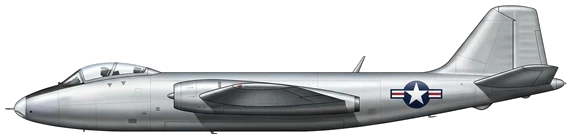
| Crew | 2 (pilot, navigator) |
| Length | 20.0 m (65.5 ft) |
| Wingspan | 19.5 m (64.0 ft) |
| Height | 4.5 m (14.8 ft) |
| Wing area | 89 m² (958.0 sqft) |
| Empty weight | 12,285 kg (27,084 lbs) |
| Max. takeoff weight | 24,365 kg (53,716 lbs) |
| Powerplant | 2 × turbojets Wright J65-W-5 3,275 kgf each |
| Maximum speed | 960 km/h (597 mph) |
| Operational range | 4,380 km (2,722 mi) |
| Service ceiling | 13,745 m (45,095 ft) |
| Climb rate | 31.4 m/s (103.0 ft/s) |
- Unguided Bomb 500 lb bomb
- Unguided Bomb 750 lb bomb
- Guided Bomb Paveway laser-guided bomb (B-57G)
- Nuclear Tactical nuclear bomb
- Rocket Pod Unguided rockets
Description
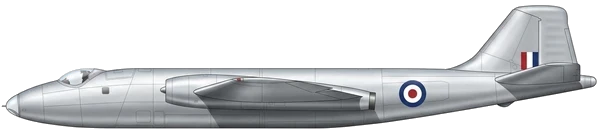
The Martin B-57 Canberra is an American twin-engined tactical bomber and reconnaissance aircraft. The Glenn L. Martin Company built it under licence from English Electric, based on the British Canberra. It entered United States Air Force (USAF) service in 1954 and was the first US jet bomber to drop bombs in combat. It flew combat missions in Vietnam and with the Pakistan Air Force against India. The USAF retired the type in 1983, and NASA still operates WB-57F research aircraft.
Development
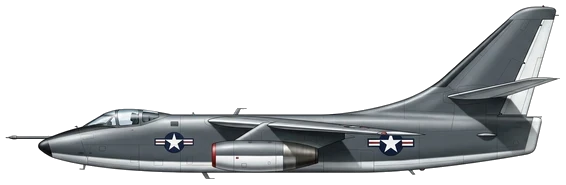
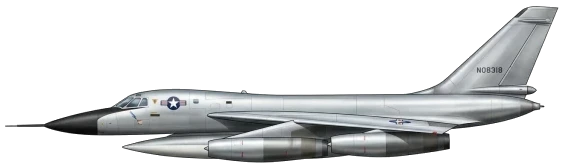
Piston-engined B-26 Invaders suffered heavy losses in the interdiction role during the Korean War. On 16 September 1950 the USAF requested a jet bomber with a 630 mph top speed, a 40,000 ft ceiling and a 1,150 mi range. The Canberra competed against the XB-51, B-45, AJ Savage and CF-100 and won a fly-off at Andrews Field on 26 February 1951. Martin received a contract for 250 aircraft on 23 March 1951.
The first production aircraft flew on 20 July 1953. After the Korean armistice, Martin completed only eight as B-57As and 67 as RB-57As. The B-57B first flew on 18 June 1954. A 1954 order added 100 B-57Bs, 38 B-57Cs and 20 RB-57Ds, and 68 B-57Es followed in 1955. Production totalled 403 aircraft between 1953 and 1957.
Design
Early aircraft closely followed the Canberra B.2 but replaced the Rolls-Royce Avons with 7,200 lbf Wright J65 engines, licence-built Armstrong Siddeley Sapphires chosen for hot-climate operations. Martin reduced the crew to two, added wingtip tanks and replaced the clamshell bomb doors with a rotating door from the XB-51. The B-57B introduced:
- a tandem fighter-style canopy
- rear-fuselage air brakes
- APW-11 bombing radar guidance
- SHORAN
- an APS-54 radar warning receiver
The B-57G conversion added a new nose with AN/ANQ-139 radar, low-light television, AN/AAS-26 FLIR and a laser rangefinder/designator.
Armament
The first 90 B-57Bs carried eight 0.50 in Browning machine guns in the wings, and later aircraft carried four 20 mm M39 cannon. The bomb bay held 4,500 lb, including nuclear weapons, and four underwing hardpoints carried 2,800 lb of bombs or rockets. A typical Vietnam load was nine 500 lb bombs internally and four 750 lb bombs externally. The B-57G carried Paveway laser-guided bombs and had its guns removed.
Operational History
From May 1963 to 1971, RB-57Es of the Patricia Lynn project flew night infrared reconnaissance from Tan Son Nhut. B-57Bs flew their first combat mission from Bien Hoa on 19 February 1965 and began striking North Vietnam under Operation Rolling Thunder on 2 March. Of 94 B-57Bs deployed to Southeast Asia, 51 were lost in combat. B-57Gs operated from Thailand from late 1970 to May 1972. A Republic of China Air Force RB-57D was shot down over China by an SA-2 missile, the first successful operational engagement by surface-to-air missiles. Pakistani B-57s flew 167 sorties in 1965 and struck 12 Indian runways on the first night of the 1971 war. Pakistan retired its B-57s in 1985.
Variants
- B-57A: Initial production bomber, almost identical to the Canberra B.2, with eight built.
- RB-57A: Photo-reconnaissance version with cameras aft of the bomb bay, with 67 built.
- B-57B: Definitive bomber with a tandem cockpit, wing guns and four underwing hardpoints, with 202 built.
- RB-57D: High-altitude strategic reconnaissance version with J57-P-9 engines and a 106 ft wingspan, with 20 built.
- B-57G: Sixteen B-57Bs converted as night intruders with FLIR, low-light television and a laser designator.
Frequently Asked Questions
What type of aircraft is the B-57 Canberra?
What is the maximum speed of the B-57 Canberra?
What is the range of the B-57 Canberra?
When did the B-57 Canberra first fly?
How many B-57 Canberra have been built?
Which countries operate the B-57 Canberra?
What is the service ceiling of the B-57 Canberra?
- SEP 302026 Created Page created: B-57 Canberra