B-66 Destroyer
American light bomber and reconnaissance aircraft, developed in the 1950s from the A-3 Skywarrior, used by the US Air Force for bombing, photo reconnaissance and electronic warfare until 1975. Key figures: top speed 1,015 km/h, range 3,974 km, service ceiling 12,009 m, max takeoff weight 37,648 kg, built 294.
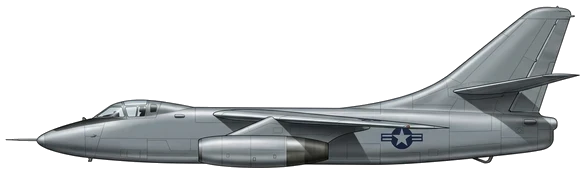
| Crew | 3 (pilot, navigator, EWO) |
| Length | 22.9 m (75.2 ft) |
| Wingspan | 22.1 m (72.5 ft) |
| Height | 7.2 m (23.6 ft) |
| Wing area | 72.5 m² (780.0 sqft) |
| Empty weight | 19,300 kg (42,549 lbs) |
| Max. takeoff weight | 37,648 kg (83,000 lbs) |
| Powerplant | 2 × turbojets Allison J71-A-11 4,627 kgf each |
| Maximum speed | 1015 km/h (631 mph) |
| Operational range | 3,974 km (2,469 mi) |
| Service ceiling | 12,009 m (39,400 ft) |
| Climb rate | 25.4 m/s (83.3 ft/s) |
- Unguided Bomb up to 15,000 lb (6,800 kg) of free-fall bombs
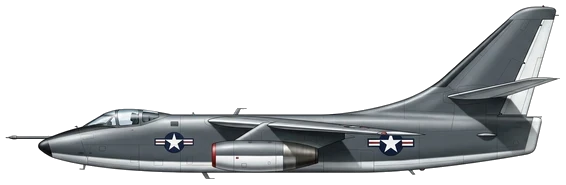
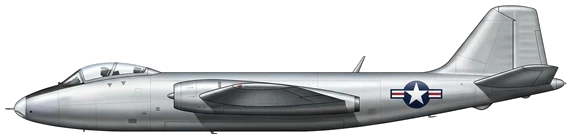
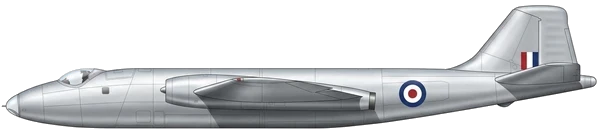
Description
The Douglas B-66 Destroyer is an American twin-jet light bomber and reconnaissance aircraft built by Douglas Aircraft Company for the United States Air Force (USAF). It was derived from the US Navy's A-3 Skywarrior and first flew on 28 June 1954. It entered service in 1956 as a replacement for the Douglas A-26 Invader. Most were built for reconnaissance, and the type is known for electronic intelligence and countermeasures work in Europe, around Cuba and over Vietnam. The last were withdrawn in 1975.
Development
USAF interest in a land-based A-3 followed Navy flight tests showing mission profiles similar to the Boeing B-47 Stratojet, including an unrefuelled combat radius of almost 1,000 miles. In June 1952 the USAF contracted Douglas for five pre-production RB-66As, intending only to remove carrier features and fit USAF avionics. Changing requirements, including low-level operation, led to a fuselage and wing redesigned from scratch. Aviation historians attribute many of the changes to inter-service rivalry rather than operational need. The first production B-66B flew on 4 January 1955, and deliveries began on 16 March 1956. The USAF cancelled 69 B-66Bs and made the RB-66B the principal production model.
Design
The B-66B is powered by two Allison J71 turbojets of 10,200 lbf thrust each, replacing the A-3's Pratt & Whitney J57s. The J71 produced less thrust and used more fuel than the J57, which was already in USAF service. The power system was redesigned to mount hydraulic pumps and generators on the engines rather than drive them by bleed air. The pressurized cockpit has a deep glazed pilot position and, unlike the A-3, ejection seats for its three crew. The B-66B carries APS-27 and K-5 radars and reaches 548 kn (1,015 km/h) at 6,000 ft (1,800 m). Its combat range is 782 nmi (1,448 km) and its ferry range 2,146 nmi (3,974 km).
Armament
The B-66B carries up to 15,000 lb (6,800 kg) of bombs. Defensive armament is two 20 mm M24 cannon in a radar-controlled, remotely operated tail turret.
Operational History
The RB-66 was the USAF's primary night photo-reconnaissance aircraft of its period. It served with tactical reconnaissance squadrons in the United Kingdom, West Germany and France. During Operation Mobile Zebra in November 1957, nine B-66s set out from California for the Philippines, and three arrived. In the early 1960s the 42nd Tactical Reconnaissance Squadron at RAF Chelveston converted 13 B-66Bs to EB-66B countermeasures aircraft. On 10 March 1964 a 19th TRS RB-66C strayed into East Germany after a compass failure and was shot down by a MiG-19. Its crew was repatriated. In Vietnam, unarmed EB-66B, EB-66C and EB-66E aircraft operating from Thailand mapped SAM and AAA sites and jammed radars for F-105 Thunderchief strikes.
Variants
- RB-66A: All-weather photo-reconnaissance pre-production model, of which five were built.
- RB-66B: Production reconnaissance model with J71-A-13 engines and higher gross weight, with sources giving 145 or 149 built.
- B-66B: Tactical bomber version of the RB-66B, of which 72 were built.
- EB-66B: 13 B-66B bombers converted in the early 1960s as electronic countermeasures aircraft.
- RB-66C: Electronic reconnaissance version with a seven-man crew and wingtip receiver pods, of which 36 were built and later redesignated EB-66C in 1966.
- WB-66D: Weather reconnaissance version with two observers, of which 36 were built and two converted to Northrop X-21A laminar-flow research aircraft.
- EB-66E: Specialised electronic warfare conversion of the B-66B.
Frequently Asked Questions
What type of aircraft is the B-66 Destroyer?
What is the maximum speed of the B-66 Destroyer?
What is the range of the B-66 Destroyer?
When did the B-66 Destroyer first fly?
How many B-66 Destroyer have been built?
Which countries operate the B-66 Destroyer?
What is the service ceiling of the B-66 Destroyer?
- OCT 12026 Created Page created: B-66 Destroyer