EF-111 Raven
American electronic warfare aircraft, extensively deployed in Gulf War, notable for radar jamming and deception operations. Key figures: top speed 2,350 km/h, range 3,220 km, service ceiling 17,000 m, max takeoff weight 39,680 kg, unit price $65M, built 42.
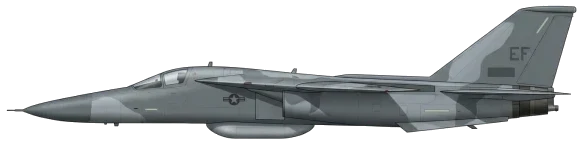
| Crew | 2 (pilot, electronic warfare officer) |
| Length | 23.5 m (77.1 ft) |
| Wingspan | 19.2 m (63.0 ft) |
| Height | 5 m (16.4 ft) |
| Wing area | 48.8 m² (525.2 sqft) |
| Empty weight | 24,230 kg (53,418 lbs) |
| Max. takeoff weight | 39,680 kg (87,479 lbs) |
| Powerplant | 2 × Pratt & Whitney TF30-P-109 8,390 kgf each |
| Maximum speed | 2350 km/h (Mach 2.2) |
| Operational range | 3,220 km (2,001 mi) |
| Endurance | 4 hours |
| Service ceiling | 17,000 m (55,774 ft) |
| Climb rate | 55.9 m/s (183.4 ft/s) |

Description
The General Dynamics–Grumman EF-111A Raven was an electronic warfare aircraft converted from the F-111A tactical bomber and operated exclusively by the United States Air Force. It entered service in 1981 and reached initial operational capability in 1983, serving as the USAF's supersonic stand-in and penetration jamming platform until its retirement on 2 May 1998. Crews knew it as the "Spark 'Vark", a play on the F-111's "Aardvark" nickname.
Development
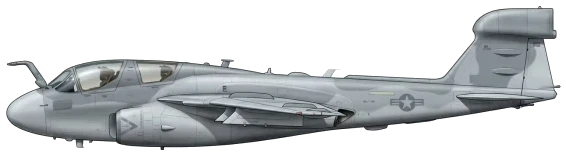
In the late 1960s the USAF sought a replacement for its EB-66 and EB-57 jamming aircraft, evaluating the US Navy's EA-6B Prowler during 1967–1968. The service instead required a jammer capable of supersonic penetration, and in 1972 chose to modify existing F-111As. Study contracts went to Grumman and General Dynamics in January 1974; Grumman was named prime contractor in December 1974 and received a contract to convert two F-111As into prototypes in January 1975. The first fully equipped aircraft, then called the "Electric Fox", flew on 10 March 1977. A total of 42 airframes were converted at a cost of US$1.5 billion. The first aircraft were deployed in November 1981 with the 388th Tactical Electronic Squadron at Mountain Home AFB, Idaho, and the final delivery took place in 1985.
Design
The Raven retained the F-111A's variable-geometry airframe and navigation suite, with the AN/APQ-160 radar revised for ground mapping. Its principal system was the AN/ALQ-99E jammer, derived from the Navy's ALQ-99, with primary electronics in the weapons bay, transmitters in a 16 ft (4.9 m) ventral "canoe" radome and receivers in a fin-tip "football" pod; the installation weighed some 6,000 lb (2,700 kg). An ALR-62 Countermeasures Receiving System provided radar homing and warning. Electrical and cooling systems were rebuilt to support the equipment, and the cockpit was rearranged so that all flight and navigation displays were on the pilot's side, with the right seat given over to the electronic warfare officer. Engines were upgraded from TF30-P-3 to the F-111D's TF30-P-9, rated at 12,000 lbf dry and 19,600 lbf with afterburner, from 1986. The Avionics Modernization Program of 1987–1994 added dual AN/ASN-41 ring laser gyroscope INS, AN/APN-218 Doppler radar, AN/APQ-146 terrain-following radar and multi-function displays.
Armament
The EF-111A carried no weapons. It could not launch anti-radiation missiles and was therefore unable to perform the Suppression of Enemy Air Defenses role, relying on speed and acceleration for self-defence.
Operational History
The type's combat debut came with the 20th Tactical Fighter Wing from RAF Upper Heyford during Operation El Dorado Canyon in 1986, when five aircraft flew 3,500 miles with four aerial refuellings to jam Libyan air defences. Two aircraft supported Operation Just Cause in Panama in 1989. Eighteen EF-111As flew in Operation Desert Storm in 1991, escorting deep-strike packages into Iraq. On 17 January 1991 Captains James Denton and Brent Brandon manoeuvred an Iraqi Mirage F1 into the ground, the only aerial victory credited to the F-111 family. On 13 February 1991 aircraft 66-0023, call sign Ratchet 75, crashed while evading a perceived threat, killing Capt Douglas L. Bradt and Capt Paul R. Eichenlaub; it was the only combat loss of three airframes lost in service. Later deployments included Operation Deliberate Force from Aviano Air Base, Provide Comfort, Northern Watch and Southern Watch. The final detachment operated from Al Kharj/Prince Sultan Air Base, Saudi Arabia, until April 1998, and the last aircraft were retired at Cannon AFB, New Mexico. There were no export customers.
Variants
- EF-111A (prototypes): Two F-111As converted under the January 1975 contract, the first flying on 10 March 1977.
- EF-111A: Production electronic warfare conversion of the F-111A, 42 airframes in total including the two prototypes.
Frequently Asked Questions
What type of aircraft is the EF-111 Raven?
What is the maximum speed of the EF-111 Raven?
What is the range of the EF-111 Raven?
When did the EF-111 Raven first fly?
How many EF-111 Raven have been built?
Which countries operate the EF-111 Raven?
How much does a EF-111 Raven cost?
What is the service ceiling of the EF-111 Raven?
- AUG 302026 Updated Description updated
- AUG 52026 Updated Climb rate added
- AUG 12026 Updated Manufacturer updated
- JUL 232026 Updated Sources and cross-references refreshed
- APR 72026 Updated Sources and cross-references refreshed
- FEB 72026 Updated Endurance added
- JAN 242026 Updated Top speed updated