A-3 Skywarrior
American jet-powered strategic bomber, developed in the mid-20th century, utilized for nuclear deterrence, electronic warfare, and aerial refueling from aircraft carriers. Key figures: top speed 980 km/h, range 4,667 km, service ceiling 12,000 m, max takeoff weight 37,195 kg, built 283.
| Crew | 3 |
| Length | 23.3 m (76.3 ft) |
| Wingspan | 22.1 m (72.5 ft) |
| Height | 6.9 m (22.8 ft) |
| Wing area | 75.4 m² (811.6 sqft) |
| Empty weight | 17,876 kg (39,410 lbs) |
| Max. takeoff weight | 37,195 kg (82,001 lbs) |
| Powerplant | 2 × Pratt & Whitney J57-P-10 turbojet 4,762 kgf each |
| Maximum speed | 980 km/h (609 mph) |
| Operational range | 4,667 km (2,900 mi) |
| Service ceiling | 12,000 m (39,370 ft) |
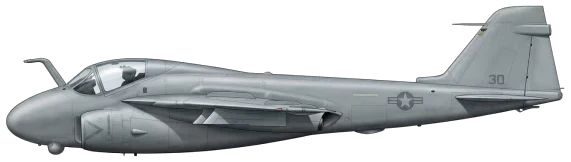
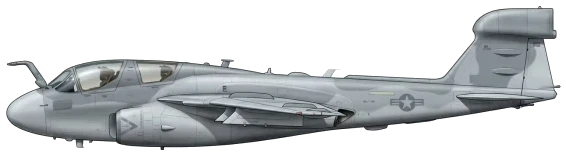
Description
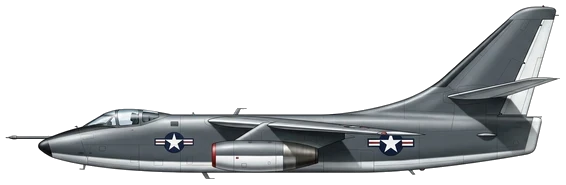
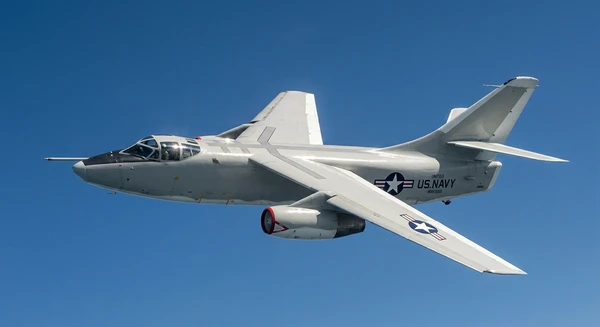
The Douglas A-3 Skywarrior is a jet-powered strategic bomber developed for the United States Navy. Douglas was awarded the contract in July 1949, proposing a 68,000 lb (31,000 kg) aircraft to facilitate operations from Midway-class carriers. The prototype XA3D-1 conducted its maiden flight on October 28, 1952. While early designs utilized Westinghouse J40 turbojets, performance failures led to the adoption of the Pratt & Whitney J57-P-10 engine. The aircraft entered squadron service on March 31, 1956, and remained in production until 1961. As the heaviest operational carrier-based aircraft of its era, it earned the nickname "Whale."
Design
The Skywarrior utilizes a 36-degree swept wing and two turbojets housed in underwing nacelles. For carrier storage, the wings fold outboard of the engines and the vertical stabilizer hinges to starboard. The fuselage is a semi-monocoque construction containing a large internal bomb bay. Early variants carried a crew of three—pilot, bombardier/navigator, and crewman/navigator—while later reconnaissance versions accommodated up to seven personnel. To reduce weight, the design omitted ejection seats, utilizing an escape tunnel for emergency egress. Avionics included the AN/ASB-1A or AN/ASB-7 bomb-director systems and defensive electronic countermeasure (ECM) equipment.
Armament
Internal armament capacity is 12,800 lb (5,800 kg). The bomb bay accommodated various munitions, including 12 Mk 82 500 lb bombs, six Mk 83 1,000 lb bombs, four 2,000 lb bombs, or a single nuclear weapon. Initial production models featured two 20mm M3L cannons in a radar-operated tail turret, though this system was later replaced by ECM fairings in most variants.
Operational History
The A-3 served as a primary nuclear deterrent until the mid-1960s when the role shifted to ballistic missile submarines. During the Vietnam War, A-3Bs performed conventional bombing and mine-laying missions between 1964 and 1967. The type subsequently transitioned to support roles, including electronic intelligence (ELINT) and aerial refueling. On May 31, 1967, a KA-3B participated in the first triple-level aerial refueling involving a KC-135 and an F-8. The EA-3B variant provided ELINT support during the Cold War and the 1991 Gulf War. The U.S. Navy officially retired the type on September 27, 1991. Following military retirement, contractors including Hughes and Raytheon operated A-3s as testbeds for F-14 and F-15 radar systems until 2011.
Variants
- A-3A (A3D-1): The initial production version consisting of 49 aircraft used primarily in developmental and training roles.
- A-3B (A3D-2): The definitive production bomber featuring a strengthened airframe, larger wing area, and more powerful engines.
- RA-3B (A3D-2P): A photographic reconnaissance variant equipped with 12 camera stations and a pressurized weapons bay for technician access.
- EA-3B (A3D-2Q): An electronic warfare platform featuring a pressurized fuselage compartment for four electronic systems operators.
- KA-3B: A dedicated aerial refueling tanker refitted with a probe-and-drogue system in place of bombing equipment.
Frequently Asked Questions
What type of aircraft is the A-3 Skywarrior?
What is the maximum speed of the A-3 Skywarrior?
What is the range of the A-3 Skywarrior?
When did the A-3 Skywarrior first fly?
How many A-3 Skywarrior have been built?
Which countries operate the A-3 Skywarrior?
What is the service ceiling of the A-3 Skywarrior?
- AUG 122026 Updated Range corrected to the ferry range
- MAY 102026 Created Page created: A-3 Skywarrior