Tu-16 Badger
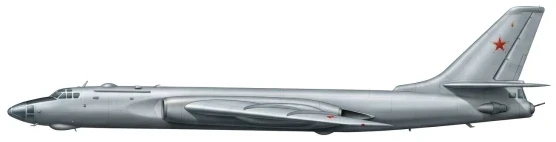
Soviet jet bomber, known for Cold War operations and extensive use in various international conflicts, including Middle-Eastern wars. Key figures: top speed 1,050 km/h, range 7,200 km, service ceiling 12,800 m, max takeoff weight 79,000 kg, unit price $6M, built 1,509.
| Crew | 6–9 |
| Length | 34.8 m (114.2 ft) |
| Wingspan | 33 m (108.3 ft) |
| Height | 10.4 m (34.0 ft) |
| Wing area | 165 m² (1776.0 sqft) |
| Empty weight | 37,200 kg (82,012 lbs) |
| Max. takeoff weight | 79,000 kg (174,165 lbs) |
| Powerplant | 2 × turbojets Mikouline AM-3 9,525 kgf each |
| Maximum speed | 1050 km/h (652 mph) |
| Operational range | 7,200 km (4,474 mi) |
| Service ceiling | 12,800 m (41,995 ft) |
- Anti-Ship Raduga KS-1 Komet (AS-1 Kennel)
- Anti-Ship Raduga K-10S (AS-2 Kipper)
- Anti-Ship Raduga KSR-2 (AS-5 Kelt)
- Anti-Ship Raduga KSR-5 (AS-6 Kingfish)
- Low-Drag FAB-250
- Low-Drag FAB-9000M-54
- Low-Drag JSC NPO Basalt FAB-500
- Nuclear KB-11 RDS-4 Tatyana
- Thermonuclear KB-11 RDS-37

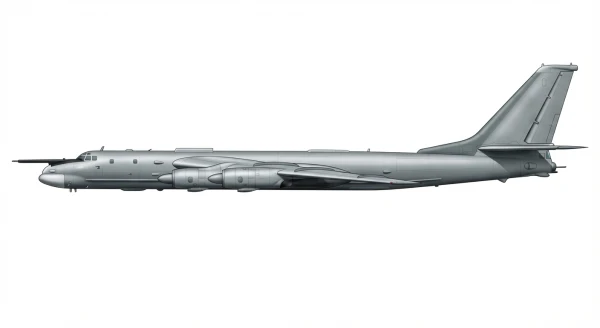
Description
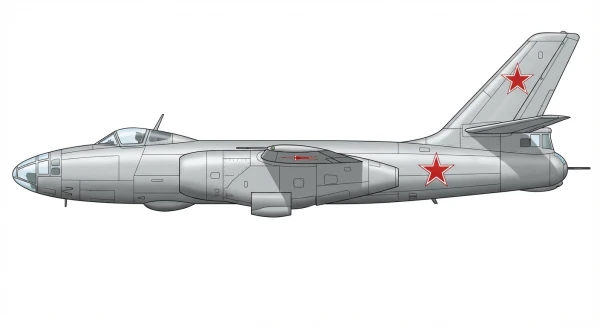
The Tu-16 Badger was a strategic bomber developed by the Soviet Union in the 1950s. Its origins date back to a 1950 requirement issued by the Soviet Air Force for a new jet bomber intended to replace the Tu-4 and Il-28.
Development
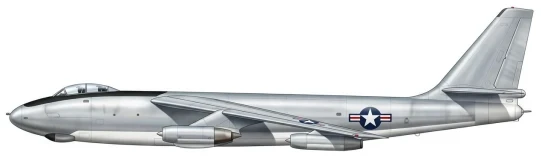
The Tupolev design team drew inspiration from the success of the American bomber Boeing B-47 Stratojet, which had impressed Soviet observers during public demonstration flights. The designers aimed to create a similar high-speed, swept-wing bomber capable of carrying a significant payload over long distances. The development of the Tu-16 required overcoming several technical challenges, including the design and production of a powerful turbojet engine, the Klimov VK-1. The first prototype made its inaugural flight in 1952, and after further improvements and testing, the Tu-16 entered service in the Soviet Air Force in the mid-1950s.
Design
Its configuration included a moderately swept-wing design, enhancing high-speed capabilities and reducing drag. The fuselage was elongated and streamlined, tapering towards the rear. The bomber was powered by two turbojet engines, typically Klimov VK-1 engines, mounted under the wings. It had a conventional tail with a single vertical stabilizer and horizontal stabilizers. The aircraft featured a large internal bomb bay capable of carrying up to 9,000 kg of offensive payload. Defensive systems, such as radar warning receivers and defensive turrets, were incorporated, along with seven 23mm NR-23 cannons for self-defense. The landing gear consisted of a tricycle configuration.
The Tu-16 Badger underwent several different versions throughout its service history:
Tu-16: The initial production version, serving as a strategic bomber. Tu-16A: A modified version equipped with in-flight refueling capability for extended range and endurance. Tu-16K: This variant was designed for anti-ship missions, equipped with air-launched cruise missiles. Tu-16KS: An enhanced anti-ship version with improved radar and missile capabilities. Tu-16R: A reconnaissance variant used for intelligence-gathering missions, equipped with cameras and sensors. Tu-16RM: An upgraded reconnaissance version with improved systems and equipment. Tu-16N: A nuclear bomber version capable of carrying and delivering nuclear weapons. Tu-16Z: An electronic warfare variant used for electronic jamming and suppression. Tu-16LL: A modified version used for flight testing and research purposes.
Operational History
The Tu-16 Badger saw varied deployments, primarily with the Soviet Union and other allied countries. It entered service in the Soviet Air Force in the late 1950s and remained in active service for several decades. The Soviet Union supplied Tu-16 bombers to various Warsaw Pact countries, including Poland, East Germany, Czechoslovakia, and Hungary. These countries operated the Tu-16 as part of their strategic air forces. China also received Tu-16 bombers from the Soviet Union in the 1950s, designating them as H-6. The Tu-16 was deployed in the Middle East, particularly in Egypt and Iraq, and was involved in conflicts such as the Arab-Israeli conflicts and the Vietnam War. Additionally, the Tu-16 was exported to non-aligned countries and clients outside the Warsaw Pact, including Algeria, Angola, Libya, and North Korea.
In total, approximately 1,500 units were produced, but none have been active since the 1990s.
Frequently Asked Questions
What type of aircraft is the Tu-16 Badger?
What is the maximum speed of the Tu-16 Badger?
What is the range of the Tu-16 Badger?
When did the Tu-16 Badger first fly?
How many Tu-16 Badger have been built?
Which countries operate the Tu-16 Badger?
How much does a Tu-16 Badger cost?
What is the service ceiling of the Tu-16 Badger?
- JUN 262026 Updated Missiles added
- APR 72026 Updated Sources and cross-references refreshed
- JAN 122026 Updated Range updated in a site-wide editorial pass