Djinn
French two-seat light helicopter of the 1950s, the first production helicopter driven by cold tip jets, used by the French and West German armies for liaison and observation. Key figures: top speed 130 km/h, range 220 km, service ceiling 3,000 m, max takeoff weight 800 kg, built 178.
| Crew | 1–2 |
| Length | 5.3 m (17.4 ft) |
| Wingspan | 11 m (36.1 ft) |
| Height | 2.6 m (8.5 ft) |
| Wing area | 95.0 m² (1022.9 sqft) |
| Empty weight | 360 kg (794 lbs) |
| Max. takeoff weight | 800 kg (1,764 lbs) |
| Powerplant | 1 × turbo-compressor Turbomeca Palouste IV 179 kW each |
| Maximum speed | 130 km/h (81 mph) |
| Operational range | 220 km (137 mi) |
| Endurance | 2 hours |
| Service ceiling | 3,000 m (9,843 ft) |
Description
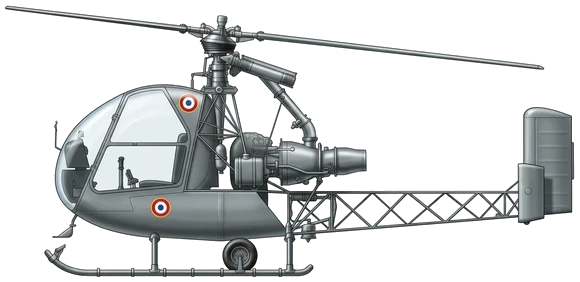
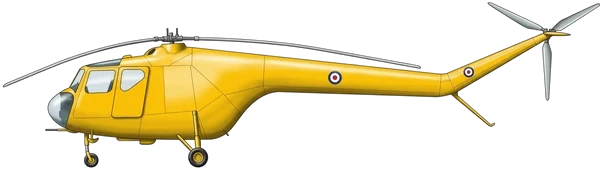
The Sud-Ouest SO.1221 Djinn is a French two-seat light helicopter designed and built by Sud-Ouest (SNCASO), which was later merged into Sud Aviation. It was the first French helicopter to enter production, the first production rotorcraft to use tip-jet propulsion, and the first production turbine-powered helicopter. Compressed air ejected at the blade tips drove the rotor, so the aircraft needed no anti-torque tail rotor. The French and West German armies used the Djinn for liaison, observation, training and casualty evacuation.
Development
The Djinn was developed as a practical application of the experimental Sud-Ouest Ariel tip-jet helicopter. Its system differed from the Ariel's but kept the same principle of feeding compressed air to the rotor blade tips. A single-seat test bed, the SO.1220, was an uncovered structure with an exposed pilot's seat. It first flew on 2 January 1953 and confirmed that the propulsion system worked. Five two-seat SO.1221 prototypes followed, and the first flew on 16 December 1953. Within days, one prototype reached 4,789 m (15,712 ft), setting a record in its class. A pre-production batch of 22 aircraft followed, and the first of these flew on 23 September 1954. Production ended in the mid-1960s after 178 had been built, and the Aérospatiale Alouette II replaced the type. In the late 1950s Sud Aviation studied an improved Djinn III, or Super Djinn, with more power and endurance.
Design
A Turbomeca Palouste gas turbine, rated at 179 kW (240 hp), drove a compressor. The compressor fed air through the hollow all-metal rotor blades to nozzles at the tips. The system was a "cold" tip-jet, with no combustion at the nozzles, which produced little noise. Each blade had a tapering spar, a honeycomb-filled trailing edge and faired roots, and the warm internal airflow prevented icing. The rotor hub was mounted on a steel pylon through a ball joint and rubber shock absorbers. The 11 m rotor could lift overload weights for about five seconds by using stored rotor kinetic energy. This allowed certification for payloads of up to 54% of gross weight.
The crew sat side by side in an enclosed, glazed cabin, with the engine directly behind them. The engine had no electronics and was started with a hand crank on the starboard fuselage. The same crank retracted the wheel-equipped twin-skid undercarriage. An uncovered tail boom carried twin fins and a rudder, and deflected engine exhaust provided directional control. Bleed air powered the blind-flying instruments, fuel gauges, cabin heating, demisting, trimmers, rescue hoists and spraying equipment. Optional equipment included stretcher carriers, radios, extra fuel tanks and a cargo hook. Empty weight was 360 kg and gross weight 800 kg. Maximum speed was 130 km/h, range 220 km and endurance 2 hours 15 minutes.
Armament
For ground attack, the Djinn could mount a single machine gun operated from the second seat. In the anti-tank role it could carry a guided missile.
Operational History
The French Army ordered 100 Djinns. Flown by a single pilot, the helicopter could carry two external litters for casualty evacuation. The US Army evaluated three pre-production aircraft as the YHO-1. One account holds that the US Army found it an excellent weapons platform but dropped it under political opposition to buying a foreign design. Ten other countries ordered the Djinn, including West Germany, which bought six. Cameroon operated ten from 1972 to 1998 and Switzerland retired its four in 1966. Some aircraft passed to civil operators for agricultural spraying.
Variants
- SO.1220: Single-seat, uncovered test bed that first flew on 2 January 1953 to prove the tip-jet concept.
- SO.1221 Djinn: Two-seat production helicopter, of which 178 were built.
- YHO-1: US Army designation for three pre-production Djinns acquired for trials.
- Djinn III (Super Djinn): Late-1950s project for a version with greater power and endurance.
Frequently Asked Questions
What type of aircraft is the Djinn?
What is the maximum speed of the Djinn?
What is the range of the Djinn?
When did the Djinn first fly?
How many Djinn have been built?
Which countries operate the Djinn?
What is the service ceiling of the Djinn?
- OCT 12026 Created Page created: Djinn