Saro Skeeter
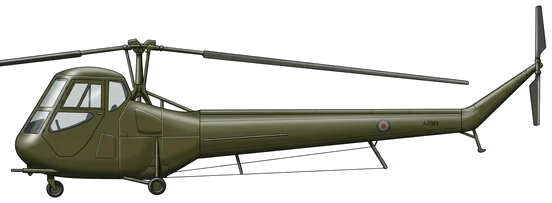
British two-seat light piston helicopter of the late 1950s, the first helicopter of the Army Air Corps, used for air observation post and training duties in Britain and West Germany. Key figures: top speed 175 km/h, range 420 km, service ceiling 3,900 m, max takeoff weight 1,043 kg, built 78.
| Crew | 2 |
| Length | 8.1 m (26.7 ft) |
| Wingspan | 9.8 m (32.0 ft) |
| Height | 2.9 m (9.5 ft) |
| Wing area | 74.7 m² (804.1 sqft) |
| Empty weight | 751 kg (1,656 lbs) |
| Max. takeoff weight | 1,043 kg (2,299 lbs) |
| Powerplant | 1 × piston engine de Havilland Gipsy Major 215 160 kW each |
| Maximum speed | 175 km/h (109 mph) |
| Operational range | 420 km (261 mi) |
| Endurance | 3 hours |
| Service ceiling | 3,900 m (12,795 ft) |
| Climb rate | 5.8 m/s (19.0 ft/s) |
Description
The Saunders-Roe Skeeter is a two-seat light training and scout helicopter developed in the United Kingdom by the Cierva Autogiro Company and produced by Saunders-Roe (Saro) of Cowes and Southampton. It entered service in the late 1950s with the British Army Air Corps, the German Army and the German Navy. It was the first helicopter operated by the Army Air Corps and was used mainly for air observation post (AOP) and training duties.
Development
Cierva began work on the W.14 Skeeter in 1947 as a compact two-seat helicopter for civil use and military aerial observation. The prototype, powered by a 110 hp Jameson FF-1, first flew at Eastleigh on 10 October 1948. It proved underpowered, partly because the engine overheated. The larger Mark 2, with a 145 hp de Havilland Gipsy Major 10, flew on 20 October 1949 but suffered from severe ground resonance and was destroyed during ground testing on 26 June 1950. The Ministry of Supply had ordered two Mark 3s and one Mark 4 for RAF and Royal Navy evaluation. In January 1951, before these were completed, Saunders-Roe took over Cierva's helicopter contracts and facilities.
In March 1953 the Blackburn Bombardier-engined Mark 3B went to the Aeroplane and Armament Experimental Establishment (A&AEE). It was still underpowered and still showed resonance, so official support was suspended. Saunders-Roe continued company-funded rig testing. That same year a Ministry of Supply requirement called for a low-cost two-seat helicopter for reconnaissance, casualty evacuation and training. It had to be transportable on an Army three-ton truck and have one hour of endurance. Fairey's tip-jet Ultra-light Helicopter received an order for four development aircraft. A redesigned undercarriage and revised rotor-head blade friction dampers cured the Skeeter's resonance, which the Mark 5 demonstrated at the A&AEE in March 1954. Four Mark 6s with 200 hp Gipsy Major 200 engines were then ordered for evaluation. West Germany offered a military order on condition that Britain also adopted the Skeeter, and the Fairey requirement was abandoned. In 1956 Saunders-Roe received an order for 64 AOP.12s with 215 hp engines, and deliveries began in 1958. In total, 78 production aircraft and 10 prototypes were built.
Design
The Skeeter is an all-metal single-rotor helicopter with a three-bladed main rotor and a three-bladed tail rotor. The main blades had a steel-tube spar bonded to wooden veneers, formers and ribs, with brass balance weights. A light-alloy replacement blade was developed later. The aircraft has fixed tricycle landing gear and an enclosed Perspex canopy with removable doors. The engine and a nylon bag-type fuel tank sit behind the cockpit in a welded tubular steel frame. The fuel-injected Gipsy Major gave relatively low fuel consumption. The AOP.12 has a maximum speed of 109 mph (175 km/h), a range of 260 mi (420 km) and a service ceiling of 12,800 ft (3,900 m).
D. Napier & Son developed the N.R.E. 19 rotor boost system, which used high test peroxide (HTP) rocket nozzles at the blade tips. It produced 22.5 lbf of thrust for 15 minutes and added 67 shp, for a system weight of under 30 lb. The system worked in trials but was rejected because of the logistical difficulties of handling HTP.
Operational History
The Royal Air Force Central Flying School operated several AOP.12s, and T.13s trained army helicopter instructors. Germany received six Mk.50s and four Mk.51s. These ten aircraft passed to Portugal in July 1961 in non-airworthy condition and were stored at OGMA. A shortage of spare parts led to their rebuild being cancelled, and they were sold. After Saro merged into Westland in 1960, plans for a turbine-powered Skeeter were dropped. The Skeeter-based P.531 led to the Westland Scout and Wasp. Preserved examples are displayed in the UK, Germany and Poland.
Variants
- Cierva W.14 Skeeter 1: Single prototype powered by a Jameson FF-1 engine.
- Skeeter 6 (mod): Two Skeeter 6s fitted with the Napier N.R.E. 19 rocket rotor boost system.
- Skeeter AOP.12: Air observation post helicopter for the Army Air Corps and trainer for the RAF.
- Skeeter Mk.50: Export version of the Skeeter 7 for German Army aviation, with six delivered.
- Skeeter Mk.51: Export version of the Skeeter 7 for the German Navy, with four delivered.
Frequently Asked Questions
What type of aircraft is the Saro Skeeter?
What is the maximum speed of the Saro Skeeter?
What is the range of the Saro Skeeter?
When did the Saro Skeeter first fly?
How many Saro Skeeter have been built?
Which countries operate the Saro Skeeter?
What is the service ceiling of the Saro Skeeter?
- OCT 12026 Created Page created: Saro Skeeter