Bell 47
American single-rotor light helicopter, developed in the mid-1940s and utilized for a wide range of civilian and military applications including reconnaissance and medical evacuation. Key figures: top speed 169 km/h, range 396 km, max takeoff weight 1,338 kg, built 5,600.

| Crew | 1–2 |
| Length | 9.6 m (31.6 ft) |
| Wingspan | 11.3 m (37.2 ft) |
| Height | 2.8 m (9.3 ft) |
| Wing area | 100.8 m² (1085.0 sqft) |
| Empty weight | 859 kg (1,894 lbs) |
| Max. takeoff weight | 1,338 kg (2,950 lbs) |
| Powerplant | 1 × Lycoming TVO-435-F1A 210 kW each |
| Maximum speed | 169 km/h (105 mph) |
| Operational range | 396 km (246 mi) |
| Climb rate | 4.4 m/s (14.4 ft/s) |
Description
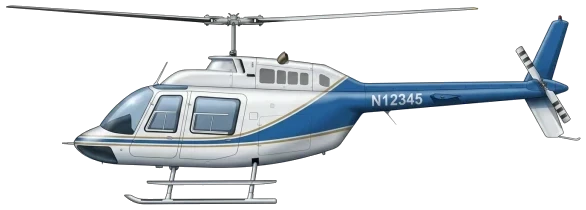
The Bell 47 is a single-rotor, single-engine light helicopter based on the third Bell 30 prototype designed by Arthur M. Young. It received the first civilian helicopter certification on 8 March 1946, with the initial delivery to Helicopter Air Transport on 31 December 1946. Total production exceeded 5,600 units, including license-built aircraft by Agusta in Italy, Kawasaki Heavy Industries in Japan, and Westland Aircraft in the United Kingdom. Early iterations featured varying configurations including open cockpits, sheet metal cabins, and four-wheel landing gear. The 47G, introduced in 1953, established a configuration featuring a "soap bubble" canopy, exposed welded-tube tail boom, saddle-mounted fuel tanks, and skid landing gear. Powerplants include vertically mounted Franklin or Lycoming piston engines ranging from 175 to 305 HP. Seating capacity varies by model from two to four occupants.
Design
The 47G-3B variant has a maximum takeoff weight of 2,950 lb and a payload capacity of 1,057 lb. It is powered by a 280 hp Lycoming TVO-435-F1A engine, providing a maximum speed of 91 knots and a range of 214 nautical miles. Later development included the 47GT-6, a proposed turboshaft version using a Rolls-Royce RR300 engine and composite rotor blades, though production was not realized.
Operational History
Entering United States military service in late 1946 as the H-13 Sioux, the aircraft operated for three decades. During the Korean War, the H-13 performed reconnaissance, scouting, search and rescue, and medical evacuation missions. In 1958, a Bell 47 designated "Telecopter" conducted the first television news broadcast from a helicopter for KTLA in Los Angeles. NASA utilized Bell 47s during the Apollo program as trainers for lunar lander operations. Flight records established by the type include an 18,550-foot altitude record set on 13 May 1949 and a 1,217-mile nonstop distance record for piston helicopters set on 17 September 1952. Military and government operators have included the Brazilian Navy, the Royal Thai Armed Forces, the United Kingdom military, and various municipal police and fire departments in the United States, Canada, and Italy.
Variants
- 47D: The first version to feature the molded soap bubble canopy.
- 47G: A three-seat model introduced in 1953 featuring twin saddle-bag fuel tanks and a Lycoming or Franklin engine.
- 47J Ranger: A four-seat variant powered by a VO-435 engine with a fully enclosed cabin and a faired monocoque tail boom.
- 47H-1: A three-seat version with an enclosed cabin and fuselage marketed as a luxury configuration.
- Kawasaki KH-4: A Japanese-produced four-seat version with a cabin similar to the 47J but utilizing an uncovered tail boom and G-series fuel tanks.
Frequently Asked Questions
What type of aircraft is the Bell 47?
What is the maximum speed of the Bell 47?
What is the range of the Bell 47?
When did the Bell 47 first fly?
How many Bell 47 have been built?
Which countries operate the Bell 47?
- MAY 102026 Created Page created: Bell 47