Mi-1 Hare
Soviet light utility helicopter, extensively used for civilian and military operations during the mid-20th century. Key figures: top speed 185 km/h, range 430 km, service ceiling 3,500 m, max takeoff weight 2,330 kg, unit price $0.1M, built 2,594.
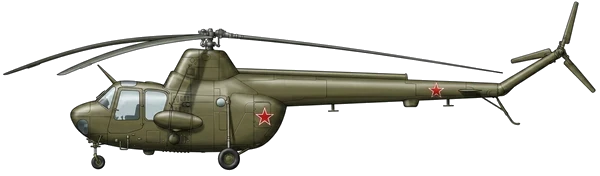
| Crew | 1 |
| Length | 12.1 m (39.7 ft) |
| Wingspan | 14.4 m (47.1 ft) |
| Height | 3.3 m (10.8 ft) |
| Empty weight | 1,700 kg (3,748 lbs) |
| Max. takeoff weight | 2,330 kg (5,137 lbs) |
| Powerplant | 1 × radial engine Ivchenko-Progress AI-26V 423 kW each |
| Maximum speed | 185 km/h (115 mph) |
| Operational range | 430 km (267 mi) |
| Service ceiling | 3,500 m (11,483 ft) |
| Climb rate | 5.3 m/s (17.4 ft/s) |
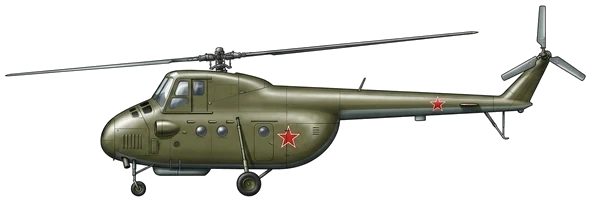
Description
Mikhail Mil's work on rotary-winged aircraft predates 1930, but the Mi-1, his first production helicopter, began in 1946, initially designated EG-1. Following Mil's appointment as head of OKB-4 design bureau in Tushino in 1947, development intensified, culminating in the GM-1 (Gyelikopter Mila). Soviet engineers incorporated a rotor hub with spaced vertical and horizontal hinges to enhance control efficiency. The prototype achieved its first free flight on September 20, 1948, piloted by Mikhail Baikalov. State trials occurred in 1949, and following successful testing despite two prototype crashes, the design was ordered into production as the Mi-1. Initial production was limited, with 15 units ordered on February 21, 1950, at factory No.3 in Moscow. Mass production increased after a demonstration to Joseph Stalin in 1951, with subsequent manufacturing taking place in Kazan in 1952–1953, and expanding to Orenburg from 1954 and Rostov from 1956. The Mi-1 underwent continuous improvements, enhancing reliability and extending the period between repairs, leading to variants with increased operational capabilities.
Design
The Mi-1 was designed with a rotor hub incorporating spaced vertical and horizontal hinges to enhance control efficiency. Early variants featured a cabin accommodating the pilot in front and two passengers behind. The Mi-1M introduced an enlarged cabin to seat three passengers on a bench with increased cabin height and width, horizontal bottom windows, larger rear side windows, and a less pointed fuselage nose. The Mi-1M could also be equipped with external side capsules for medical transport or mail. Improvements were made during production to increase reliability, coinciding with the evolution of rotor technology.
Armament
Primarily a light utility helicopter, there were trials of an armed anti-tank variant designated the Mi-1MU, conducted in 1961. Proposed armament included either four 3M11 Falanga (AT-2) or six 9M14 Malyutka (AT-3) anti-tank missiles. This marked the first Soviet attack helicopter trial, though the Mi-1MU did not enter production due to a small payload and the discontinuation of the base variant's production. Beyond this prototype, standard Mi-1 variants were not typically equipped with offensive weaponry. Its operational strengths included its utility as a light general-purpose helicopter, suitable for passenger transport, air ambulance duties, and agricultural tasks. Limitations included its piston engine technology and its relatively small payload capacity.
Operational History
The Mi-1 saw extensive operational use across numerous countries and air forces, serving in a variety of roles from utility transport to reconnaissance. Its deployment spanned diverse geographical theaters, including service with the Afghan Air Force, the People's Liberation Army Air Force, and various Warsaw Pact countries' air forces, such as Poland, Czechoslovakia, and East Germany.
Variants
Main Variants:
-
Mi-1: The initial production model was a three-seat light general-purpose helicopter, accommodating a pilot and two passengers, and powered by a 575 hp radial piston engine.
-
Mi-1T: An improved three-seat general-purpose transport helicopter, seating a pilot and two passengers, powered by an AI-26V radial piston engine, and featuring additional operational equipment, including a full radio and blind-flying instruments.
-
Mi-1A: A further refinement of the Mi-1, this three-seat general-purpose transport helicopter, introduced in 1957, offered increased reliability and provisions for a 160 L external fuel tank.
-
Mi-1M: This major variant, introduced in 1957, featured an enlarged cabin to accommodate a pilot and three passengers, along with a more powerful AI-26VF engine, a horizontal bottom windows line, and a less pointed nose.
-
SM-1 (SM-1/300): This was the Polish production version, manufactured under license at WSK PZL-Świdnik and powered by a LiT-3 radial piston engine.
Frequently Asked Questions
What type of aircraft is the Mi-1 Hare?
What is the maximum speed of the Mi-1 Hare?
What is the range of the Mi-1 Hare?
When did the Mi-1 Hare first fly?
How many Mi-1 Hare have been built?
Which countries operate the Mi-1 Hare?
How much does a Mi-1 Hare cost?
What is the service ceiling of the Mi-1 Hare?
- APR 72026 Updated Sources and cross-references refreshed