Bristol Sycamore
British light utility helicopter, developed in the late 1940s and in service from the 1950s to the early 1970s, used for search and rescue, casualty evacuation and transport. Key figures: top speed 212 km/h, range 531 km, max takeoff weight 2,540 kg, built 180.
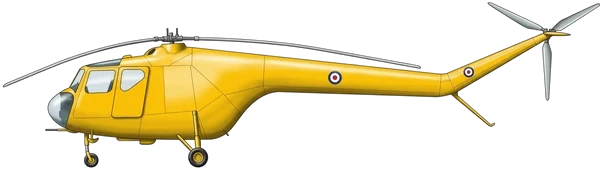
| Crew | 2 |
| Length | 18.6 m (61.1 ft) |
| Wingspan | 14.8 m (48.6 ft) |
| Height | 4.2 m (13.9 ft) |
| Wing area | 172 m² (1851.4 sqft) |
| Empty weight | 1,728 kg (3,810 lbs) |
| Max. takeoff weight | 2,540 kg (5,600 lbs) |
| Powerplant | 1 × radial piston engine Alvis Leonides 410 kW each |
| Maximum speed | 212 km/h (132 mph) |
| Operational range | 531 km (330 mi) |
| Endurance | 3 hours |
Description
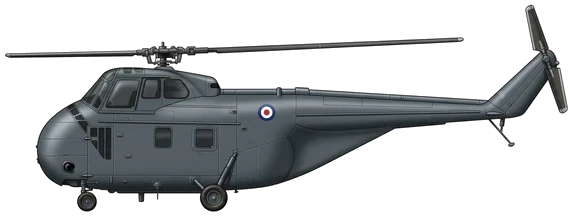
The Bristol Type 171 Sycamore is a single-engine piston helicopter built by the helicopter division of the Bristol Aeroplane Company in the United Kingdom. It was the first British helicopter to receive a certificate of airworthiness and the first British-designed helicopter to enter Royal Air Force (RAF) service, beginning with No. 275 Squadron in April 1953. In RAF service it was used mainly for search and rescue and casualty evacuation. Production ended in 1959 after 180 had been built.
Development
Bristol formed its helicopter division in 1944, staffed by engineers from the Airborne Forces Experimental Establishment at Beaulieu and headed by the founder of a rotorcraft company Bristol had acquired. Work on a four-seat civil and military helicopter began in June 1944, with emphasis on the endurance of mechanical components. The first prototype, VL958, flew in July 1947 with a 450 hp Pratt & Whitney Wasp Junior, since no suitable Bristol engine existed. The third prototype, completed in mid-1948 to Mk.2 standard, used the 550 hp Alvis Leonides, which became the standard powerplant. A certificate of airworthiness followed on 25 April 1949. A Mk.2 completed deck landing trials aboard HMS Triumph in 1951.
The Mk.3 had a wider five-seat fuselage and a shortened nose. Twenty-three were built, 15 of them for joint evaluation by the RAF, Army Air Corps and British European Airways. The main production Mk.4 moved the pilot to the right-hand seat and standardised a four-door layout. It entered RAF service as the HR.14. Civil aircraft were sold as the Bristol Type 171. By May 1958 more than 150 had been built, at a rate of four per month.
Design
Each airframe had fixed fittings for six roles: search and rescue, air ambulance, passenger transport, freight, aerial crane and dual instruction. The cabin seated four to five occupants, and a separate luggage compartment was fitted. The air ambulance model carried two stacked stretchers internally, using detachable Perspex side blisters for width, or three seated casualties. It also had a swivelling attendant's seat and a power outlet for electric blankets.
The three-bladed main rotor used interleaving steel plates at the hub, with tie-rods carrying centrifugal loads. An irreversible mechanism kept blade loads from reaching the control stick. Droop stops held the blades clear of the tailboom at low speed and retracted above 100 rpm. The Leonides was mounted below and behind the rotor on a flexible mounting, inside a fireproof enclosure with fire detection and extinguishing equipment. Fuel was varied automatically with collective pitch, and the pilot made fine power adjustments by twisting the lever. The HR.14 had a 14.8 m rotor, a gross weight of 2,540 kg, a maximum speed of 212 km/h and a range of 531 km.
Operational History
The Air-Sea Warfare Development Unit at RAF St Mawgan tested the type from 1952 to 1955. In 1953, No. 275 Squadron became the RAF's first helicopter search and rescue squadron in Britain. Nine squadrons eventually flew the type, and the Central Flying School used it for training. In June 1953 a Sycamore towing an RAF Ensign led 640 aircraft at the Coronation Review.
During the Malayan Emergency, Sycamores inserted Army patrols into the jungle. Rotor blade failures caused several crashes and led to a redesigned blade. The type also served in Cyprus, Aden and Brunei. The RAF retired it in December 1971 when critical parts reached their fatigue limits, although No. 32 Squadron flew two until August 1972.
Germany received 50 aircraft and Belgium three for the Congo. The Royal Australian Navy received ten, and the RAAF operated two at Woomera from 1951 to 1965. Civil operators used the type for M1 motorway construction support and Outback charter work.
Variants
- Mk 1: Prototype, two built.
- Mk 3: Five-seat model with a widened fuselage and shortened nose, 23 built including the Mk 3A.
- Mk 3A: Civil version with an additional freight hold, two built for British European Airways.
- HR.14: Military Mk.4, 85 built for RAF search and rescue.
- Mk.52: 50 built for the German Air Force and Navy.
Frequently Asked Questions
What type of aircraft is the Bristol Sycamore?
What is the maximum speed of the Bristol Sycamore?
What is the range of the Bristol Sycamore?
When did the Bristol Sycamore first fly?
How many Bristol Sycamore have been built?
Which countries operate the Bristol Sycamore?
- OCT 12026 Created Page created: Bristol Sycamore