ERJ 135
Brazilian regional jet, known for worldwide commercial and military usage since the late 20th century. Key figures: top speed 828 km/h, range 3,240 km, service ceiling 11,278 m, max takeoff weight 19,000 kg, unit price $10M, built 1,231. In service with 7 air forces as of 2026 — Brazil (14), Argentina (3), India (3) and 4 others.
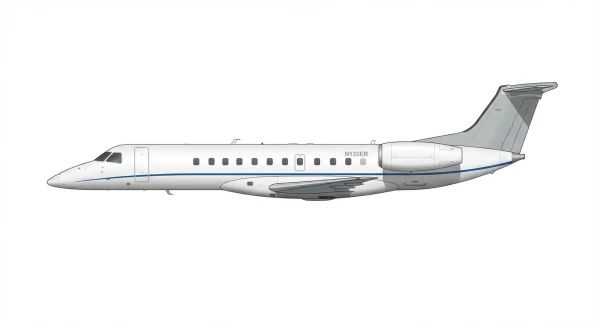
| Length | 26.3 m (86.4 ft) |
| Wingspan | 20.0 m (65.7 ft) |
| Height | 6.8 m (22.2 ft) |
| Empty weight | 11,501 kg (25,355 lbs) |
| Max. takeoff weight | 19,000 kg (41,888 lbs) |
| Powerplant | 2 × turbofans Rolls-Royce AE 3007A-1 3,538 kgf each |
| Maximum speed | 828 km/h (514 mph) |
| Operational range | 3,240 km (2,013 mi) |
| Service ceiling | 11,278 m (37,001 ft) |
| Takeoff distance | 1,640 m (5,381 ft) |




Description
The Embraer ERJ 135 is a twin-engine regional jet produced by the Brazilian manufacturer Embraer, seating 37 passengers in three-abreast configuration. It is a shortened derivative of the ERJ 145, 3.54 m (11 ft 7 in) shorter than the baseline aircraft while retaining 95% parts commonality with it. The type entered service in 1999 and has also been operated in VIP and government transport roles, with a business jet development marketed as the Legacy 600.
Development
The ERJ family originated with the EMB 145, launched at the 1989 Paris Air Show as a stretch of the EMB 120 Brasilia turboprop. Development was suspended for six months in November 1990 following Brazilian government spending cuts, and the configuration was revised repeatedly before settling on a swept wing and two rear-fuselage-mounted Rolls-Royce AE 3007 turbofans. The ERJ 145 first flew on 11 August 1995 and received FAA type certification on 10 December 1996. Embraer then shortened the airframe to create the ERJ 135 and the 44-seat ERJ 140, both introduced in 1999; all three share a single pilot type rating. Risk-sharing partners included Gamesa (wing), Enaer (tail), SONACA (centre and rear fuselage, doors, engine pylons, wing leading edges) and C&D Interiors (cabin). Production of the ERJ family ended in 2020 after 1,231 aircraft, including 41 assembled in China by the Harbin Embraer joint venture between 2004 and 2016.
Design
The airframe uses stretched, machined and chemically milled aluminium, with CFRP for moving surfaces, GFRP for fairings and sidewalls, kevlar leading edges and Nomex honeycomb sandwich floors. The semi-monocoque wing has two main spars and one auxiliary spar, double-slotted Fowler flaps and spoilers. Power comes from two Rolls-Royce AE 3007 turbofans with a 5:1 bypass ratio and dual FADEC control, with thrust ratings differentiated largely by FADEC software; the ERJ 135LR uses the AE 3007A1 flat-rated at 33.1 kN (7,440 lbf). Avionics are the Honeywell Primus 1000 suite, with a five-screen EFIS comprising two PFDs, two MFDs and an EICAS display, originally CRT with optional LCD replacement. Standard equipment includes Primus 1000 colour weather radar, dual air data computers, dual AHRS, TCAS and GPWS, with FMS/GPS optional and a HUD for Cat III landings offered from 2000.
Operational History
The ERJ 135 entered service in 1999 and was operated in the United States by American Eagle alongside ERJ 145 variants, the shared type rating allowing a single pilot pool across the mixed fleet. Belgium operated the type for VIP transport between 2001 and 2020, carrying the prime minister, cabinet members, members of the royal family and military officials. The Royal Thai Navy designates its ERJ 135LR as the B.LL.2. In May 2017, monthly lease rates for the ERJ 135 ranged from $33,000 to $43,000. Retired airliners have frequently been converted for charter and corporate use.
Variants
- ERJ 135ER: Baseline extended-range model, a simple shrink of the ERJ 145 seating 37 passengers.
- ERJ 135LR: Long-range version with increased fuel capacity and AE 3007A1 engines; launch customer was the Belgian Air Component.
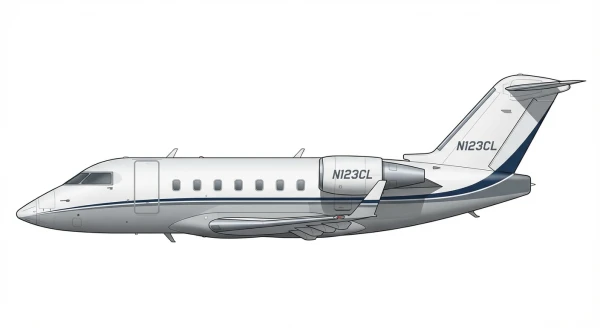
- Legacy 600 (EMB 135BJ): Business jet development of the ERJ 135 with winglets and additional fuel tanks.
- Legacy 650: Legacy 600 derivative with increased range.
- B.LL.2: Royal Thai Navy designation for the ERJ 135LR.
Frequently Asked Questions
What type of aircraft is the ERJ 135?
What is the maximum speed of the ERJ 135?
What is the range of the ERJ 135?
When did the ERJ 135 first fly?
How many ERJ 135 have been built?
Which countries operate the ERJ 135?
How much does a ERJ 135 cost?
What is the service ceiling of the ERJ 135?
- AUG 302026 Updated Description updated
- AUG 52026 Updated Powerplant updated in a site-wide editorial pass
- APR 82026 Updated Empty weight added
- APR 72026 Updated Picture credits updated in a site-wide editorial pass
- JAN 122026 Updated Range updated in a site-wide editorial pass