F-106 Delta Dart
American all-weather interceptor aircraft, developed in the mid-1950s, primarily used by the United States Air Force during the Cold War era. Key figures: top speed 2,454 km/h, range 4,345 km, service ceiling 17,000 m, max takeoff weight 15,653 kg, built 350.
| Crew | 1 |
| Length | 21.6 m (70.7 ft) |
| Wingspan | 11.7 m (38.3 ft) |
| Height | 6.2 m (20.3 ft) |
| Wing area | 61.5 m² (661.5 sqft) |
| Empty weight | 11,077 kg (24,421 lbs) |
| Max. takeoff weight | 15,653 kg (34,509 lbs) |
| Powerplant | 1 × Pratt & Whitney J75-P-17 109 kN each |
| Maximum speed | 2454 km/h (Mach 2.3) |
| Operational range | 4,345 km (2,700 mi) |
| Service ceiling | 17,000 m (55,774 ft) |
| Climb rate | 150.0 m/s (492.1 ft/s) |
- Nuclear AIR-2A Genie
- Gun Pod M61 Vulcan 20 mm cannon
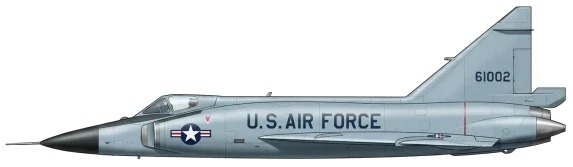
Description
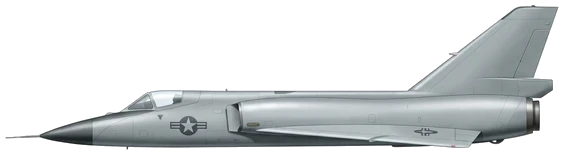
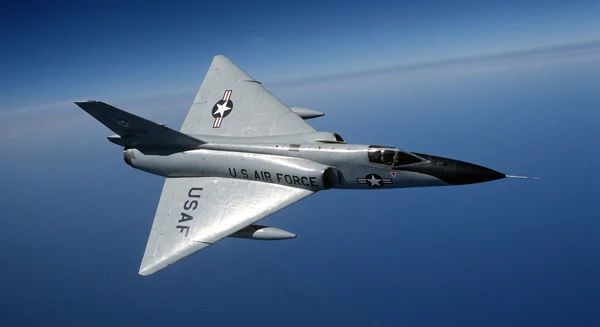
The Convair F-106 Delta Dart is an all-weather interceptor produced by Convair, a division of General Dynamics. Developed as part of the 1954 interceptor program, the aircraft was a development of the F-102 Delta Dagger and was designated the F-102B prior to its redesignation as the F-106. The first prototype conducted its maiden flight on 26 December 1956. Although the United States Air Force (USAF) originally planned to procure 1,000 aircraft, the order was reduced to 350 after flight testing demonstrated lower performance gains than anticipated.
Design
The F-106 is powered by a Pratt & Whitney J75 turbojet engine and features redesigned air inlets with variable-geometry ducts to support supersonic speeds. For flight control and interception, the aircraft uses the Hughes MA-1 integrated fire-control system, which can be linked to the Semi-Automatic Ground Environment (SAGE) network for ground-controlled steering. To maintain a clean aerodynamic profile for supersonic flight, the aircraft carries its munitions in an internal weapons bay. Pilot escape systems evolved through three configurations: the Weber interim seat, the Convair Supersonic Rotational B-seat, and the Weber Zero-Zero ROCAT seat, the latter of which was retrofitted after 1965. On 15 December 1959, an F-106 set a world speed record of 1,525.96 mph.
Armament
Armament typically consisted of four Hughes AIM-4 Falcon air-to-air missiles—using either infrared or semi-active radar homing—and one 1.5-kiloton warhead AIR-2 Genie unguided air-to-air rocket. Starting in 1972, Project Six Shooter modified the F-106A with a clear-view canopy, an optical gunsight, and an M61 Vulcan 20 mm rotary cannon with 650 rounds, which replaced the AIR-2 Genie in the weapons bay.
Operational History
Operational service began in June 1959. The F-106 served as the primary USAF all-weather interceptor throughout the Cold War, with deployments in the contiguous United States, Alaska, Iceland, Germany, and South Korea. It never engaged in combat and was never exported to foreign customers. The USAF began replacing the F-106 with the McDonnell Douglas F-15 Eagle in 1981, and the type was retired from Air National Guard service in 1988. Following retirement, 194 aircraft were converted into QF-106 target drones under the Pacer Six program. NASA operated six aircraft for experimental purposes, including lightning strike research and aerotow-launch vehicle feasibility studies, until 1998.
Variants
- F-106A: The primary single-seat production interceptor version equipped with the MA-1 fire control system.
- F-106B: A combat-capable two-seat trainer version with tandem seating and a modified fuselage for area ruling.
- NF-106B: Two F-106Bs modified for use as research and test aircraft by NASA.
- F-106C: An unbuilt advanced version intended to carry the AN/ASG-18 radar and AIM-47 missiles.
- QF-106A: Retired airframes converted into remotely piloted target drones for the Pacer Six program.
Frequently Asked Questions
What type of aircraft is the F-106 Delta Dart?
What is the maximum speed of the F-106 Delta Dart?
What is the range of the F-106 Delta Dart?
When did the F-106 Delta Dart first fly?
How many F-106 Delta Dart have been built?
Which countries operate the F-106 Delta Dart?
What is the service ceiling of the F-106 Delta Dart?
- AUG 122026 Updated Range corrected to the ferry range
- AUG 52026 Updated Thrust updated
- MAY 102026 Created Page created: F-106 Delta Dart