F-102 Delta Dagger
American interceptor, operational during the Cold War, primarily deployed for combat and reconnaissance missions in the United States. Key figures: top speed 1,328 km/h, range 2,170 km, service ceiling 16,276 m, max takeoff weight 14,288 kg, unit price $2.5M, built 1,000.
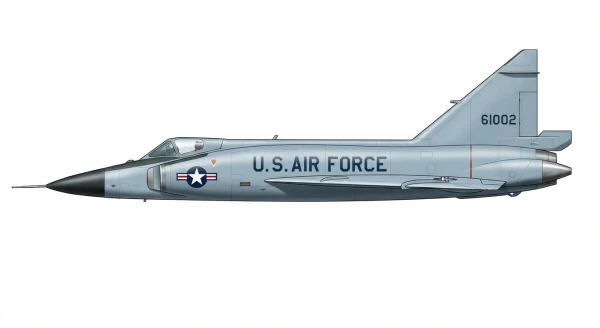
| Crew | 1 |
| Length | 20.8 m (68.3 ft) |
| Wingspan | 11.6 m (38.1 ft) |
| Height | 6.5 m (21.2 ft) |
| Wing area | 61.5 m² (662.2 sqft) |
| Empty weight | 8,777 kg (19,350 lbs) |
| Max. takeoff weight | 14,288 kg (31,500 lbs) |
| Powerplant | 1 × turbojet Pratt & Whitney J57-P-25 7,711 kgf each |
| Ejection seat | Weber We-Convair |
| Maximum speed | 1328 km/h (Mach 1.33) |
| Operational range | 2,170 km (1,348 mi) |
| Service ceiling | 16,276 m (53,399 ft) |
| Climb rate | 66.0 m/s (216.5 ft/s) |
Description
The Convair F-102 Delta Dagger is a single-seat interceptor designed and produced by the American manufacturer Convair. A member of the Century Series, it was the United States Air Force's (USAF) first supersonic interceptor and first operational delta-wing fighter. Entering service in June 1956, it was intended to intercept Soviet strategic bombers, chiefly the Tupolev Tu-95, and was the first USAF fighter designed without a gun.
Development
The programme originated in an 8 October 1948 USAF recommendation for an interceptor to enter service in 1954, the "1954 Ultimate Interceptor". In November 1949 the USAF decided the aircraft would be built around a fire-control system designed before the airframe. Hughes Aircraft was selected for the FCS on 2 October 1950. Convair, Republic and Lockheed were authorised to build mockups under Project MX-1554; Lockheed withdrew and Republic's Mach 3 ramjet design was disqualified as too risky, leaving Convair, which was authorised to proceed in November 1951. Delays to the Curtiss-Wright J67 engine and the MA-1 FCS led to an interim F-102A with the Pratt & Whitney J57 and a simplified FCS. The YF-102 first flew on 23 October 1953 from Edwards AFB with Richard L. Johnson at the controls, and was destroyed nine days later. The second aircraft flew on 11 January 1954 and was limited to Mach 0.98 with a 48,000 ft ceiling. Convair redesigned the fuselage per the area rule, lengthening it by 11 ft, and adopted a thinner, wider wing with conical droop leading edge. The YF-102A flew on 20 December 1954 and exceeded Mach 1 the following day, reaching Mach 1.22 and 53,000 ft. A production contract was signed in March 1954 and the first production F-102 flew on 24 June 1955. From the 26th aircraft a taller vertical tail with 40 percent greater area was fitted. A total of 1,000 were built, including 111 TF-102A two-seat trainers.
Design
The F-102A is a single-engine tailless delta powered by a Pratt & Whitney J57-P-25 afterburning turbojet rated at 17,000 lbf. Maximum speed is Mach 1.25, range 1,350 mi and service ceiling 53,400 ft; two 215 US gal drop tanks on underwing pylons reduced performance to subsonic. Production aircraft used the Hughes MC-3 fire-control system, later upgraded to the MG-10. Most airframes were retrofitted with a nose-mounted infrared search and track set, radar warning receivers, transponders and backup artificial horizons. The TF-102A used side-by-side seating and a widened nose, requiring canopy vortex generators to suppress buffet from Mach 0.72.
Armament
Weapons were carried in a three-segment internal bay under the fuselage. Initial armament was three pairs of GAR-1/2/3/4 (later AIM-4) Falcon missiles in infrared and semi-active radar homing variants. The two forward bay doors each carried tubes for 12 folding-fin aerial rockets, initially 2-inch and later 2.75-inch, for 24 total. Later aircraft could carry up to two AIM-26 nuclear Falcons in the centre bay, requiring redesigned doors without rocket tubes. An MB-1 Genie was test fired from a YF-102A in May 1956 but never adopted.
Operational History
The 327th Fighter-Interceptor Squadron at George AFB was the first unit equipped, moving to Thule AB, Greenland, in June 1958. USAFE and PACAF units operated the type, and the 57th FIS at Keflavik flew it until 1973 against Soviet reconnaissance and bomber patrols. Detachments deployed to Southeast Asia from 1962 against a perceived Il-28 threat, and F-102s escorted Arc Light B-52 strikes. The 509th FIS arrived at Da Nang on 4 August 1964 and flew ground-attack and night harassment sorties along the Ho Chi Minh Trail. Fourteen aircraft were lost in Vietnam, one to a MiG-21 firing an AA-2 Atoll; operations ended in 1968. Greece received 24 aircraft in 1969 for the 342nd Squadron at Tanagra, retiring them in 1977. Turkey received about 50 from 1968, flown by the 142nd and 182nd Filo and used during the 1974 invasion of Cyprus, retired in 1979. USAF withdrawal came in 1976; the last PQM-102B drone was expended in 1986.
Variants
- YF-102: Two non-area-ruled prototypes powered by the 14,500 lb J57-P-11.
- YF-102A: Four pre-production aircraft converted with area-ruled fuselage and 16,000 lb J57-P-23.
- F-102A: Production interceptor, eight pre-production non-area-ruled aircraft plus 879 area-ruled machines.
- TF-102A: Two-seat side-by-side combat-capable trainer, 111 built.
- PQM-102B: Target drone conversion flyable remotely or from the cockpit, 146 converted.
Frequently Asked Questions
What type of aircraft is the F-102 Delta Dagger?
What is the maximum speed of the F-102 Delta Dagger?
What is the range of the F-102 Delta Dagger?
When did the F-102 Delta Dagger first fly?
How many F-102 Delta Dagger have been built?
How much does a F-102 Delta Dagger cost?
What is the service ceiling of the F-102 Delta Dagger?
- AUG 302026 Updated Description updated
- AUG 52026 Updated Thrust updated
- APR 72026 Updated Sources and cross-references refreshed
- JAN 122026 Updated Range updated in a site-wide editorial pass