Tu-128 Fiddler
Soviet interceptor, operational from 1961-1992, notably deployed for long-range patrols and defense against strategic bombers. Key figures: top speed 1,665 km/h, range 2,565 km, service ceiling 15,600 m, max takeoff weight 43,000 kg, unit price $7M, built 198.
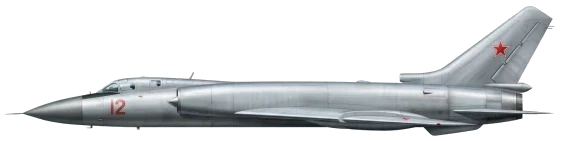
| Crew | 2 (pilot, WSO) |
| Length | 27.2 m (89.2 ft) |
| Wingspan | 18.1 m (59.4 ft) |
| Height | 7 m (23.0 ft) |
| Wing area | 80 m² (861.1 sqft) |
| Empty weight | 24,500 kg (54,013 lbs) |
| Max. takeoff weight | 43,000 kg (94,799 lbs) |
| Powerplant | 2 × turbojets AL-7F-2 10,105 kgf each |
| Ejection seat | Tupolev KT-1 |
| Maximum speed | 1665 km/h (Mach 1.6) |
| Operational range | 2,565 km (1,594 mi) |
| Service ceiling | 15,600 m (51,181 ft) |
| Climb rate | 125.0 m/s (410.1 ft/s) |
- Air-to-Air Medium-Range Bisnovat R-4 (AA-5 Ash)
Description
The Tupolev Tu-128, NATO reporting name Fiddler, was a Soviet long-range interceptor introduced in the 1960s and the largest and heaviest fighter ever to enter serial production. It was designed for one task: to patrol the vast, thinly defended stretches of Soviet airspace — above all the long northern border — from a small number of widely separated airbases, and to destroy NATO bombers before they reached anything worth defending. It was known in the West as the Tu-28, the designation the Soviet military itself used until 1963, when it was changed to Tu-128 to match the Tupolev bureau's own numbering. 198 were built and the type served until 1990.
Development
In the 1950s the Soviet Union faced the problem of defending against nuclear-armed American bombers across a five-thousand-kilometre air front. Interceptors of the day such as the Yak-28P could cover a radius of only a few hundred kilometres from northern bases like Talagi and Savatiya, and the new surface-to-air missiles reached less far still. Providing dense coverage everywhere was economically impossible, so the PVO chose looser coverage of the entire territory instead, and in 1955 issued a requirement for a large area-defence interceptor: supersonic, with enormous fuel tanks for both long patrol endurance and long range, a capable radar, and the most powerful air-to-air missiles that could be built. The first attempt, the 30-tonne Lavochkin La-250, failed and proved to be the last aircraft the Lavochkin bureau designed.
Iosif Nezval of the Tupolev bureau took over the task, beginning work in 1958 from the single prototype of the unsuccessful Tu-98 supersonic bomber. The interceptor appeared publicly at the 1961 Tushino parade, where Western observers, not realising that the bulge under the fuselage carried test instrumentation, took it for a large ventral radar and concluded the aircraft had a mixed interceptor and airborne early warning role. Production aircraft had no such bulge. Production ended in 1970 after 198 aircraft. A series of proposed developments — the Tu-28A, Tu-28-80, Tu-28-100, Tu-138 and the variable-geometry Tu-148 — were all abandoned.
Design
The Tu-128 had a broad low- to mid-mounted swept wing carrying the main landing gear in wing-mounted pods, slab tailplanes, and two Lyulka AL-7F-2 afterburning turbojets of 10,100 kgf each buried in the fuselage. The crew of two, pilot and navigator, sat in tandem. A large nose radome housed the RP-S Smerch radar, with a detection range of about 50 km and a lock-on range of about 40 km.
At a maximum weight of 43 tonnes it was the heaviest fighter ever to serve. Wing loading was correspondingly high, the avionics were unsophisticated but reliable, and visibility from the cockpit was poor. None of that was considered a defect: the aircraft was never meant to manoeuvre against fighters, only to reach a B-52 far from anywhere and shoot it down, and it was flown to its target under ground-controlled interception from the radar chain.
Armament
Armament was four Bisnovat R-4 air-to-air missiles, known as the K-80 during development and as the AA-5 Ash in the West, carried on four underwing pylons; there was no internal weapons bay and no gun. A standard load mixed guidance types, with two semi-active radar homing R-4Rs on the outer pylons and two infrared-homing R-4Ts on the inner ones, so that a single pass offered two independent ways of hitting the target.
Operational History
The Tu-128 entered service with the Soviet Air Defence Forces and was never exported. Its only publicly reported combat successes were against NATO reconnaissance balloons. It remained in service until 1990, and through the 1980s the regiments flying it converted to the MiG-31, which brought far more capable sensors and weapons to the same long-range interception mission.
Variants
- Tu-28 prototype (Fiddler-A) — one development aircraft. In Western usage Fiddler-A covered the aircraft with twin ventral fins, the prototype and perhaps two early production machines.
- Tu-128 (Fiddler-B) — the main version, operational from 1964 or 1966 depending on the source. The complete weapon system of aircraft, radar and missiles was designated Tu-128S-4.
- Tu-128UT — the training version, with an additional cockpit forward of the normal one in place of the radar. Ten were built and four converted from interceptors.
- Tu-128M — a 1979 modernisation of almost the whole fleet for better low-altitude interception, with the RP-SM Smerch-M radar and R-4RM and R-4TM missiles, the complete system designated Tu-128S-4M. Engines and airframe were unchanged.
Frequently Asked Questions
What type of aircraft is the Tu-128 Fiddler?
What is the maximum speed of the Tu-128 Fiddler?
What is the range of the Tu-128 Fiddler?
When did the Tu-128 Fiddler first fly?
How many Tu-128 Fiddler have been built?
Which countries operate the Tu-128 Fiddler?
How much does a Tu-128 Fiddler cost?
What is the service ceiling of the Tu-128 Fiddler?
- AUG 132026 Updated Service entry corrected to the year the interceptor was accepted
- AUG 52026 Updated Description, maximum weight and 3 more fields updated
- JUL 232026 Updated Sources and cross-references refreshed
- APR 72026 Updated Sources and cross-references refreshed
- FEB 72026 Updated Range added
- JAN 242026 Updated Thrust updated