Il-80
Soviet airborne command post, designed during the Cold War, most notably deployed in strategic air command scenarios. Key figures: top speed 850 km/h, range 4,000 km, service ceiling 11,000 m, max takeoff weight 208,000 kg, built 4. In service with 1 air force as of 2026 — Russia (3).
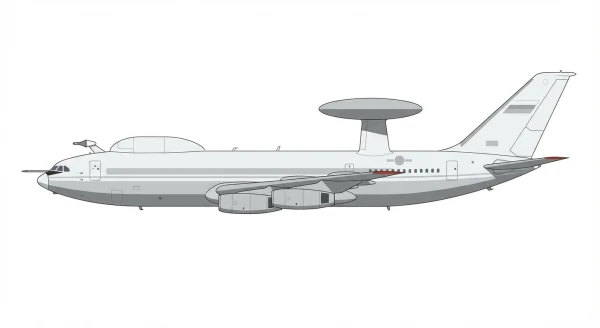
| Length | 59.5 m (195.3 ft) |
| Wingspan | 48.1 m (157.7 ft) |
| Empty weight | 120,000 kg (264,554 lbs) |
| Max. takeoff weight | 208,000 kg (458,561 lbs) |
| Powerplant | 4 × turbofans Kuznetsov NK-86 13,000 kgf each |
| Maximum speed | 850 km/h (528 mph) |
| Operational range | 4,000 km (2,485 mi) |
| Service ceiling | 11,000 m (36,089 ft) |

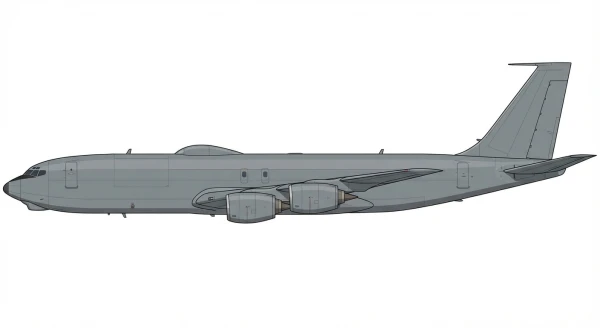
Description
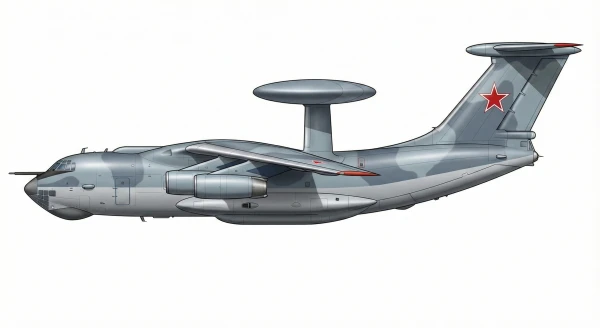
The Ilyushin Il-80 (NATO reporting name: Maxdome), also designated Il-86VKP, is a Soviet and Russian airborne command post converted from the Ilyushin Il-86 wide-body airliner. It was built to carry the Russian national leadership, including the President, during a nuclear conflict, filling a role equivalent to that of the Boeing E-4B. Deliveries began in 1987, and four airframes were produced. The Russian service name for the type is Aimak (or Eimak), from the Mongolian for "clan"; some sources list its NATO name as Camber, as with the Il-86 airliner.
Development
All four aircraft were converted from retired Aeroflot Il-86s. The first flight is believed to have taken place in the summer of 1985 from Pridacha Airport in Voronezh, with the first post-modification flight on 5 March 1987 and deliveries beginning later that year. The four conversions were registered CCCP-86146 through CCCP-86149 and were first photographed by Western observers in 1992. A replacement airborne command post based on the Ilyushin Il-96-400M is planned once the current fleet reaches the end of its service life.
Design
The Il-80 has no external windows apart from those in the cockpit, a measure intended to shield the interior from nuclear blast effects and nuclear electromagnetic pulse. Of the standard Il-86 door arrangement, only the forward upper-deck door on the left and the aft door on the right are retained, and a single airstair door replaces the original three. A baffle covers the aft cockpit windows, possibly to block EMP or RF pulses. Two electrical generator pods are mounted inboard of the engine nacelles, each about 9.5 m (32 ft) long and 1.3 m (4 ft) in diameter, and each incorporating landing lights. A dorsal canoe fairing houses satellite communications equipment, and a trailing wire antenna in the lower aft fuselage provides very low frequency (VLF) transmission and reception, likely for communication with ballistic missile submarines.
Operational History
All four aircraft were delivered to the 8th Special Purposes Aviation Division at Chkalovsky Airbase, 30 km (19 mi) northeast of Moscow. As of 2011, three remained in service, carrying civil registrations RA-86147, RA-86148 and RA-86149 and painted in Aeroflot livery; the first aircraft, RA-86146, has been photographed without engines and is apparently withdrawn from use. The type is operated by the Russian Aerospace Forces, 1338 test centre, at Chkalovsky. The aircraft are rarely seen flying, though at least one has appeared at an air show. In December 2020, Russian media reported the theft of radio communication equipment from one of the Il-80s while it was undergoing maintenance.
Frequently Asked Questions
What type of aircraft is the Il-80?
What is the maximum speed of the Il-80?
What is the range of the Il-80?
When did the Il-80 first fly?
How many Il-80 have been built?
Which countries operate the Il-80?
What is the service ceiling of the Il-80?
- AUG 302026 Updated Description updated
- AUG 52026 Updated Powerplant updated in a site-wide editorial pass
- APR 82026 Updated Empty weight added
- APR 72026 Updated Picture credits updated in a site-wide editorial pass
- FEB 72026 Updated Top speed added; range added