Il-86 Camber
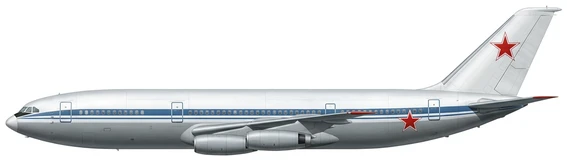
Soviet short- to medium-range wide-body jet airliner, introduced in the late 1980s for high-capacity passenger transport and later adapted for military command post duties. Key figures: top speed 950 km/h, range 5,800 km, built 106.
| Crew | 3 |
| Length | 59.9 m (196.7 ft) |
| Wingspan | 48.1 m (157.7 ft) |
| Powerplant | 4 × turbofans Kuznetsov NK-86 13,000 kgf each |
| Maximum speed | 950 km/h (590 mph) |
| Operational range | 5,800 km (3,604 mi) |
Description
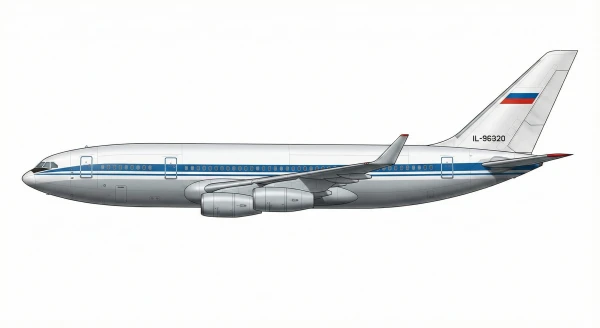
The Ilyushin Il-86 (NATO reporting name: Camber) is a short- to medium-range wide-body jet airliner designed by the Ilyushin design bureau and manufactured in the Soviet Union. As the USSR's first wide-body aircraft, it entered commercial service with Aeroflot in December 1980. The type is known for its lower-deck "luggage at hand" baggage system and integral airstairs, designed to operate from existing Soviet airports without ground infrastructure upgrades.
Development
In October 1967, the Soviet government approved a specification for a 350-seat aerobus capable of operating from 2,600-meter runways. Development was assigned to the Ilyushin design bureau in September 1969 under head designer Genrikh Novozhilov. Prototype flight testing began on December 22, 1976. State acceptance trials concluded on December 24, 1980, missing the planned service deadline for the 1980 Moscow Olympics. Serial production occurred between 1976 and 1991 at Minaviaprom Factory 64 in Voronezh, with Poland's WSK-Mielec producing tail units, control surfaces, and engine pylons. Production totaled 106 airframes, including one static test article and three exported units.
Design
The Il-86 is an all-metal low-wing monoplane featuring a three-spar swept wing with full-span six-segment leading-edge slats and two-segment double-slotted flaps. Its circular-section fuselage uses a two-deck layout, housing a main passenger deck and a lower deck with three entry vestibules, luggage compartments, and a galley. Power is provided by four Kuznetsov NK-86 low-bypass turbofan engines suspended on underwing pylons and fitted with cascade thrust reversers. Flight controls are hydraulically driven via four independent hydraulic systems and an SAU-1T-2 automatic flight control system. Avionics center on the Pizhma-1 navigational system, complemented by a weather radar, Warsaw Pact identification aids, and an electromagnetic pulse deicing system.
Operational History
Aeroflot initiated Il-86 passenger operations on December 26, 1980, serving domestic routes before extending to international flights across Europe, Cuba, and South America. Civil exports were restricted to three aircraft delivered to China Xinjiang Airlines in 1990. The aircraft accumulated no passenger fatalities from accidents throughout its commercial service life. Noise regulations led to European Union and United States operational bans in 2002, and Aeroflot retired its fleet in November 2006. Four specialized military command post airframes were delivered to the 8th Special Purposes Aviation Division, with three remaining in active service with the Russian Air Force by late 2020.
Variants
-
Il-86: Standard production wide-body airliner accommodating up to 350 passengers.
-
Il-86D: Proposed long-range variant with an extended wingspan and D-18 engines that served as the basis for the Il-96.
-
Il-86V: Proposed high-capacity 450-seat variant test-flown in 1982, later used for projected re-engined concepts.
-
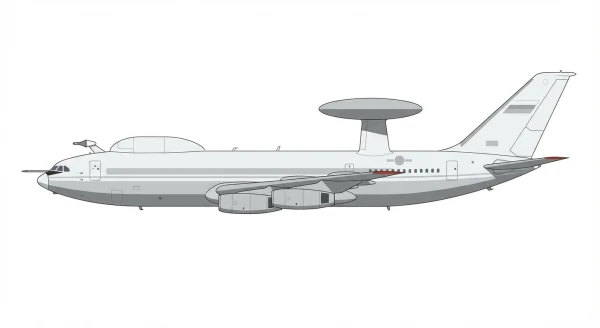
Il-86VKP: Military airborne command post variant fitted with specialized avionics and assigned the NATO reporting name Maxdome.
Frequently Asked Questions
What type of aircraft is the Il-86 Camber?
What is the maximum speed of the Il-86 Camber?
What is the range of the Il-86 Camber?
When did the Il-86 Camber first fly?
How many Il-86 Camber have been built?
- AUG 62026 Created Page created: Il-86 Camber