KJ-500
Chinese third-generation airborne early warning and control aircraft, developed in the late 2000s, deployed by the Chinese military for aerial surveillance and command. Key figures: top speed 550 km/h, range 5,700 km, max takeoff weight 77,000 kg, built 60. In service with 1 air force as of 2026 — China (60).
| Max. takeoff weight | 77,000 kg (169,756 lbs) |
| Maximum speed | 550 km/h (342 mph) |
| Operational range | 5,700 km (3,542 mi) |
| Endurance | 12 hours |

Description
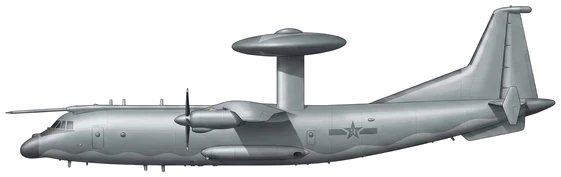
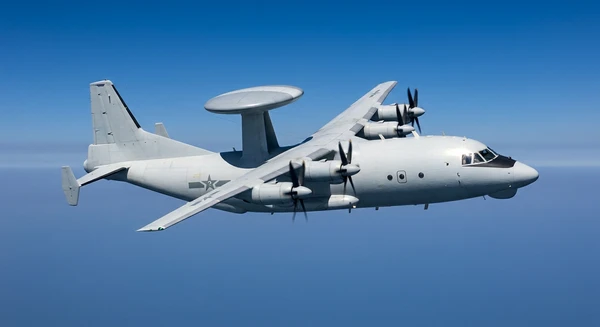
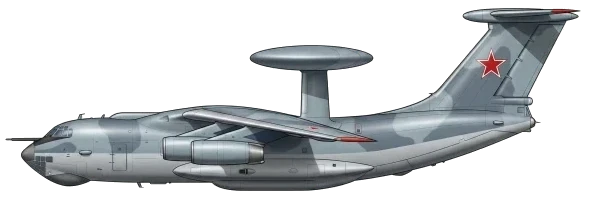
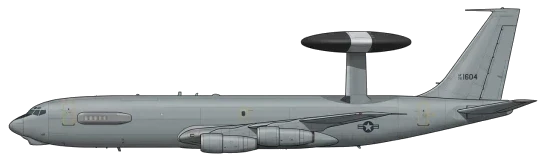
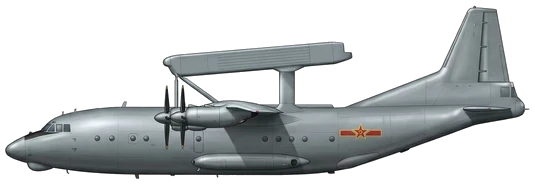
The Shaanxi KJ-500 is a third-generation airborne early warning and control (AEW&C) aircraft built by the Shaanxi Aircraft Corporation for the Chinese People's Liberation Army Air Force (PLAAF). Based on the Y-9 airframe, development began in the late 2000s to address capabilities of modern fighter aircraft and low-altitude cruise missiles. The platform was designed to meet operational requirements for networked, multi-functional, integrated, and lightweight systems. The KJ-500 reached full operational capability in 2018, at which point production of older Chinese AEW&C platforms reportedly ceased. The PLAAF operates 40 KJ-500 aircraft, while the People's Liberation Army Naval Air Force operates more than 20 units.
Design
The aircraft is configured with a fixed dorsal radome containing three active electronically scanned array (AESA) radar arrays that provide 360-degree coverage. This sensor suite provides a detection range of 470 km against fighter-sized targets. Performance specifications include a maximum takeoff weight of 77 tons, a maximum speed of 550 km/h, a maximum range of 5,700 km, and a maximum endurance of 12 hours.
Operational History
In March 2022, U.S. Pacific Air Forces command identified the KJ-500 as an enabler for long-range Chinese air-to-air missiles. Pakistan officially announced plans to acquire four KJ-500 aircraft for its air force on June 6, 2025.
Variants
-
KJ-500: The base variant of the AEW&C aircraft.
-
KJ-500H: A variant developed for the People's Liberation Army Naval Air Force.
-
KJ-500A: A variant featuring an aerial refueling probe and sensor enhancements that entered service in late 2020.
Identified in 122 sorties in the official China-Taiwan Tensions activity reports between 2020 and 2024 — a floor, not a census: only sorties the source identified by type are counted, and how much it disclosed varies by year.
Frequently Asked Questions
What type of aircraft is the KJ-500?
What is the maximum speed of the KJ-500?
What is the range of the KJ-500?
How many KJ-500 have been built?
Which countries operate the KJ-500?
- AUG 142026 Updated Air force inventory entries linked to this aircraft page
- JUN 302026 Created Page created: KJ-500; then built added; manufacturer updated