Cirrus SR-20
American civil utility aircraft, renowned from the late 20th century, extensively deployed in private aviation and flight training. Key figures: top speed 287 km/h, range 1,450 km, service ceiling 5,334 m, max takeoff weight 1,383 kg, unit price $0.63M, built 1,459. In service with 5 air forces as of 2026 — Saudi Arabia (25), United States (24), France (16) and 2 others.
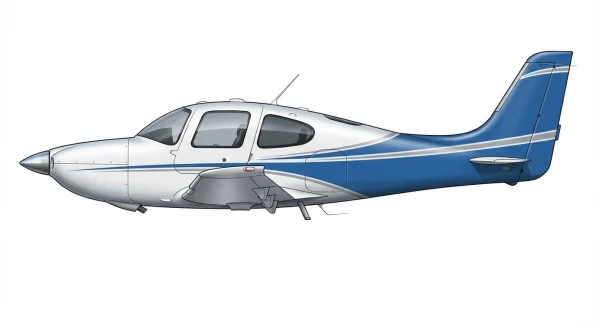
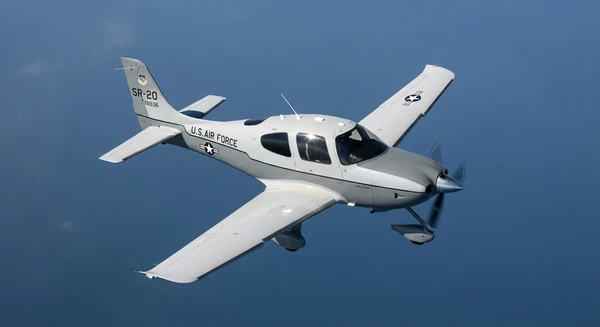
| Length | 8 m (26.2 ft) |
| Wingspan | 11.7 m (38.4 ft) |
| Height | 2.5 m (8.1 ft) |
| Wing area | 13.5 m² (144.9 sqft) |
| Empty weight | 943 kg (2,079 lbs) |
| Max. takeoff weight | 1,383 kg (3,049 lbs) |
| Powerplant | 1 × pistons engine Continental IO-360-ES 149 kW each |
| Maximum speed | 287 km/h (178 mph) |
| Operational range | 1,450 km (901 mi) |
| Endurance | 4 hours |
| Service ceiling | 5,334 m (17,500 ft) |
| Climb rate | 4.2 m/s (13.8 ft/s) |


Recent Events — Cirrus SR-20
2 events →-
AUG 172026
 France
Forced landing on a departmental road near Salon-de-Provence during a training flight; the aircraft caught fire, both occupants slightly injured.
Crash
France
Forced landing on a departmental road near Salon-de-Provence during a training flight; the aircraft caught fire, both occupants slightly injured.
Crash
-
APR 102026
France
Crashed during low-level training near Montagne de Lure, southern France; both crew survived with injuries.
Crash
Description
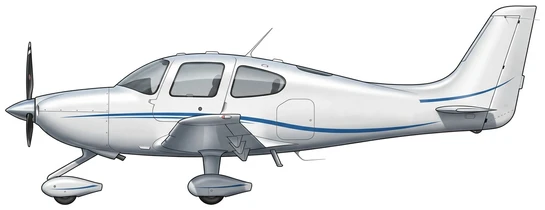
The Cirrus SR20 is an American four- or five-seat composite monoplane built by Cirrus Aircraft of Duluth, Minnesota. Designed as a general aviation and trainer aircraft, it earned Federal Aviation Administration certification in October 1998 and entered service in July 1999. The aircraft is known for being the first mass-manufactured light aircraft with all-composite construction, flat-panel glass avionics, and a deployable aircraft parachute system for emergency recovery.
Development
Cirrus unveiled a mock-up of the SR20 in 1994, and the prototype made its first flight on 21 March 1995. The aircraft achieved FAA Part 23 certification on 23 October 1998, followed by European Aviation Safety Agency certification on 1 June 2004. Deliveries began in July 1999, with over 1,000 SR20s sold. The design evolved through sequential production generations, including the G2 in 2004, G3 in 2008, G6 in 2017, G7 in 2024, and G7+ in 2025. The platform also served as the basis for the Cirrus SR22, introduced in 2001.
Design
The SR20 features composite construction and utilizes side-stick flight controls combining features of a traditional yoke. Base models are powered by a 200-horsepower Continental IO-360-ES six-cylinder engine, while later models use a 215-horsepower Lycoming IO-390 engine. Avionics transitioned from analog gauges with a multifunction display to standard glass cockpits, including the Garmin Cirrus Perspective suite with dual flight displays, WAAS GPS navigation, and Mode S transponders. Emergency equipment includes airbag seatbelts and the Cirrus Airframe Parachute System (CAPS), a ballistic parachute that lowers the entire aircraft to the ground in the event of control loss or structural failure.
Operational History
The SR20 is operated by civil flight schools, private owners, and military entities. In 2011, the United States Air Force Academy selected the aircraft for cadet flight instruction under the military designation T-53A, purchasing 25 units to replace leased T-52A trainers. The French Air and Space Force and French Navy Academies operate a fleet of 16 SR20s managed by Cassidian. Following improved training regarding parachute deployment, the aircraft's fatal accident rate decreased from 1.6 per 100,000 flight hours in early evaluations to 0.42 per 100,000 flight hours by 2014. By September 2018, the airframe parachute system had been deployed 79 times, resulting in 163 survivors.
Variants
-
SR20: Original production version introduced in 1999, featuring composite construction and traditional analog instruments or early glass cockpit options.
-
SRV: VFR-only flight training variant introduced in 2004 that omitted standard hardware such as wheel fairings before production ceased for 2010.
-
T-53A: Military training variant adopted by the United States Air Force Academy in 2011, equipped with Cirrus Perspective avionics and airbag seat belts.
-
TRAC20: Instruction-oriented variant introduced in 2019 featuring a simplified durable interior, rear-seat radio switches, and simulated retractable landing gear controls.
-
SR20 G7: Modernized variant introduced in January 2024 featuring a touchscreen Perspective Touch+ flight deck, automatic fuel selection system, and side-yoke stick shakers for stall warnings.
Frequently Asked Questions
What type of aircraft is the Cirrus SR-20?
What is the maximum speed of the Cirrus SR-20?
What is the range of the Cirrus SR-20?
When did the Cirrus SR-20 first fly?
How many Cirrus SR-20 have been built?
Which countries operate the Cirrus SR-20?
How much does a Cirrus SR-20 cost?
What is the service ceiling of the Cirrus SR-20?
- AUG 62026 Updated Description updated
- JUL 272026 Updated Name updated
- APR 72026 Updated Picture credits updated in a site-wide editorial pass
- FEB 72026 Updated Top speed added; ceiling added; endurance added
- JAN 122026 Updated Range added; price added