MiG-9 Fargo
Soviet first-generation jet fighter, introduced in the post-World War II era, primarily operated for air defense and pilot training roles. Key figures: top speed 910 km/h, range 800 km, service ceiling 13,000 m, max takeoff weight 4,860 kg, built 610.
| Crew | 1 |
| Length | 9.8 m (32.0 ft) |
| Wingspan | 10 m (32.8 ft) |
| Height | 3.2 m (10.6 ft) |
| Wing area | 18.2 m² (195.9 sqft) |
| Empty weight | 3,283 kg (7,238 lbs) |
| Max. takeoff weight | 4,860 kg (10,714 lbs) |
| Powerplant | 2 × turbojets Tumansky RD-20 800 kgf each |
| Maximum speed | 910 km/h (565 mph) |
| Operational range | 800 km (497 mi) |
| Service ceiling | 13,000 m (42,651 ft) |
| Climb rate | 22.0 m/s (72.2 ft/s) |
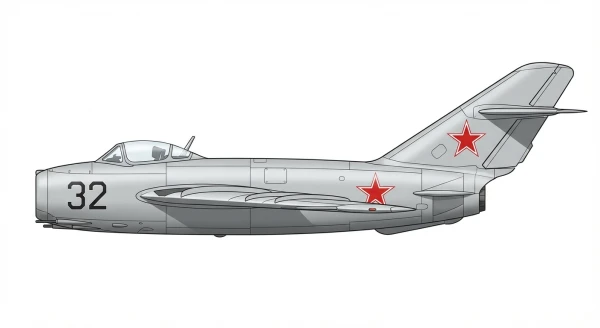
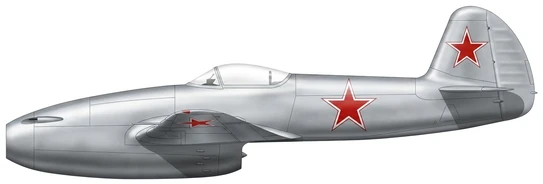
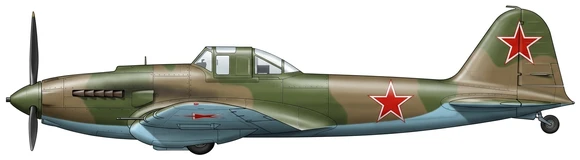
Description
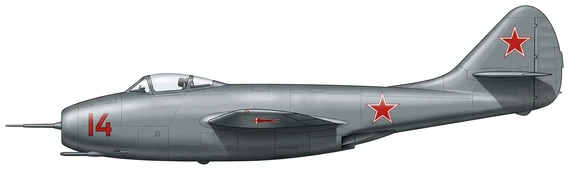
The Mikoyan-Gurevich MiG-9 (NATO reporting name: Fargo) was a first-generation single-seat turbojet fighter aircraft developed by the Soviet Union. Manufactured by Mikoyan-Gurevich, the aircraft entered service with the Soviet Air Forces in 1948. Powered by reverse-engineered German jet engines, it was the first operational Soviet turbojet fighter, though it was characterized by engine flameout issues caused by gun gas ingestion during high-altitude cannon fire.
Development
Development began in February 1945 when the Soviet government ordered a single-seat jet fighter powered by two BMW 003 engines. Designated I-300 by the design bureau, the aircraft made its first flight on 24 April 1946. Early flight testing was marked by stability problems, tail structural failures, and a fatal crash of the first prototype. Despite these issues and incomplete state trials, initial production was ordered at Factory No. 1 in late 1946. A total of 610 aircraft were constructed before production ceased in 1948 to transition manufacturing to the MiG-15.
Design
The MiG-9 featured an all-metal pod-and-boom layout with unswept mid-mounted wings, slotted flaps, and a tricycle landing gear arrangement. Propulsion was provided by two RD-20 axial-flow turbojets—Soviet-built versions of the BMW 003—mounted in the lower fuselage with exhausts exiting under the tail unit. Steel laminate heatshields protected the underside of the rear fuselage, and internal bag-type tanks provided a total fuel capacity of 1,625 liters. Production aircraft featured unpressurized cockpits lacking pilot armor or ejection seats, though special test variants later incorporated pressurized cockpits or radar guidance systems.
Armament
Standard armament comprised one 37 mm Nudelman N-37 autocannon with 40 rounds, mounted centrally in the nose air intake divider. Two 23 mm Nudelman-Suranov NS-23 autocannons with 80 rounds each were installed along the lower lip of the air intake. Attempts to resolve engine flameouts caused by cannon gas ingestion included testing muzzle vanes, barrel extensions, and offset cannon placements.
Operational History
The MiG-9 entered service in 1948, equipping Soviet Air Forces fighter regiments deployed within the Soviet Union, Kaliningrad, and East Germany. In late 1950, 372 aircraft were transferred to China to defend cities against Nationalist air attacks and train People's Liberation Army Air Force pilots. Chinese commanders opted not to deploy the aircraft to the Korean War, choosing instead to transition pilots directly to the MiG-15.
Variants
-
MiG-9 (I-301): Main single-seat production fighter variant powered by RD-20 or RD-21 turbojet engines.
-
MiG-9UTI (I-301T): Two-seat training variant featuring tandem cockpits and ejection seats, constructed in two prototype examples.
-
MiG-9M (I-308): Experimental prototype featuring a pressurized cockpit, repositioned cannon, and RD-21 engines.
-
MiG-9L: Avionics testbed modified with nose and tail radars to evaluate guidance systems for the KS-1 Komet anti-shipping cruise missile.
-
I-300: Initial prototype design featuring a pod-and-boom airframe layout, with three examples produced.
Frequently Asked Questions
What type of aircraft is the MiG-9 Fargo?
What is the maximum speed of the MiG-9 Fargo?
What is the range of the MiG-9 Fargo?
When did the MiG-9 Fargo first fly?
How many MiG-9 Fargo have been built?
What is the service ceiling of the MiG-9 Fargo?
- AUG 62026 Created Page created: MiG-9 Fargo