Yak-25 Flashlight
Soviet twin-engine swept-wing jet interceptor and reconnaissance aircraft, introduced in the 1950s and operated through the late 1970s. Key figures: top speed 1,090 km/h, range 2,700 km, service ceiling 12,000 m, max takeoff weight 9,220 kg, built 638.
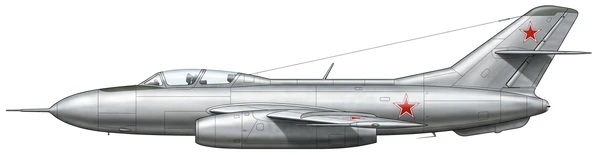
| Crew | 2 (pilot, radar intercept operator) |
| Length | 15.7 m (51.4 ft) |
| Wingspan | 11.0 m (36.0 ft) |
| Wing area | 29.0 m² (311.6 sqft) |
| Empty weight | 6,210 kg (13,691 lbs) |
| Max. takeoff weight | 9,220 kg (20,327 lbs) |
| Powerplant | 2 × turbojets Mikulin AM-5 2,000 kgf each |
| Maximum speed | 1090 km/h (Mach 1.09) |
| Operational range | 2,700 km (1,678 mi) |
| Endurance | 4 hours |
| Service ceiling | 12,000 m (39,370 ft) |
| Climb rate | 44.0 m/s (144.4 ft/s) |
- Air-to-Air Short-Range RS-1U
- Air-to-Air Medium-Range K-8
- Rocket Pod ARS-212
- Rocket Pod ARS-57 Skvorets
- Rocket Pod TRS-190
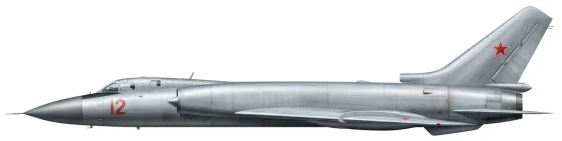
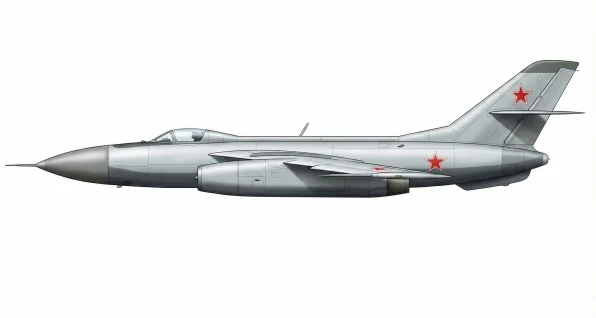
Description
The Yakovlev Yak-25 (NATO reporting names Flashlight and Mandrake) is a Soviet twin-engine, swept-wing interceptor and reconnaissance aircraft developed by the Yakovlev design bureau. Built to fulfill a Soviet requirement for a long-range patrol interceptor to protect northern and eastern USSR territory, the type entered service with Soviet air defense forces in 1955. It is known as the Soviet Union's primary all-weather territorial defense interceptor of the mid-1950s and for its high-altitude reconnaissance derivatives.
Development
Development began following an official Soviet specification issued on 6 August 1951 for a two-seat, twin-engine patrol interceptor and related reconnaissance aircraft. Designated Yak-120 by the design bureau, the first prototype made its maiden flight on 19 June 1952. State acceptance trials led to production approval in September 1953 under the service designation Yak-25, with manufacturing assigned to Factory No. 292 in Saratov. Serial production yielded 67 baseline Yak-25s and 406 modified Yak-25M variants, alongside 155 high-altitude Yak-25RV reconnaissance aircraft.
Design
The aircraft features thin mid-set wings swept back at 45 degrees, a swept cruciform tail with a ventral fin, and a bicycle landing gear configuration supported by wingtip outrigger struts. Power is provided by two Mikulin AM-5 (later RD-5A) turbojets mounted in nacelles beneath the wings, producing 19.6 kN of thrust each. The crew of two—a pilot and a radar intercept operator—sit in tandem under an aft-sliding canopy equipped with dual controls. Avionics include an RP-6 Sokol or RP-1D Izumrud radar in a glass-fiber nose radome, an AP-28 autopilot, an SRO-1 IFF transponder, an RSIU-3 VHF radio, and hot-air and electrical de-icing systems for all-weather operation.
Armament
Fixed armament consists of two 37 mm Nudelman NL-37L cannons installed low on the sides of the center fuselage, carried with 50 rounds per gun. Hardpoints beneath the wings provide provision for two 212 mm ARS-212 unguided rockets.
Operational History
The Yak-25 began equipping Soviet Anti-Air Defense (PVO) units in 1955, carrying out long-range patrols over remote northern and eastern regions. Ground operations required clean airfields because the low-slung engine nacelles were prone to foreign object ingestion, though twin-engine redundancy minimized fatal accidents from engine failures. The aircraft's 12,000-meter service ceiling proved insufficient to intercept high-altitude American RB-47 reconnaissance flights over Soviet territory. Frontline interceptor units began retiring the type in 1963, completing phase-out by 1967, while Yak-25RV high-altitude reconnaissance variants served until 1974. The Yak-25 was operated exclusively by the Soviet Union and was not exported to Warsaw Pact members or foreign nations.
Variants
- Yak-25: Initial production interceptor variant equipped with an RP-1D radar and two 37 mm cannons, with 67 built.
- Yak-25M: Main production interceptor fitted with upgraded RD-5A engines, an RP-6 Sokol radar, and a forward-shifted nose gear, with 406 built.
- Yak-25R: Pre-production tactical reconnaissance variant featuring a redesigned nose compartment with cameras and a navigator position.
- Yak-125B: Prototype nuclear bomber derivative featuring an internal bomb bay, twin nose wheels, and an RMM-2 ground-mapping radar.
- Yak-25RV: High-altitude reconnaissance variant featuring an enlarged straight wing and internal sensor payloads, with 155 built.
Frequently Asked Questions
What type of aircraft is the Yak-25 Flashlight?
What is the maximum speed of the Yak-25 Flashlight?
What is the range of the Yak-25 Flashlight?
When did the Yak-25 Flashlight first fly?
How many Yak-25 Flashlight have been built?
What is the service ceiling of the Yak-25 Flashlight?
- AUG 62026 Created Page created: Yak-25 Flashlight