J-5 Fresco
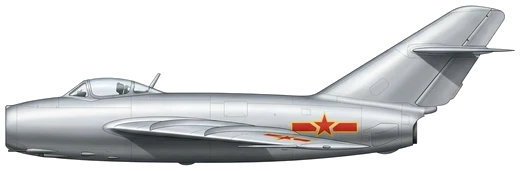
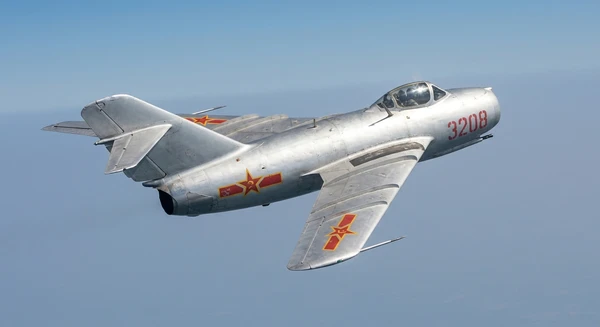
Chinese single-seat jet interceptor and fighter aircraft, derived from the Soviet MiG-17, developed in the mid-1950s and widely operated during the Cold War. Key figures: top speed 1,130 km/h, range 1,730 km, service ceiling 16,500 m, max takeoff weight 6,000 kg, unit price $0.6M, built 767. In service with 1 air force as of 2026 — North Korea (241).
| Crew | 1 |
| Length | 11.1 m (36.4 ft) |
| Wingspan | 9.6 m (31.6 ft) |
| Height | 3.8 m (12.5 ft) |
| Wing area | 22.6 m² (243.3 sqft) |
| Empty weight | 3,939 kg (8,684 lbs) |
| Max. takeoff weight | 6,000 kg (13,228 lbs) |
| Powerplant | 1 × Wopen WP-5 33 kN each |
| Maximum speed | 1130 km/h (702 mph) |
| Operational range | 1,730 km (1,075 mi) |
| Service ceiling | 16,500 m (54,134 ft) |
| Climb rate | 65.0 m/s (213.3 ft/s) |

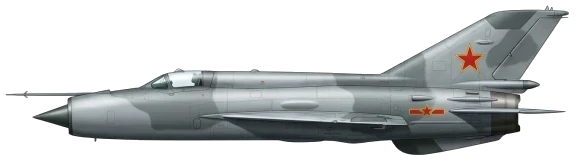
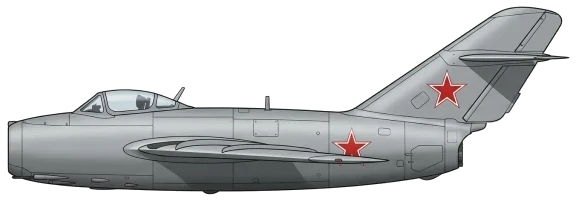
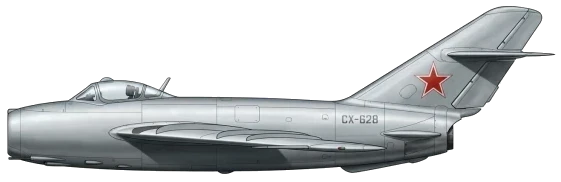
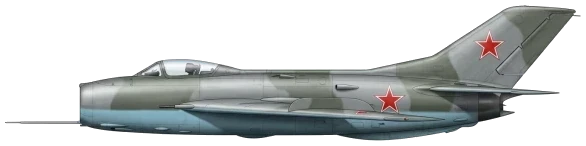
Description
The Shenyang J-5 is a Chinese-built single-seat jet interceptor and fighter aircraft derived from the Soviet Mikoyan-Gurevich MiG-17. Originally designated Dongfeng-101 and Type 56, the aircraft received the designation J-5 in 1964, while export models were designated F-5. Development began in 1955 when the People's Liberation Army Air Force (PLAAF) acquired plans, pattern aircraft, knockdown kits, and parts for the MiG-17F. The first Chinese-built MiG-17F, produced at the Shenyang factory, first flew on 19 July 1956 with test pilot Wu Keming at the controls. In 1961, China obtained plans for the radar-equipped MiG-17PF interceptor, which was produced as the J-5A. Due to the Sino-Soviet split, the first J-5A did not fly until 1964. Production ended in 1969 after the manufacture of 767 J-5 and J-5A aircraft. Chengdu also manufactured 1,061 JJ-5 twin-seat trainers between 1968 and 1986.
Design
The single-seat J-5A has a length of 11.09 meters, a wingspan of 9.628 meters, and a maximum speed of 1,130 km/h at 5,000 meters. Power is provided by a single Wopen WP-5 turbojet engine producing 25.5 kN of dry thrust and 33.8 kN with afterburning. The standard armament for the J-5A consists of three Type 23-1 23 mm aircraft cannons. The two-seat JJ-5 trainer variant deleted the internal armament of the fighter and instead carried a single Nudelman-Richter NR-23 23 mm cannon in a ventral pack. A single torpedo-bomber variant was modified to carry a centerline torpedo, which required the removal of the central cannon and some fuel storage.
Operational History
The J-5 and JJ-5 served with the PLAAF and the People's Liberation Army Naval Air Force until replaced by J-6 and J-7 aircraft. Export customers operated the type across several regions. North Korea remains an operator with 106 F-5s and 135 FT-5s. Albania operated 70 F-5s and eight FT-5s, using them against Yugoslav air incursions before retiring them. Vietnam utilized J-5s for interception missions until their retirement in the 1990s. Pakistan operated over 25 FT-5 trainers from 1975 until 2012. Other operators included Bangladesh, Cambodia (where the fleet was destroyed on the ground by a North Vietnamese attack in 1971), Indonesia, Sri Lanka, Sudan, Tanzania, Zambia, and Zimbabwe.
Variants
- Shenyang J-5: Single-seat production fighter, originally designated Type 56 and Dongfeng-101.
- Shenyang J-5A: Radar-equipped interceptor variant based on the MiG-17PF.
- Chengdu JJ-5: Tandem twin-seat trainer version combining the J-5 airframe with a MiG-15UTI cockpit section.
- Shenyang J-5 torpedo bomber: A single aircraft modified with a centerline torpedo rack, reduced fuel storage, and a removed central cannon.
- F-5: Export designation for the single-seat J-5 fighter.
Frequently Asked Questions
What type of aircraft is the J-5 Fresco?
What is the maximum speed of the J-5 Fresco?
What is the range of the J-5 Fresco?
When did the J-5 Fresco first fly?
How many J-5 Fresco have been built?
Which countries operate the J-5 Fresco?
How much does a J-5 Fresco cost?
What is the service ceiling of the J-5 Fresco?
- AUG 272026 Updated Unit price re-based (flyaway cost of the most-produced variant, then-year USD convention)
- AUG 132026 Updated Service entry corrected to the 1957 PLAAF adoption
- AUG 122026 Updated Range corrected to the figure with drop tanks at altitude
- AUG 52026 Updated Thrust updated
- JUL 142026 Created Page created: J-5 Fresco