Yak-15 Feather
Soviet first-generation turbojet fighter, developed immediately after World War II, primarily used to qualify piston-engine-experienced pilots to fly jet aircraft. Key figures: top speed 786 km/h, range 510 km, service ceiling 12,000 m, max takeoff weight 2,638 kg, built 280.
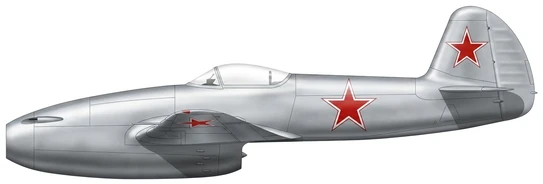
| Crew | 1 |
| Length | 8.7 m (28.5 ft) |
| Wingspan | 9.2 m (30.2 ft) |
| Wing area | 14.9 m² (159.8 sqft) |
| Empty weight | 1,852 kg (4,083 lbs) |
| Max. takeoff weight | 2,638 kg (5,816 lbs) |
| Powerplant | 1 × turbojet Klimov RD-10 900 kgf each |
| Maximum speed | 786 km/h (488 mph) |
| Operational range | 510 km (317 mi) |
| Service ceiling | 12,000 m (39,370 ft) |
| Climb rate | 21.6 m/s (70.9 ft/s) |
Description
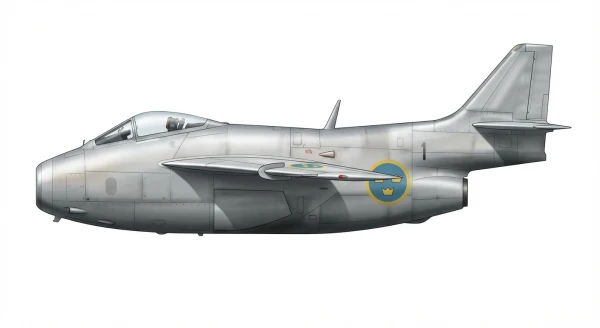
The Yakovlev Yak-15 (NATO reporting name Feather, USAF/DOD designation Type 2) is a first-generation Soviet single-seat turbojet fighter developed by the Yakovlev design bureau immediately after World War II. Built at Factory No. 31 in Tbilisi, the aircraft entered production in late 1946 and operational service in 1947. Nominally designated as a fighter, it was primarily utilized by the Soviet Air Forces to qualify piston-engine pilots to fly jet aircraft. The Yak-15 and the Swedish Saab 21R were the only two jet fighters converted from piston-powered airframes to successfully enter production.
Development
On 9 April 1945, the Council of People's Commissars ordered the Yakovlev design bureau to develop a single-seat jet fighter powered by a German Jumo 004 engine. Designated initially as the Yak-Jumo, taxi tests began in October 1945, and the prototype made its first flight on 24 April 1946. On 29 April 1946, the Soviet government issued a revised requirement for an aircraft powered by the Soviet-built RD-10 engine, designated as the Yak-15. Joseph Stalin subsequently ordered 15 pre-production aircraft to be built by Factory No. 31 for a November 1946 parade in Red Square. State acceptance trials lasted until April 1947, though production had already been authorized in December 1946. A total of 280 production Yak-15s were completed through the end of 1947.
Design
The Yak-15 was constructed by modifying the metal fuselage of the Yak-3 piston fighter, mounting the jet engine underneath the forward fuselage in a pod-and-boom arrangement. A steel heatshield was fitted to the lower fuselage, and the tailwheel was modified with steel leaf springs to handle exhaust heat. The front wing spar was bent into an inverted U-shape to clear the engine, and the vertical stabilizer was enlarged. The recontoured nose accommodated the powerplant, an additional fuel tank raising total fuel capacity to 590 kg, and two 23 mm autocannon. Testing revealed that the thick wing inherited from the Yak-3 restricted top speed and engine smoke frequently leaked into the cockpit.
Armament
Standard armament for production Yak-15 fighters consisted of two 23 mm Nudelman-Suranov NS-23 autocannon mounted in the upper nose. Each cannon was supplied with 60 rounds of ammunition. Early parade aircraft and trainer variants were built without armament or fitted with only a single 23 mm cannon.
Operational History
The Soviet Air Forces accepted the Yak-15 primarily as a conversion trainer to transition pilots to jet propulsion. Small numbers were distributed to fighter aviation regiments based across the USSR, Poland, Romania, Hungary, and Manchuria. The aircraft's maneuverability led to its adoption by informal aerobatic display teams during the late 1940s. In 1949, a single Yak-15 was fitted with dummy equipment to conduct aerial refueling trials with a Tupolev Tu-2 tanker.
Variants
- Yak-Jumo (Yak-3-Jumo): The initial prototype series powered by captured German Jumo 004 engines.
- Yak-15-RD10: Early prototypes and initial production models equipped with Soviet-built RD-10 engines and reduced or omitted armament.
- Yak-15: Standard single-seat production fighter variant equipped with two 23 mm autocannon.
- Yak-21: Two-seat conversion trainer prototype featuring a forward trainee cockpit, which was cancelled in favor of the Yak-17 trainer.
- Yak-15U: Improved single-seat variant fitted with a tricycle landing gear and drop tanks that served as the prototype for the Yak-17.
Frequently Asked Questions
What type of aircraft is the Yak-15 Feather?
What is the maximum speed of the Yak-15 Feather?
What is the range of the Yak-15 Feather?
When did the Yak-15 Feather first fly?
How many Yak-15 Feather have been built?
What is the service ceiling of the Yak-15 Feather?
- AUG 62026 Created Page created: Yak-15 Feather