Mirage 4000
French delta-winged fighter prototype, designed in the late 1970s, not adopted or deployed in any operational military roles. Key figures: top speed 2,445 km/h, range 2,000 km, service ceiling 20,000 m, max takeoff weight 32,000 kg, unit price $35M, built 1.
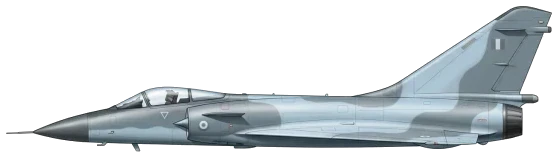
| Crew | 1 |
| Length | 18.7 m (61.4 ft) |
| Wingspan | 11.9 m (39.1 ft) |
| Height | 6.0 m (19.6 ft) |
| Wing area | 72.7 m² (782.5 sqft) |
| Empty weight | 13,490 kg (29,740 lbs) |
| Max. takeoff weight | 32,000 kg (70,548 lbs) |
| Powerplant | 2 × turbofans SNECMA M53-2 11,100 kgf each |
| Ejection seat | Martin-Baker Mk 10 |
| Maximum speed | 2445 km/h (Mach 2.3) |
| Operational range | 2,000 km (1,243 mi) |
| Service ceiling | 20,000 m (65,617 ft) |
| Climb rate | 305.0 m/s (1000.7 ft/s) |
Description
The Dassault Mirage 4000, sometimes referred to as the Super Mirage 4000, was a prototype twin-engine fighter aircraft developed by Dassault-Breguet as an evolution of the Mirage 2000. Considerably larger and heavier than its single-engined predecessor, the Mirage 4000 was powered by two SNECMA M53-2 turbofan engines. Financed as a private venture by Dassault, the aircraft was intended to function as both a long-range interceptor and a fighter-bomber, comparable in size to the American F-15 Eagle. The first flight occurred on March 9, 1979. The expertise gained from the Mirage 4000 project influenced the later Dassault Rafale.
Design
The design retained the delta wing configuration and semi-conical Oswatitsch-type air intakes of its predecessor. It featured small canards positioned above the engine air intakes and incorporated a bubble canopy.
Armament
The aircraft was equipped with two 30 mm DEFA cannons, each holding 125 rounds. It featured 11 hardpoints with a total capacity exceeding 8,000 kg for various combinations of ordnance. These hardpoints could accommodate up to three 2,500-liter drop tanks, a FLIR pod, a reconnaissance pod, a laser designator pod, and an ALTIS III targeting system. For air-to-air combat, the aircraft could carry two long-range air-to-air missiles (AAMs) and between 8 to 14 advanced AAMs. Air-to-ground capabilities included provisions for up to four air-to-ground missiles (AGMs) or up to 27 × 250 kg bombs, as well as up to four rocket pods.
Operational History
The Dassault Mirage 4000 was primarily a prototype, and its operational history is limited to flight testing. Designed to be a long-range interceptor and fighter-bomber, it was never adopted by the French Air Force or any other nation. The program was discontinued in the early 1980s after potential customers like the Royal Saudi Air Force opted for the Panavia Tornado, and the Iranian Revolution in 1979 eliminated Iran as another possible buyer. The French Air Force chose to concentrate on the Mirage 2000. The sole prototype completed a total of 336 flights, with the last taking place on January 8, 1988. The prototype was later moved to the Musée de l'air et de l'espace in November 1992.
Variants
The Dassault Mirage 4000 had no official variants as only one prototype was ever produced.
Frequently Asked Questions
What type of aircraft is the Mirage 4000?
What is the maximum speed of the Mirage 4000?
What is the range of the Mirage 4000?
When did the Mirage 4000 first fly?
How many Mirage 4000 have been built?
Which countries operate the Mirage 4000?
How much does a Mirage 4000 cost?
What is the service ceiling of the Mirage 4000?
- AUG 52026 Updated Powerplant updated in a site-wide editorial pass
- APR 72026 Updated Sources and cross-references refreshed
- JAN 242026 Updated Thrust updated