Mirage 4000 vs Rafale
Mirage 4000 vs Rafale at a glance — top speed 2,445 vs 1,912 km/h, range 2,000 vs 3,700 km, max takeoff weight 32,000 vs 24,500 kg, built 1 vs 316 units.
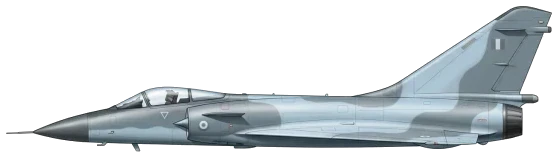
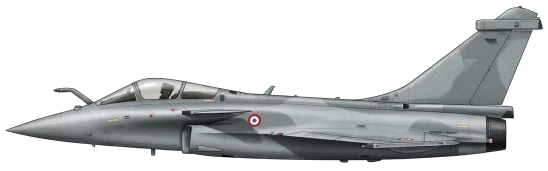
| Mirage 4000 | Rafale | |
|---|---|---|
| Origin country | 🇫🇷 France | 🇫🇷 France |
| Category | Combat Aircraft | Combat Aircraft |
| Manufacturer | Dassault | Dassault |
| First flight | 9 March 1979 | 4 July 1986 |
| Year introduced | -- | 2001 |
| Number produced | 1 units | 316 units |
| Average unit price | $35 million | $95 million |
| Wing area | 72.7 m² | 45.7 m² |
| Wingspan | 11.9 m | 10.9 m |
| Height | 6.0 m | 5.3 m |
| Length | 18.7 m | 15.3 m |
| Maximum speed | 2445 km/h | 1912 km/h |
| Operational range | 2,000 km | 3,700 km |
| Service ceiling | 20,000 m | 15,835 m |
| Max. takeoff weight | 32,000 kg | 24,500 kg |
| Empty weight | 13,490 kg | 9,850 kg |
| Total thrust | 2 x 11,100 kgf | 2 x 7,648 kgf |
Detailed Comparison
The Dassault Mirage 4000 was a privately funded, heavy twin-engine fighter prototype, conceived as a larger, more powerful counterpart to the Mirage 2000. In contrast, the Dassault Rafale is a state-supported, smaller, and more agile "omnirole" aircraft that successfully entered service, integrating many of the aerodynamic and systemic lessons learned from the Mirage 4000's development into a more advanced and versatile platform.
Development and Design
The Mirage 4000 was a private venture by Dassault, an ambitious attempt to create a long-range interceptor and fighter-bomber comparable to the American F-15 Eagle. It scaled up the successful delta-wing design of the Mirage 2000, adding a second SNECMA M53 engine and canards for improved performance. Its design philosophy prioritized speed and payload for interception and deep strike roles. However, without a domestic order from the French Air Force, which opted for the cheaper Mirage 2000, and with the loss of key export prospects like Iran and Saudi Arabia, the project was financially unsustainable and was terminated after one prototype flew.
The Rafale originated from France's withdrawal from the Eurofighter program, driven by a need for a smaller, carrier-capable aircraft that preserved French industrial independence. The Rafale's design combines a delta wing with close-coupled canards, creating an aerodynamically unstable platform that relies on digital fly-by-wire controls to achieve exceptional agility. While not a true stealth aircraft, its design incorporates a reduced radar cross-section through shaping and extensive use of composite materials. From its inception, the Rafale was conceived as an "omnirole" fighter, capable of performing air-to-air, strike, and reconnaissance missions during a single sortie, a significant philosophical shift from the specialized roles of previous generation fighters.
Specifications and Performances
The Mirage 4000's design for high-speed interception is reflected in its specifications. It was substantially larger and heavier, with an empty weight of 13,490 kg and a maximum speed of 2,445 km/h at a service ceiling of 20,000 m. The Rafale is a more compact aircraft (10,196 kg empty weight) with a lower top speed (1,912 km/h) and ceiling (15,240 m), but its performance is optimized for agility and versatility across a wider flight envelope. While both aircraft share an identical listed climb rate of 305 m/s, the Rafale's advanced aerodynamics and flight control system give it superior maneuverability, particularly at lower speeds. The Rafale's impressive takeoff distance of just 400 meters underscores its suitability for short-field and carrier operations, a key requirement the Mirage 4000 was not designed to meet.
Deployment and usage
The Mirage 4000’s history is confined to its flight test program. The single prototype completed 336 flights, providing crucial data on twin-engine delta-canard configurations that directly informed the Rafale program. It never entered military service.
The Rafale, by contrast, has a significant and ongoing operational history. Introduced in 2001, it serves with both the French Air Force and Navy, and has achieved considerable export success. It has been combat-proven in multiple theaters, including Afghanistan, Libya, Mali, and Iraq/Syria. Key capabilities demonstrated in combat include:
- The SPECTRA integrated defensive-aids system, allowing it to operate in contested airspace.
- Advanced sensor fusion, combining data from its RBE2 AESA radar and electro-optical systems.
- True omnirole performance, seamlessly switching between air-to-air engagements and precision ground strikes with weapons like AASM Hammer missiles and SCALP cruise missiles.
Conclusion
The Mirage 4000 stands as a technologically impressive but commercially unsuccessful prototype. It was a capable heavy fighter design that served as a critical technological demonstrator, proving the concepts that would be refined in its successor. The Rafale represents the successful culmination of those efforts, embodying a more modern and pragmatic design philosophy. By prioritizing agility, sensor fusion, and genuine omnirole versatility over the raw speed and size of the Mirage 4000, Dassault created a highly effective and marketable combat aircraft that has proven its value in complex 21st-century operations.


