TH-55 Osage
American training helicopter, prominent during the Vietnam War, extensively utilized for instructional duties by the US Army. Key figures: top speed 140 km/h, range 480 km, service ceiling 4,000 m, max takeoff weight 703 kg, built 2,800. In service with 8 air forces as of 2026 — Thailand (45), Indonesia (20), Greece (18) and 5 others.
| Crew | 2 |
| Length | 8.8 m (28.9 ft) |
| Wingspan | 7.7 m (25.3 ft) |
| Height | 2.5 m (8.2 ft) |
| Empty weight | 435 kg (959 lbs) |
| Max. takeoff weight | 703 kg (1,550 lbs) |
| Powerplant | 1 × Lycoming HIO-360-A1A 4-cylinder piston engine 130 kW each |
| Maximum speed | 140 km/h (87 mph) |
| Operational range | 480 km (298 mi) |
| Service ceiling | 4,000 m (13,123 ft) |
| Climb rate | 5.8 m/s (19.0 ft/s) |


Description
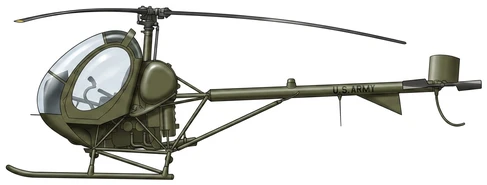
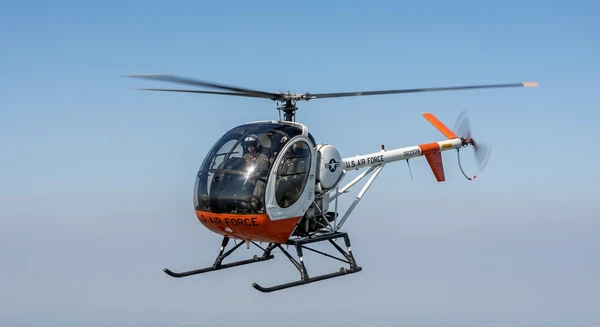
The Hughes TH-55 Osage is an American piston-powered light training helicopter produced by Hughes Tool Company's Aircraft Division and later developed by Schweizer. Based on the Model 269 family, it entered service with the United States Army in 1964 as a primary helicopter trainer. The aircraft trained over 60,000 US Army pilots during its operational lifespan, making it the service's longest-serving primary helicopter trainer.
Development
Hughes initiated private development of the Model 269 in September 1955 following a market survey that identified demand for a low-cost, two-seat lightweight helicopter. The prototype conducted its maiden flight on 2 October 1956. Quantity production was authorized four years later after the original truss-work tailboom was replaced with an aluminum tubular structure and the cockpit was refined, resulting in the Model 269A. The Federal Aviation Administration granted type certification on 9 April 1959, and civil deliveries commenced in 1961. Hughes introduced the three-seat Model 269B in 1964 and the upgraded Model 300C in 1969. Schweizer began building the type under license in 1983 and acquired full rights to the aircraft line in 1986. Between Hughes, Schweizer, and foreign licensees, nearly 3,000 Model 269 and 300 series helicopters were produced.
Design
The Model 269 features a compact open-framework fuselage with side-by-side seating for an instructor and student. Flight controls are linked directly to the swashplate, eliminating the need for hydraulic systems. The dynamic components consist of a Drago Jovanovich-designed fully articulated three-blade main rotor and a two-blade tail rotor. The helicopter utilizes shock absorber-damped skid landing gear. Power is provided by a horizontally-opposed four-cylinder air-cooled Lycoming engine, such as the HIO-360-B1A installed on the TH-55A.
Operational History
In 1958, the United States Army evaluated five preproduction Model 269A helicopters under the designation YHO-2HU for a light observation role, but did not order the type into production. The service later selected a modified Model 269A-1 as its standard primary trainer in 1964, designating it the TH-55A Osage. Hughes delivered 792 TH-55A aircraft to the US Army by 1969, and the type served in this role until its replacement by the UH-1 Huey in 1988. Hughes and its licensees also supplied variants to international military customers, including the Japanese Ground Self-Defense Force, the Brazilian Navy, and the Hellenic Army. In 1964, a civil Model 269 established an endurance record by remaining in a ground-effect hover for 101 hours.
Variants
-
Model 269A: The initial production variant featuring a tubular aluminum tailboom, optional dual controls, and Lycoming O-360 series engines.
-
TH-55A: The United States Army primary trainer variant derived from the Model 269A-1, fitted with military radios and flight instrumentation.
-
Model 269B: A three-seat civil version marketed as the Hughes Model 300, powered by a 190 hp Lycoming HIO-360-A1A engine.
-
Model 300C: An upgraded variant introduced in 1969 featuring a 190 hp Lycoming HIO-360-D1A engine and an enlarged 26 ft 10 in main rotor.
-
TH-55J: A military trainer variant of the TH-55A license-built by Kawasaki for the Japanese Ground Self-Defense Force.
Frequently Asked Questions
What type of aircraft is the TH-55 Osage?
What is the maximum speed of the TH-55 Osage?
What is the range of the TH-55 Osage?
When did the TH-55 Osage first fly?
How many TH-55 Osage have been built?
Which countries operate the TH-55 Osage?
What is the service ceiling of the TH-55 Osage?
- AUG 62026 Updated Description updated
- AUG 52026 Updated Climb rate added
- JUL 232026 Updated Sources and cross-references refreshed
- APR 72026 Updated Picture credits updated in a site-wide editorial pass
- JAN 122026 Updated Range updated in a site-wide editorial pass