Robinson R44 Raven
American light, four-seat helicopter, extensively used worldwide for civilian operations, military training, and police usage since the 1990s. Key figures: top speed 240 km/h, range 560 km, service ceiling 4,300 m, max takeoff weight 1,134 kg, unit price $0.6M, built 6,331. In service with 8 air forces as of 2026 — Jordan (12), Bolivia (6), Lebanon (6) and 5 others.
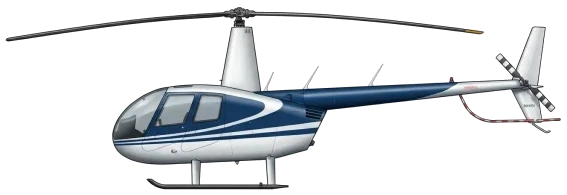
| Crew | 2 |
| Length | 11.7 m (38.3 ft) |
| Wingspan | 10 m (32.8 ft) |
| Height | 3.3 m (10.8 ft) |
| Empty weight | 683 kg (1,506 lbs) |
| Max. takeoff weight | 1,134 kg (2,500 lbs) |
| Powerplant | 1 × Lycoming IO-540-AE1A5 6-cylinder pistons engine 183 kW each |
| Maximum speed | 240 km/h (149 mph) |
| Operational range | 560 km (348 mi) |
| Service ceiling | 4,300 m (14,108 ft) |
-
 Jordan
12
Jordan
12
-
 Bolivia
6
Bolivia
6
-
 Lebanon
6
Lebanon
6
-
 Poland
3
Poland
3
-
 Dominican Republic
2
Dominican Republic
2
-
 Philippines
2
Philippines
2
-
 Nicaragua
1
Nicaragua
1
-
 Peru
1
Peru
1
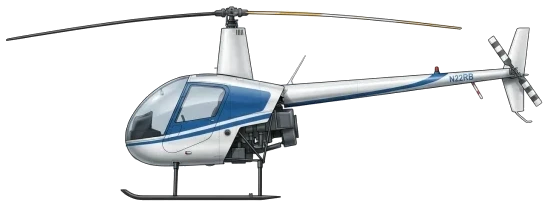
Description
The Robinson R44 is a four-seat single-engine light helicopter produced by the Robinson Helicopter Company of Torrance, California, since 1992. Derived from the two-seat R22, it is used for private flying, flight training, law enforcement, aerial news gathering and utility work, with military and paramilitary operators in around a dozen countries. It has been the world's best-selling general aviation helicopter every year since 1999, with 5,941 delivered between 2001 and 2020.
Development
Frank Robinson and his engineering staff designed the R44 during the 1980s as a larger, hydraulically assisted development of the R22. The prototype first flew on 31 March 1990, and the R44 Astro received an FAA type certificate in December 1992, with first deliveries in early 1993. The Newscopter, fitted with electronic news gathering equipment, was delivered from 1998. The Raven, introduced in January 2000, added hydraulically assisted controls and adjustable pedals; the Raven II followed in July 2002 with a fuel-injected engine, wider blades, higher gross weight and improved altitude performance. Robinson announced the Cadet in November 2015 and has ground-run a diesel engine intended to replace the Lycoming IO-540, reducing fuel burn from 16 to 12 US gal per hour. In 2023 Rotor Technologies developed the R550X, an unmanned helicopter based on the Raven II.
Design
The R44 uses a semi-rigid two-bladed main rotor of 33 ft (10 m) diameter, a two-bladed tail rotor and skid landing gear, with an enclosed cabin seating a pilot and three passengers in two rows. Tail rotor rotation is reversed relative to the R22, placing the advancing blade at the bottom for greater yaw control authority. The Raven II is powered by a 245 hp (183 kW) Lycoming IO-540-AE1A5 six-cylinder air-cooled piston engine, giving a maximum speed of 130 kn (240 km/h), a cruise of 109 kn and a range of 300 nmi (560 km) without reserve. Empty weight is 1,505 lb (683 kg) and gross weight 2,500 lb (1,134 kg). Following findings on post-crash fuel leaks, Robinson fitted bladder-type fuel tanks to new aircraft from 2009 and issued Service Bulletin SB-78 in December 2010 mandating retrofit of aluminium-tanked aircraft; Australia's CASA grounded non-compliant aircraft on 30 April 2013.
Operational History
In 1997 Jennifer Murray flew an R44 on the first helicopter circumnavigation of the world by a woman, covering 36,000 miles in 97 days. As of 2014 an R44 held the piston helicopter speed record of 123 kn (228 km/h). Military and government operators include the Bolivian Air Force, Dominican Republic Army, Royal Jordanian Air Force, Lebanese Air Force, Mexican Navy, Nicaraguan Air Force, Peruvian Army, Royal Thai Army, the Philippine Army, Navy and National Police, the South African Police Service Air Wing, the Alaska State Troopers and the Police of Uruguay.
Variants
- R44 Astro: Initial production model, certificated December 1992 with non-hydraulic controls.
- R44 Raven: Introduced January 2000 with hydraulically assisted controls and adjustable pedals.
- R44 Raven II: 2002 model with fuel-injected engine, wider blades, higher gross weight and better altitude performance.
- R44 Newscopter: Electronic news gathering variant delivered from 1998.
- R44 Cadet: Announced November 2015; Raven I with rear seats replaced by a cargo area and a derated engine.
Frequently Asked Questions
What type of aircraft is the Robinson R44 Raven?
What is the maximum speed of the Robinson R44 Raven?
What is the range of the Robinson R44 Raven?
When did the Robinson R44 Raven first fly?
How many Robinson R44 Raven have been built?
Which countries operate the Robinson R44 Raven?
How much does a Robinson R44 Raven cost?
What is the service ceiling of the Robinson R44 Raven?
- AUG 302026 Updated Description updated
- JUL 272026 Updated Name updated
- JUL 232026 Updated Sources and cross-references refreshed
- APR 72026 Updated Sources and cross-references refreshed
- FEB 72026 Updated Wingspan added
- JAN 122026 Updated Range updated in a site-wide editorial pass