Guimbal Cabri G2
French light helicopter, prevalent in the 21st century, primarily utilized for training and surveillance purposes globally. Key figures: top speed 185 km/h, range 700 km, service ceiling 2,286 m, max takeoff weight 700 kg, unit price $0.39M, built 300. In service with 3 air forces as of 2026 — Poland (6), Bulgaria (2), China (2).
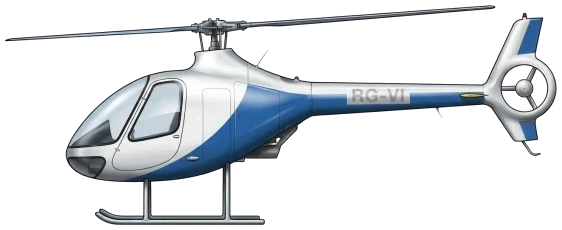
| Crew | 1 |
| Length | 8.1 m (26.4 ft) |
| Wingspan | 7.2 m (23.6 ft) |
| Height | 2.5 m (8.2 ft) |
| Empty weight | 420 kg (926 lbs) |
| Max. takeoff weight | 700 kg (1,543 lbs) |
| Powerplant | 1 × radial engine Lycoming O-360-J2A 108 kW each |
| Maximum speed | 185 km/h (115 mph) |
| Operational range | 700 km (435 mi) |
| Service ceiling | 2,286 m (7,500 ft) |


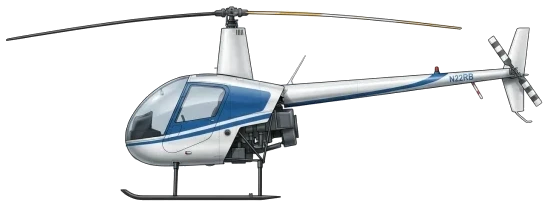
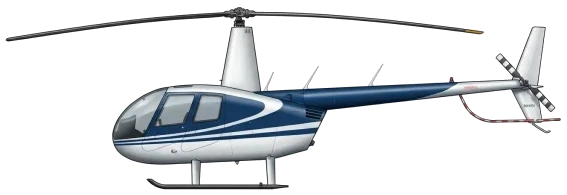
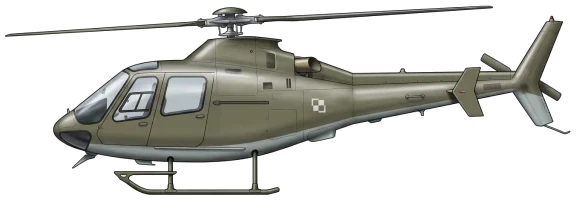
Description
The Guimbal Cabri G2 is a two-seat light helicopter powered by a single piston engine, produced by Hélicoptères Guimbal of Aix-en-Provence, France. Designed by Bruno Guimbal, a former Eurocopter engineer, it flew as a demonstrator in April 1992 and entered commercial service in 2008 following EASA certification. It is used for general aviation and flight training, and has served as the basis for unmanned rotorcraft development.
Development
While working at Eurocopter on the AS365 Dauphin and EC120 Colibri during the 1980s, Bruno Guimbal began independent development of a two-seat piston helicopter incorporating technologies normally confined to turbine types, including the Fenestron shrouded tail rotor, a Spheriflex-derived main rotor, and a composite fuselage. Eurocopter sponsored the programme in the early 1990s and provided test support. The prototype Cabri G2-01 made a 45-minute first flight in April 1992 and in 1996 set a distance record for helicopters under 500 kg at 481.32 km. Guimbal left Eurocopter in 2000 to found Hélicoptères Guimbal and certify the type; the first production aircraft flew in March 2005. After a six-year programme and 300 hours of flight testing, EASA type certification followed in December 2007, making the Cabri the first two-seat piston helicopter certified in over 30 years. Twenty-eight had been built by 2014, 44 were delivered in 2015 and 56 were projected for 2016. FAA certification was granted in February 2015, and by February 2016 the type held approvals in 24 countries.
Design
The Cabri G2 has a three-bladed fully articulated main rotor turning clockwise and a Fenestron tail rotor. The composite main rotor blades are damage-tolerant with no life limit. Skid landing gear is attached by elastomeric mounts rather than bolted directly, reducing ground resonance. The fuselage is an all-composite monocoque. Seating is side-by-side with removable dual controls and a removable left seat; equipment includes a 200-litre externally accessible baggage compartment and a remote door locking system with immobiliser. Power comes from a 180 hp (134 kW) Lycoming O-360-J2A rated at 145 hp continuous and 160 hp for five minutes, mounted behind the cabin with the exhaust raised above the tail boom. Only three components are time-limited. Avionics centre on the Electronic Pilot Management (EPM) glass cockpit, using three displays for power, engine and rotor speed, fuel and flight time, with backup instruments. Safety features include a four-way trim system, energy-absorbing seats and structure, automatic carburettor ice protection, and a crash-resistant fuel tank meeting FAA CRFS standards. Options include air conditioning, moving map, GPS, cargo hook and automatically deployed flotation gear. Maximum speed is 185 km/h, range 700 km, endurance 4.5 hours and service ceiling 3,963 m at a 700 kg gross weight.
Operational History
The first production aircraft was delivered to French training operator iXAir on 19 September 2008, the first of ten ordered. Precision Helicopters of Newberg, Oregon, was the North American launch customer, receiving its first aircraft in February 2014. The United Kingdom became the largest operator, with 14 aircraft by February 2016 and 28 by May 2017, when the 200th Cabri was delivered to distributor HeliGroup. In early 2015 the type was in service with 32 operators worldwide with 100 further aircraft on order; 70 percent of sales to that date were for training.
Variants
- Cabri G2: Two-seat piston-engined production helicopter powered by the Lycoming O-360-J2A.
- Orka 1200: Vertical take-off and landing UAV developed from 2003 by Eurocopter and Hélicoptères Guimbal for military use, marketed through the Vertivision joint venture formed in June 2005.
- Airbus Helicopters VSR700: Naval UAV derivative powered by a 155 hp Continental CD-155, with prototype flight planned for 2018 and introduction in 2021.
Frequently Asked Questions
What type of aircraft is the Guimbal Cabri G2?
What is the maximum speed of the Guimbal Cabri G2?
What is the range of the Guimbal Cabri G2?
When did the Guimbal Cabri G2 first fly?
How many Guimbal Cabri G2 have been built?
Which countries operate the Guimbal Cabri G2?
How much does a Guimbal Cabri G2 cost?
What is the service ceiling of the Guimbal Cabri G2?
- AUG 302026 Updated Description updated
- JUL 272026 Updated Name updated
- JUL 232026 Updated Sources and cross-references refreshed
- APR 72026 Updated Picture credits updated in a site-wide editorial pass
- FEB 72026 Updated Wingspan added
- JAN 222026 Updated Category updated
- JAN 122026 Updated Range updated in a site-wide editorial pass