Shackleton
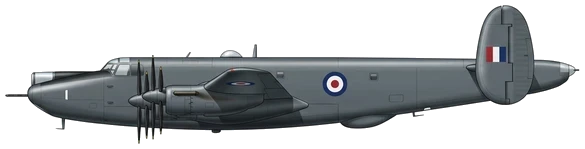
British four-engined long-range maritime patrol aircraft derived from the Avro Lincoln, in RAF service from 1951 and flown in the airborne early warning role until 1991. Key figures: top speed 485 km/h, range 6,782 km, service ceiling 5,669 m, max takeoff weight 44,452 kg, built 185.
| Crew | 10 |
| Length | 28.2 m (92.5 ft) |
| Wingspan | 36.5 m (119.8 ft) |
| Height | 7.1 m (23.3 ft) |
| Wing area | 132 m² (1420.8 sqft) |
| Empty weight | 26,218 kg (57,801 lbs) |
| Max. takeoff weight | 44,452 kg (98,000 lbs) |
| Powerplant | 4 × piston engines Rolls-Royce Griffon 57A 1,460 kW each |
| Maximum speed | 485 km/h (301 mph) |
| Operational range | 6,782 km (4,214 mi) |
| Service ceiling | 5,669 m (18,599 ft) |
- Anti-Submarine Mk 101 Lulu
- Homing torpedoes
- Depth charges
- Mines
Description
The Avro Shackleton is a British four-engined long-range maritime patrol aircraft built by Avro and derived from the Lincoln bomber, itself a Lancaster development. It entered RAF Coastal Command service in April 1951 in the anti-submarine warfare (ASW) role and was also flown by the South African Air Force from 1957 to 1984. It was named after polar explorer Sir Ernest Shackleton. The last RAF examples served in the airborne early warning (AEW) role until 1991.
Development
Work on a new patrol aircraft began in 1944. After the war, the expected growth of the Soviet submarine force and the adoption of the snorkel reshaped the requirement into Air Ministry specification R.5/46. Avro designed the Type 696, which combined Lincoln and Tudor components and was required to fly 3,000 nmi (5,600 km) carrying 6,000 lb (2,700 kg) of weapons and equipment. Three prototypes were ordered in May 1947. The first flew on 9 March 1949 at Woodford, Cheshire. The RAF received 29 MR 1, 47 MR 1A, 69 MR 2 and 34 MR 3 aircraft, and South Africa received eight MR 3s. A Napier Nomad-powered MR 4 for a Canadian requirement was cancelled in 1955.
Design
The wing centre section came from the Lincoln, and the outer wings and undercarriage from the Tudor. A new, wider fuselage accommodated a ten-man crew and a large bomb bay. Four 1,960 hp Griffon 57 engines drove 13 ft 4 in (4.06 m) contra-rotating propellers. The Griffon's lower engine speed reduced fuel use while the aircraft loitered at around 500 ft (150 m).
The MR 2 moved the ASV Mk 13 radar to a retractable ventral radome. The radar detected a surfaced submarine at 20 nmi (37 km). Other equipment included sonobuoys, Orange Harvest ESM, an Autolycus diesel fume detector and reconnaissance cameras. The MR 3 added a tricycle undercarriage, wingtip tanks and crew rest facilities. Phase III aircraft gained two Armstrong Siddeley Viper turbojets for takeoff. Airframe fatigue led to the Shackleton's replacement by the Hawker Siddeley Nimrod from 1969.
Armament
The MR 1 carried two 20 mm cannon in a Bristol dorsal turret, later removed. The MR 2 added two 20 mm Hispano Mk V cannon in the nose. The bomb bay held up to 10,000 lb (4,536 kg) of bombs, homing torpedoes, mines or depth charges. Nuclear depth bombs, including the Mk 101 Lulu, entered use in 1966.
Operational History
No. 120 Squadron received the first aircraft on 30 March 1951, and seven squadrons operated the type by late 1952. Shackletons flew in the Suez Crisis and the Jebel Akhdar War in Oman. They also flew anti-smuggling patrols during the Indonesia–Malaysia confrontation and enforced the Rhodesia oil blockade from Madagascar. Other duties included colonial policing, search and rescue, and transport.
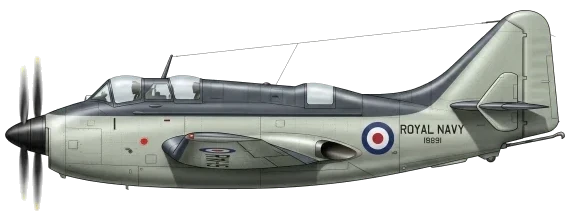
From 1972, No. 8 Squadron at RAF Lossiemouth flew twelve AEW 2s fitted with ex-Gannet AN/APS-20 radars. The Boeing E-3 Sentry replaced them in 1991. In South Africa, 35 Squadron patrolled the Cape sea lanes. In March 1971 its Shackletons sank the tanker SS Wafra with depth charges. One aircraft crashed on 8 August 1963, killing all thirteen crew. The UN arms embargo restricted spares, and the fleet was retired in November 1984.
Variants
- MR 1/MR 1A: Initial production model with tailwheel undercarriage and dorsal turret, entering service in 1951.
- MR 2: Lengthened nose, ventral radome, nose cannon and twin retractable tailwheels, entering service in January 1953.
- MR 3: Redesigned model with tricycle undercarriage, wingtip tanks and later Viper booster engines, entering service in August 1957.
- T 4: Navigation trainer conversion of 17 MR 1As between 1956 and 1961.
- AEW 2: Twelve MR 2s converted with AN/APS-20 radar, serving from 1972 to 1991.
Frequently Asked Questions
What type of aircraft is the Shackleton?
What is the maximum speed of the Shackleton?
What is the range of the Shackleton?
When did the Shackleton first fly?
How many Shackleton have been built?
Which countries operate the Shackleton?
What is the service ceiling of the Shackleton?
- SEP 302026 Created Page created: Shackleton