P-2 Neptune
American twin-engined maritime patrol and anti-submarine aircraft that entered US Navy service in 1947 and was replaced by the P-3 Orion; late versions added two auxiliary jets. Key figures: top speed 584 km/h, range 3,471 km, service ceiling 6,828 m, max takeoff weight 36,240 kg, built 1,177.
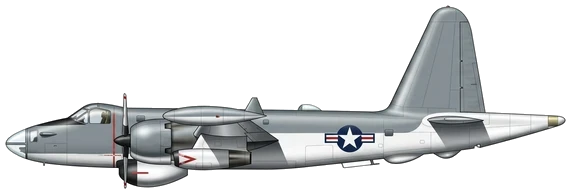
| Crew | 7–9 |
| Length | 27.9 m (91.7 ft) |
| Wingspan | 31.7 m (103.8 ft) |
| Height | 8.9 m (29.3 ft) |
| Wing area | 92.9 m² (1000.0 sqft) |
| Empty weight | 22,650 kg (49,935 lbs) |
| Max. takeoff weight | 36,240 kg (79,895 lbs) |
| Powerplant | 2 × piston engines Wright R-3350-32W Duplex-Cyclone 2,759 kW each |
| Maximum speed | 584 km/h (363 mph) |
| Operational range | 3,471 km (2,157 mi) |
| Service ceiling | 6,828 m (22,402 ft) |
- Free-fall bombs
- Depth charges
- Torpedoes
- Rocket Pod 2.75 in FFAR
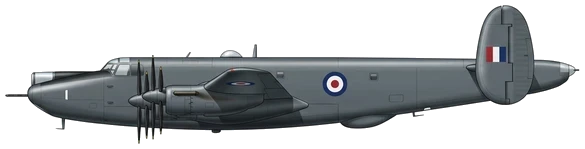
Description
The Lockheed P-2 Neptune (designated P2V by the US Navy until September 1962) is a twin-engine American maritime patrol and anti-submarine warfare (ASW) aircraft built by Lockheed. It replaced the PV-1 Ventura and PV-2 Harpoon, entered US Navy service in 1947, and was succeeded by the P-3 Orion. It is known for the 1946 "Truculent Turtle" distance record, for its use as a carrier-launched nuclear bomber, and for service with at least ten national operators.
Development
Design work began at Lockheed's Vega subsidiary as a private venture on 6 December 1941. The Navy signed a letter of intent for two XP2V prototypes on 19 February 1943, confirmed by contract on 4 April 1944, with 15 more aircraft ordered ten days later. The design emphasised ease of manufacture and maintenance. The prototype flew in May 1945, and production began in 1946. On 9 September 1946, the third production P2V-1, "the Turtle", flew 11,236.6 mi (18,083.6 km) unrefuelled from Perth to Columbus, Ohio, in 55 hours 18 minutes. This remained the absolute unrefuelled distance record until 1962. Lockheed built 424 P2V-5s and 287 P2V-7s, including 48 P2V-7s assembled by Kawasaki.
Design
Beginning with the P2V-5F, Neptunes combined two Wright R-3350 radials with two Westinghouse J34 turbojets in underwing pods. The J34s burned the same avgas as the piston engines. Intake doors closed when the jets were shut down to prevent windmilling. The jets were used for takeoff and during low-level ASW flight. ASW equipment included a belly-mounted AN/APS-20 search radar, an AN/ASQ-8 magnetic anomaly detector in an extended tail, and aft sonobuoy chutes. The P2V-7 had 3,700 hp R-3350-32W engines, a maximum speed of 363 mph (584 km/h), a range of 2,157 mi (3,471 km), and a crew of 7–9.
Armament
The XP2V-1 had twin .50 in machine guns in nose, tail and dorsal turrets, plus 8,000 lb (3,600 kg) in an internal bomb bay. The P2V-1 could carry 16 HVAR or four Tiny Tim rockets. Later versions carried six fixed 20 mm cannon or an Emerson 20 mm nose turret. The P2V-5F carried up to 10,000 lb (4,500 kg) of weapons. The P2V-6B carried two AUM-N-2 Petrel anti-ship missiles. The P2V-7 carried free-fall bombs, depth charges, torpedoes and 2.75 in FFAR rocket pods.
Operational History
From 1948, P2V-3Cs were modified as JATO-launched carrier nuclear bombers carrying Little Boy weapons, until the AJ Savage replaced them. Under Project Cherry, the CIA converted P2V-7s to RB-69As. The ROCAF 34th Squadron flew them over China from 1957 to 1966, and all five original aircraft were lost. In Vietnam, VO-67 flew OP-2Es on Igloo White sensor-seeding missions, losing three aircraft and 20 aircrew. The US Army's "Crazy Cat" unit flew 42,500 accident-free hours from 1967 to 1972. On 17 May 1962, a Dutch P2V Neptune shot down an Indonesian C-47. On 4 May 1982, Argentine Neptunes directed the Super Étendard strike that sank HMS Sheffield. Other operators included the UK (52 aircraft), Canada, Australia, France, Japan, Brazil and Portugal. VP-94 retired the last US Navy P-2 Neptune in 1978. Civilian operators later used the type as a firefighting tanker.
Variants
- P2V-5: Principal production variant with tip tanks, AN/APS-20 radar and later a glazed nose and MAD boom; 424 built.
- P2V-5F (P-2E): P2V-5 fitted with two J34 jet engines and R-3350-32W radials.
- P2V-7 (P-2H): Final Lockheed production model with jet pods, a revised radome and a bulged canopy; 287 built.
- RB-69A (P2V-7U): CIA ELINT and reconnaissance conversion flown by the ROCAF 34th Squadron.
- Kawasaki P-2J: Japanese licence-built version powered by T64 turboprops; 82 built.
Frequently Asked Questions
What type of aircraft is the P-2 Neptune?
What is the maximum speed of the P-2 Neptune?
What is the range of the P-2 Neptune?
When did the P-2 Neptune first fly?
How many P-2 Neptune have been built?
Which countries operate the P-2 Neptune?
What is the service ceiling of the P-2 Neptune?
- SEP 302026 Created Page created: P-2 Neptune