Nimrod
British jet-powered maritime patrol aircraft derived from the de Havilland Comet, flown by the RAF from 1969 to 2011 for anti-submarine warfare, maritime surveillance and signals intelligence. Key figures: top speed 926 km/h, range 9,262 km, service ceiling 13,411 m, max takeoff weight 87,090 kg, built 49.
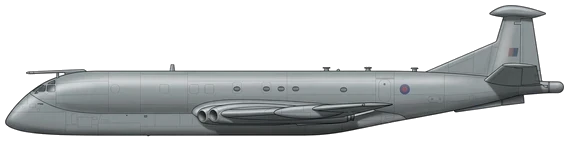
| Crew | 13 |
| Length | 38.6 m (126.7 ft) |
| Wingspan | 35 m (114.8 ft) |
| Height | 9.5 m (31.0 ft) |
| Wing area | 197.1 m² (2121.0 sqft) |
| Empty weight | 39,009 kg (86,000 lbs) |
| Max. takeoff weight | 87,090 kg (192,000 lbs) |
| Powerplant | 4 × turbofans Rolls-Royce Spey 5,516 kgf each |
| Maximum speed | 926 km/h (575 mph) |
| Operational range | 9,262 km (5,755 mi) |
| Endurance | 10 hours |
| Service ceiling | 13,411 m (43,999 ft) |
- Air-to-Air Short-Range AIM-9 Sidewinder
- Air-to-Surface Nord AS.12
- Air-to-Surface Martel
- Air-to-Surface AGM-65 Maverick
- Anti-Ship AGM-84 Harpoon
- Nuclear B57
- Nuclear WE.177A
- Unguided Bomb 1,000 lb general-purpose bomb
- Cluster Bomb BL755
- Torpedo Mk 46
- Torpedo Sting Ray
- Naval mines
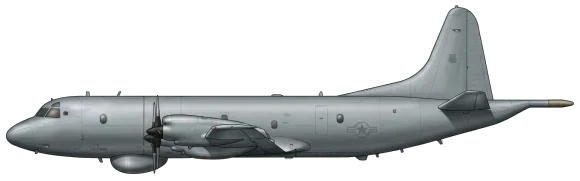
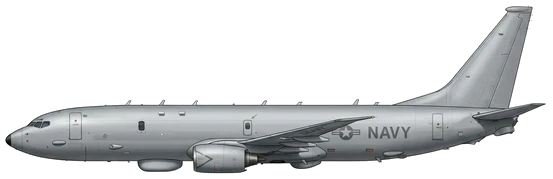
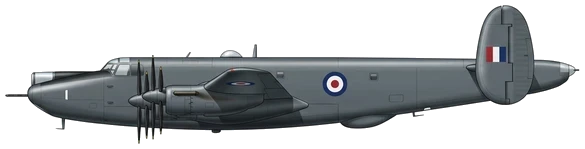
Description
The Hawker Siddeley Nimrod is a retired British maritime patrol aircraft derived from the de Havilland Comet jet airliner. Hawker Siddeley designed it, and its successors British Aerospace and BAE Systems carried out later development and support. The Nimrod entered Royal Air Force service in October 1969 and was the first jet-powered maritime patrol aircraft to enter service. Its primary role was anti-submarine warfare (ASW), with secondary roles in maritime surveillance, anti-surface warfare and search and rescue (SAR). The MR2 was withdrawn in March 2010, and the R1 signals intelligence variant made the type's last flight on 28 June 2011.
Development
The British Government issued Air Staff Requirement 381 on 4 June 1964 to replace the Avro Shackleton, whose fleet was approaching its fatigue life limits. Other contenders included the Lockheed P-3 Orion, the Breguet Atlantic, and derivatives of the Trident, One-Eleven and VC10. On 2 February 1965, Prime Minister Harold Wilson announced that Hawker Siddeley's HS.801 Comet derivative would be ordered. The first two prototypes, XV148 and XV147, were built from unfinished Comet 4C airframes. After the first flight in May 1967, the RAF ordered 46 MR1s. From 1975, 35 aircraft were upgraded to MR2 standard and were re-delivered from August 1979. The Nimrod AEW3 and MRA4 programmes were both cancelled after cost overruns, and the RAF ordered nine Boeing P-8A Poseidons in July 2016.
Design
The Comet's Avon turbojets were replaced by four Rolls-Royce Spey turbofans rated at 12,160 lbf each. On patrol, up to two engines could be shut down as fuel burned off. Inactive engines were restarted using crossfed compressor air, and this crossfeed duct was later identified as a fire hazard. Unrefuelled endurance was ten hours. Airframe changes included an internal weapons bay, an extended radar nose, a tail fairing housing ESM sensors, and a MAD boom. Much of the sensor equipment sat outside the pressure shell in the pannier lower fuselage. A central tactical compartment controlled navigation, sensors and weapons. The MR2 replaced the ASV Mk 21 radar with EMI Searchwater and added the AQS-901 acoustic processor and Yellow Gate ESM wingtip pods. Maximum crew was 25, and a typical crew numbered about 12.
Armament
The internal bomb bay had a capacity of 20,000 lb (9,100 kg) and carried Mk 46 and Sting Ray torpedoes, AGM-84 Harpoon missiles, mines, bombs, and nuclear depth charges. These included the WE.177A and US-owned B57 weapons, the latter carried until 1992. The bay could also hold up to 150 sonobuoys or Lindholme Gear for SAR. Two underwing pylons were provided. For the Falklands War, the aircraft received AIM-9 Sidewinders, 1,000 lb bombs and BL755 cluster bombs.
Operational History
Nimrods deployed to Ascension Island on 5 April 1982 and flew 111 missions during the Falklands War. On 15 May 1982, XV232 flew a 19-hour patrol, and on 20/21 May an MR2 covered 8,453 miles. In the Gulf War, up to five MR2s at Seeb, Oman, flew night patrols and were credited with assisting in sinking or damaging 16 Iraqi vessels. Nimrods also flew overland intelligence missions over Afghanistan and Iraq. On 2 September 2006, XV230 was destroyed near Kandahar and all 14 personnel aboard were killed. Five Nimrods were lost in accidents during RAF service. SAR operations included the 1979 Fastnet race and the 1980 Alexander L. Kielland rig disaster.
Variants
- MR1: Initial maritime patrol version, 46 ordered, with sensors carried over from the Shackleton.
- R1: Signals intelligence variant flown by No. 51 Squadron from 1974 to 2011, with no MAD boom.
- MR2: Upgraded version with Searchwater radar, later modified with in-flight refuelling as the MR2P.
- AEW3: Airborne early warning conversion, cancelled in December 1986 in favour of the E-3 Sentry.
- MRA4: Rebuilt MR2 with BR710 engines and a new wing, cancelled in 2010 at £789 million over budget.
Frequently Asked Questions
What type of aircraft is the Nimrod?
What is the maximum speed of the Nimrod?
What is the range of the Nimrod?
When did the Nimrod first fly?
How many Nimrod have been built?
Which countries operate the Nimrod?
What is the service ceiling of the Nimrod?
- SEP 302026 Created Page created: Nimrod