Strikemaster
British jet-powered training and light attack aircraft, developed in the late 1960s, widely utilized for pilot training and counter-insurgency operations by export customers. Key figures: top speed 774 km/h, range 2,224 km, service ceiling 12,000 m, max takeoff weight 5,216 kg, built 146.
| Crew | 2 |
| Length | 10.3 m (33.7 ft) |
| Wingspan | 11.2 m (36.8 ft) |
| Height | 3.3 m (11.0 ft) |
| Wing area | 19.9 m² (213.7 sqft) |
| Empty weight | 2,810 kg (6,195 lbs) |
| Max. takeoff weight | 5,216 kg (11,499 lbs) |
| Powerplant | 1 × Rolls-Royce Viper Mk.535 14 kN each |
| Maximum speed | 774 km/h (481 mph) |
| Operational range | 2,224 km (1,382 mi) |
| Service ceiling | 12,000 m (39,370 ft) |
| Climb rate | 26.7 m/s (87.6 ft/s) |
- Unguided Bomb 500lb bomb
- Unguided Bomb 25lb practice bomb
- Unguided Bomb 20lb fragmentation bomb
- Rocket Pod SURA R80 rocket
- Rocket Pod SNEB 68mm rocket pod
- Gun Pod 0.5 inch mini-gun pod
Description
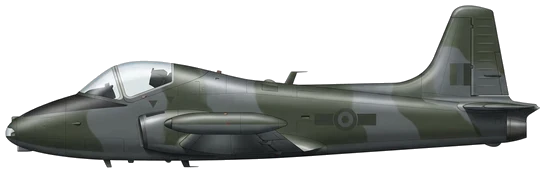
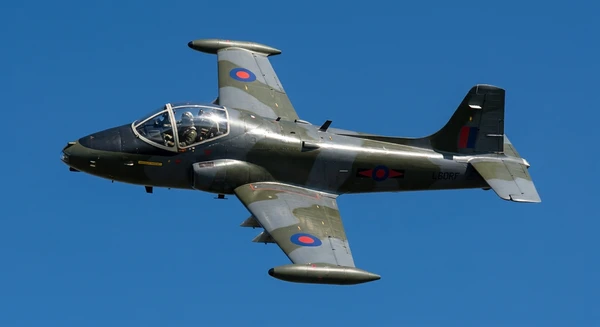
The BAC 167 Strikemaster is a jet trainer and light attack aircraft designed and produced by the British Aircraft Corporation in the United Kingdom. An armed derivative of the Hunting Jet Provost T Mk 5, it first flew in 1967 and entered service in 1968. Marketed as a counter-insurgency aircraft, it was mostly acquired by air forces seeking an advanced trainer, and it saw combat in the service of Ecuador, Oman and South Yemen.
Development
The Jet Provost, which entered service with the Royal Air Force during the 1950s, was the first ab initio jet trainer standardised by an air force. In the 1960s, the British Aircraft Corporation, which had taken over Hunting Percival, developed a light attack version designated BAC 167, several competitions having rejected the Jet Provost for insufficient firepower. The first prototype made its maiden flight on 26 October 1967 from Warton aerodrome; two prototypes were built for manufacturer's trials. The name Strikemaster, the result of an internal competition, was officially adopted in October 1968. Production, initially established at Warton, was transferred to Hurn Airport in the late 1970s; 146 were built before production ended in 1983.
Design
The Strikemaster is powered by a single Armstrong Siddeley (Rolls-Royce) Viper Mk.535 turbojet uprated to 3,140 lbf (14.0 kN). The revised fuel system includes tip tanks and provision for four 75-gallon drop tanks; total capacity reaches 366 imperial gallons. The wing was strengthened to absorb the loads of carrying munitions, the flaps received two actuators and the airbrakes enlarged actuators. The aircraft has two ejection seats capable of low-altitude ejection, fitted with canopy breakers, as well as new communication and navigation equipment and a modified electrical system. A G90 gun camera can be installed in the nose cone, with various sights for one or both crew members. The Mk 88 reaches 774 km/h at 5,500 m, a ceiling of 12,000 m and a combat radius of 233 km.
Armament
Two 7.62 mm FN machine guns, with 550 rounds each, are housed in the lower lips of the air intakes. Four underwing hardpoints, two per wing, allow 3,000 lb (1,400 kg) of stores: four 500 lb bombs, 24 SURA R80 rockets, eight 25 lb practice bombs, eight 20 lb fragmentation bombs, four 18-tube 68 mm SNEB pods, two 0.5 inch machine-gun pods, drop tanks or napalm tanks.
Operational History
Saudi Arabia was the first to order the type, with 25 Strikemaster Mk 80s in May 1966, first deliveries taking place on 26 August 1968 and continuing until May 1978. Oman ordered the type in 1967 and received it in the summer of 1969; the Royal Air Force of Oman flew strikes from October 1969 during the Dhofar rebellion. In July 1972, during the Battle of Mirbat, four Omani Strikemasters supported ground forces attacked by about 300 insurgents. Three aircraft were shot down during the conflict, one of them by an SA-7 missile. The Kenya Air Force introduced the type in the early 1970s, alongside its Hawker Hunters. The Botswana Defence Force Air Wing acquired nine second-hand ex-Kenyan and ex-Kuwaiti aircraft, retired in the late 1990s in favour of the CF-5. The Ecuadorian Air Force committed the Strikemaster during the Cenepa War in 1995 against Peruvian positions. After the Royal New Zealand Air Force discovered fatigue cracks in the wing, operations were restricted at most military users; a shortage of brakes and starter-generators has complicated keeping the type flying since the late 2010s.
Variants
- Strikemaster Mk 80/80A: export version for Saudi Arabia, 25 then 22 aircraft.
- Strikemaster Mk 82/82A: export version for Oman, 12 then 13 aircraft.
- Strikemaster Mk 84: export version for Singapore, 16 aircraft, all retired in 1984.
- Strikemaster Mk 88: export version for New Zealand, 16 aircraft of No. 14 Squadron.
- Strikemaster Mk 89/89A: export version for Ecuador, 22 then 6 aircraft.
Frequently Asked Questions
What type of aircraft is the Strikemaster?
What is the maximum speed of the Strikemaster?
What is the range of the Strikemaster?
When did the Strikemaster first fly?
How many Strikemaster have been built?
Which countries operate the Strikemaster?
What is the service ceiling of the Strikemaster?
- AUG 302026 Updated Description updated
- AUG 12026 Updated Manufacturer updated
- JUN 302026 Created Page created: Strikemaster