SW-4 Puszczyk
Polish utility helicopter, deployed in the early 21st century, primarily used for training and light transport applications. Key figures: top speed 260 km/h, range 790 km, service ceiling 5,200 m, max takeoff weight 1,800 kg, unit price $0.7M, built 40. In service with 1 air force as of 2026 — Poland (23).
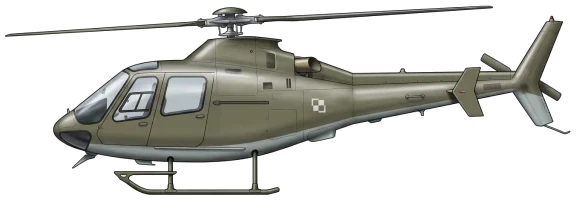
| Crew | 1 |
| Length | 10.6 m (34.7 ft) |
| Wingspan | 9 m (29.5 ft) |
| Height | 3.1 m (10.0 ft) |
| Empty weight | 1,050 kg (2,315 lbs) |
| Max. takeoff weight | 1,800 kg (3,968 lbs) |
| Powerplant | 1 × turboprop Rolls-Royce 250-C20R2 336 kW each |
| Maximum speed | 260 km/h (162 mph) |
| Operational range | 790 km (491 mi) |
| Service ceiling | 5,200 m (17,060 ft) |
| Climb rate | 10.3 m/s (33.8 ft/s) |

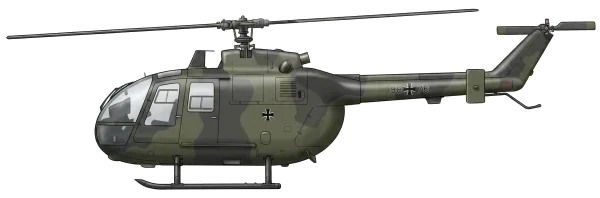
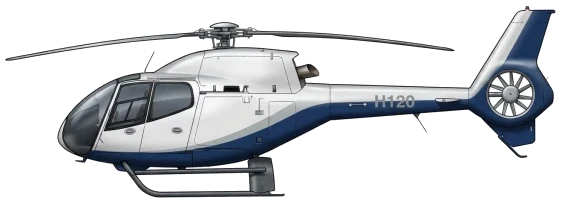
Description
The PZL SW-4 Puszczyk is a Polish light single-engine multipurpose helicopter manufactured by PZL-Świdnik (later part of AgustaWestland). The rotorcraft entered service in 2002, serving primarily in utility and military pilot training roles for the Polish Armed Forces. The type was later developed into the SW-4 Solo optionally piloted vehicle and rebranded for the commercial market as the AW009.
Development
Initial design work at PZL-Świdnik began around 1981 for a light utility helicopter powered by a 300 kW PZL Rzeszów GTD350 turboshaft engine. Following European geopolitical restructuring in the 1990s, the programme was formally re-launched in 1995 with a redesign to incorporate an Allison (later Rolls-Royce) Model 250 engine, an epoxy resin-based composite fuselage structure, and an aluminium tail boom. A non-flying prototype began ground testing in December 1994, and the official first flight was conducted on October 29, 1996. Delays caused by a main rotor head redesign postponed serial production until October 1, 2002, with European Aviation Safety Agency (EASA) type certification granted on September 27, 2007. Under a 2006 agreement with China's Jiujiang Hongying Technology Development, local co-production was established, leading to the first Chinese-assembled flight in February 2010.
Design
The SW-4 is powered by a single 335 kW Rolls-Royce Model 250C20R/2 turboshaft engine driving a fully articulated three-blade main rotor and a two-blade tail rotor, with a 460 kW Pratt & Whitney Canada PW200/9 offered as an alternative engine. The main and tail rotor blades are constructed from composite materials, and flight controls are hydraulically actuated. The airframe accommodates up to five occupants, including the pilot, in crashworthy seating with access via two main sliding cabin doors and a dedicated lower baggage compartment. Maximum takeoff weight is 1,800 kg, with a useful payload capacity of up to 600 kg. Specialized optional equipment includes external extension arms for a forward-looking infrared (FLIR) sensor, searchlight, wire strike protection system, cargo sling, and night vision goggle (NVG) compatible cockpit instrumentation.
Operational History
The principal operator of the aircraft is the Polish Air Force, which acquired 24 SW-4 Puszczyk helicopters to replace the Mil Mi-2 for pilot training at the Center of Aviation Education and Training in Dęblin. In commercial export operations, five co-produced units were delivered to Chinese customers by March 2015 following Civil Aviation Administration of China certification in 2008.
Variants
-
SW-4 Puszczyk: Military training and utility variant operated by the Polish Armed Forces.
-
SW-4 Solo: Optionally piloted vehicle developed with AgustaWestland for unmanned rotorcraft capability demonstrations.
-
AW009: Upgraded commercial variant launched in 2016 featuring a Genesys Aerospace glass cockpit, mass vibration absorber, and modified hydraulic systems.
Frequently Asked Questions
What type of aircraft is the SW-4 Puszczyk?
What is the maximum speed of the SW-4 Puszczyk?
What is the range of the SW-4 Puszczyk?
When did the SW-4 Puszczyk first fly?
How many SW-4 Puszczyk have been built?
Which countries operate the SW-4 Puszczyk?
How much does a SW-4 Puszczyk cost?
What is the service ceiling of the SW-4 Puszczyk?
- AUG 62026 Updated Description updated
- AUG 12026 Updated Manufacturer updated
- APR 72026 Updated Picture credits updated in a site-wide editorial pass
- FEB 72026 Updated Wingspan added
- JAN 122026 Updated SW-4 Puszczyk: range added; SW-4 Puszczyk: price added