Switchblade 300
American man-portable loitering munition, introduced in the early 2010s, used for precision strikes against personnel and light vehicles in various global conflicts. Key figures: top speed 160 km/h, range 10 km, max takeoff weight 6 kg, built 4,000.
| Length | 0.5 m (1.6 ft) |
| Empty weight | 3 kg (6 lbs) |
| Max. takeoff weight | 6 kg (13 lbs) |
| Powerplant | 1 × Electric motor |
| Maximum speed | 160 km/h (99 mph) |
| Operational range | 10 km (6 mi) |
- Guided Bomb Integrated 40mm explosive warhead
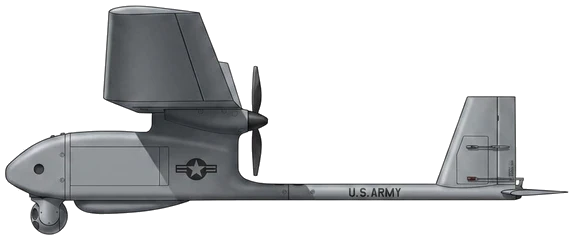


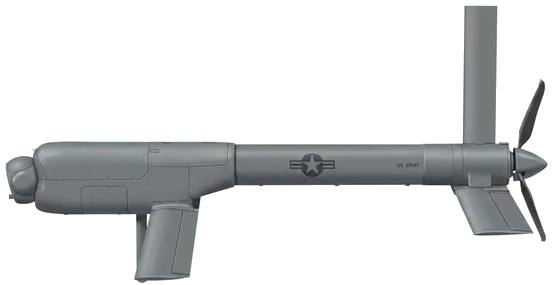
Description
The AeroVironment Switchblade 300 is a man-portable loitering munition designed by the U.S. Air Force Special Operations Command (AFSOC) and developed by the U.S. Army. Introduced in 2011, the system provides infantry units with organic precision fire support to counter ambushes and targets beyond the range of standard weapons. It was rebranded as the Switchblade 300 in 2020 following the introduction of the larger Switchblade 600 variant.
Design
The munition is characterized by spring-loaded wings that deploy after it is released from a launch tube. The Block 10C variant is 610 mm long and weighs 2.7 kg, including its carrying case and launcher. It is powered by an electric motor, reaching flight speeds of 85 knots with an endurance of 10 minutes and a control range of 10 km. The Block 20 variant increased the weight to 3.6 kg and extended endurance to 20 minutes. Sensors include daytime color and infrared cameras, GPS, and an aided target tracker for locking onto stationary or moving targets. The system uses a Digital Data Link (DDL) for encrypted communications and is compatible with Ground Control Stations used by the Raven, Wasp, and Puma UAVs.
Armament
The Switchblade 300 carries an internal explosive warhead equivalent to a 40 mm grenade. The munition utilizes a forward-firing focused blast to reduce collateral damage and can be fused to detonate at a predetermined height. Operators maintain a "man-in-the-loop" capability, allowing them to wave off or abort an attack up to four seconds before impact.
Operational History
Operational history includes extensive use by the U.S. Army and Marine Corps in Afghanistan, where over 4,000 units were deployed by the end of Operation Enduring Freedom. In 2017, 350 units were delivered to SOCOM for operations against Islamic State forces. Following the 2022 Russian invasion of Ukraine, the United States supplied approximately 700 Switchblade 300 units to the Ukrainian Armed Forces. Ukrainian units utilized the system against fuel trucks, personnel carriers, and machine gun nests, though effectiveness declined as Russian electronic warfare and jamming capabilities improved. Current operators include the United States, United Kingdom, Lithuania, Ukraine, and New Zealand. Future procurement contracts have been signed or announced by Australia, Canada, France, Greece, Romania, Sweden, and Taiwan.
Variants
- Switchblade 300 Block 10C: Standard variant featuring a 10-minute flight time and Digital Data Link for secure communications.
- Switchblade 300 Block 20: Enhanced variant with 20-minute endurance, an EO/IR panning camera suite, and improved DDL range.
- Blackwing: An unarmed variant designed for the U.S. Navy to provide ISR and command and control relay from surface and undersea platforms.
- Switchblade 600: A larger anti-armor variant featuring a Javelin-based warhead, a 40-minute loiter time, and an 80 km total range.
Frequently Asked Questions
What type of aircraft is the Switchblade 300?
What is the maximum speed of the Switchblade 300?
What is the range of the Switchblade 300?
When did the Switchblade 300 first fly?
How many Switchblade 300 have been built?
Which countries operate the Switchblade 300?
- APR 82026 Updated Empty weight added
- MAR 282026 Created Page created: Switchblade 300