Tu-4 Bull
Soviet piston-engined strategic bomber, developed in the late 1940s, extensively used for long-range nuclear and conventional bombing missions. Key figures: top speed 558 km/h, range 5,400 km, service ceiling 11,200 m, max takeoff weight 63,600 kg, built 847.
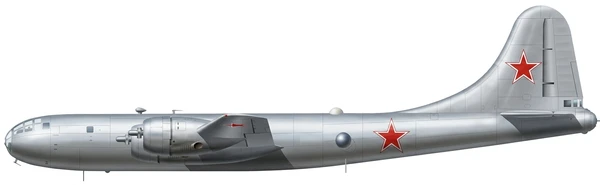
| Crew | 11 |
| Length | 30.2 m (99.0 ft) |
| Wingspan | 43.1 m (141.2 ft) |
| Height | 8.5 m (27.8 ft) |
| Wing area | 161.7 m² (1740.5 sqft) |
| Empty weight | 36,850 kg (81,240 lbs) |
| Max. takeoff weight | 63,600 kg (140,214 lbs) |
| Powerplant | 4 × radial piston engines Shvetsov ASh-73TK 1,790 kW each |
| Maximum speed | 558 km/h (347 mph) |
| Operational range | 5,400 km (3,355 mi) |
| Service ceiling | 11,200 m (36,745 ft) |
| Climb rate | 4.6 m/s (15.1 ft/s) |
- Anti-Ship KS-1 Komet
- Unguided Bomb 1,000 kg bomb
- Nuclear RDS-1
- Nuclear RDS-3
- Nuclear RDS-5
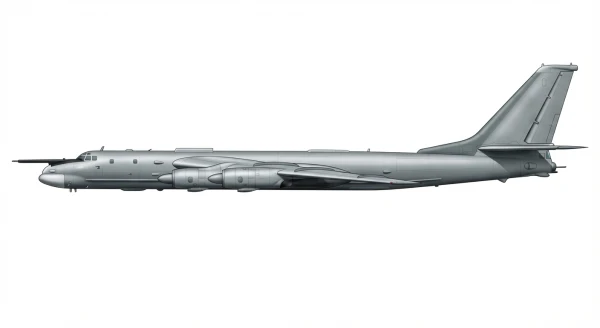
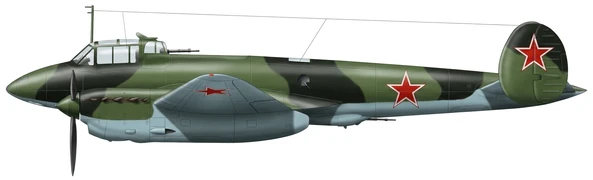
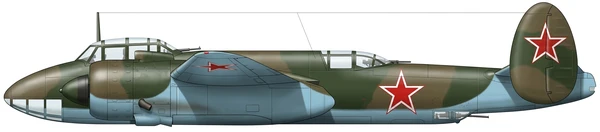
Description
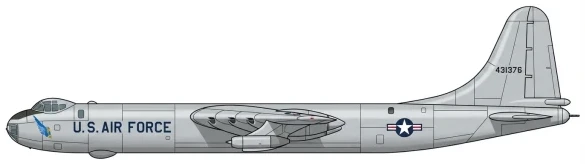
The Tupolev Tu-4 (NATO reporting name: Bull) is a Soviet four-engined, piston-powered strategic bomber developed by Tupolev. Reverse-engineered from seized American Boeing B-29 Superfortresses that made emergency landings in the Soviet Union during World War II, the aircraft entered Soviet Air Force service in 1949 as the USSR's first mass-produced long-range nuclear delivery platform.
Development
To establish a heavy strategic bombing capability to replace the obsolete Petlyakov Pe-8, Joseph Stalin ordered the direct copy of American Boeing B-29 Superfortresses interned during 1944. Tupolev was instructed to duplicate the B-29 rather than continue development of the native ANT-64/Tu-10. The reverse-engineering program involved 900 factories and research institutes, producing 105,000 engineering drawings. The prototype Tu-4 made its first flight on 19 May 1947, piloted by Nikolai Rybko, and serial production continued until 1952, yielding a total of 847 aircraft.
Design
Because Soviet industry utilized metric measurements, sheet aluminum gauges differed from standard U.S. measurements, requiring structural re-engineering that made the prototype 340 kg (750 lb) heavier than the original B-29 design. The aircraft was powered by four 1,790 kW (2,400 hp) Shvetsov ASh-73TK 18-cylinder air-cooled radial piston engines. Internal equipment modifications included radio equipment derived from Lend-Lease B-25 bombers, Soviet identification friend or foe (IFF) systems, and local parachutes. The aircraft retained the B-29 airframe dimensions, featuring a length of 30.18 meters, a wingspan of 43.05 meters, and a maximum takeoff weight between 55,600 kg and 63,600 kg.
Armament
Defensive armament consisted of ten 23 mm Nudelman NS-23 cannon mounted in pairs across four remote-controlled turrets and a manned tail barbette. Internal bomb bays carried a standard payload of six 1,000 kg high-explosive conventional bombs. Specialized nuclear variants were adapted to carry single RDS-1, RDS-3, or RDS-5 nuclear fission weapons, while anti-shipping configurations carried two underwing KS-1 Komet standoff anti-ship missiles.
Operational History
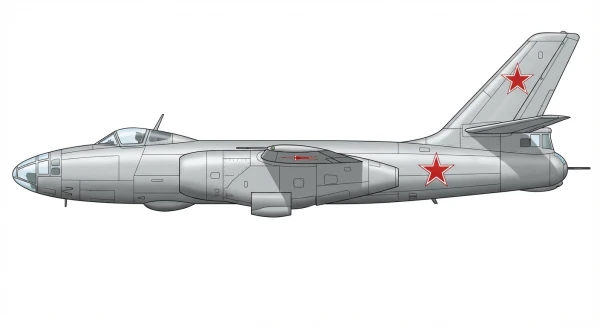
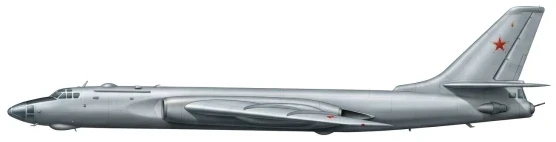
The Soviet Air Force introduced the Tu-4 into service in 1948, re-equipping the 185th Guards Aviation Regiment as its initial operational unit. A modified Tu-4A conducted the first Soviet air-dropped nuclear test when it released an RDS-3 bomb. The Soviet Union exported 12 Tu-4 airframes to the Chinese People's Liberation Army Air Force (PLAAF) between 1953 and 1960. Soviet front-line units phased out the type during the late 1950s as Tupolev Tu-16 jet bombers and Tu-95 turboprop bombers entered service, reassigning remaining airframes to transport and engine testbed roles. Chinese Tu-4s were retrofitted with Ivchenko AI-20K turboprop engines in the 1970s and remained in PLAAF service until 1988.
Variants
-
Tu-4: Standard production strategic bomber variant equipped with Shvetsov ASh-73TK radial engines.
-
Tu-4A: Modified nuclear-capable bomber variant configured to carry Soviet nuclear fission weapons.
-
Tu-4D: Dedicated military troop transport conversion engineered to transport up to 300 personnel.
-
Tu-4K: Anti-shipping strike variant modified with underwing pylons to launch two KS-1 Komet standoff missiles.
-
KJ-1: Chinese airborne early warning prototype featuring AI-20K turboprop engines and a roof-mounted Type 843 radar rotodome.
Frequently Asked Questions
What type of aircraft is the Tu-4 Bull?
What is the maximum speed of the Tu-4 Bull?
What is the range of the Tu-4 Bull?
When did the Tu-4 Bull first fly?
How many Tu-4 Bull have been built?
What is the service ceiling of the Tu-4 Bull?
- AUG 62026 Created Page created: Tu-4 Bull