B-29 Superfortress
American four-engined heavy strategic bomber, developed in the early 1940s, extensively used in the Pacific theater of World War II and the Korean War. Key figures: top speed 575 km/h, range 5,230 km, service ceiling 9,710 m, max takeoff weight 60,555 kg, unit price $0.64M, built 3,970.
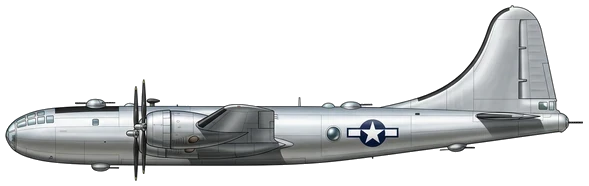
| Crew | 11 (pilot, co-pilot, bombardier, flight engineer, navigator, radio operator, radar observer, right gunner, left gunner, central fire control, tail gunner) |
| Length | 30.2 m (99.0 ft) |
| Wingspan | 43.1 m (141.2 ft) |
| Height | 8.5 m (27.8 ft) |
| Wing area | 161.3 m² (1736.2 sqft) |
| Empty weight | 33,793 kg (74,501 lbs) |
| Max. takeoff weight | 60,555 kg (133,501 lbs) |
| Powerplant | 4 × radial piston engines Wright R-3350-23 Duplex-Cyclone 1,640 kW each |
| Maximum speed | 575 km/h (357 mph) |
| Operational range | 5,230 km (3,250 mi) |
| Service ceiling | 9,710 m (31,857 ft) |
| Climb rate | 4.6 m/s (15.1 ft/s) |
- Nuclear Little Boy
- Nuclear Fat Man
- Nuclear Mark 4
- Nuclear Mark 6
- Guided Bomb VB-3 Razon
- Guided Bomb VB-13 Tarzon
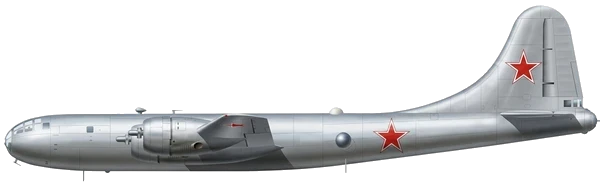
Description
The Boeing B-29 Superfortress is an American four-engined, propeller-driven heavy bomber designed by Boeing and operated by the USAAF and USAF during World War II and the Korean War. It was designed for high-altitude strategic bombing and was also used for low-altitude night incendiary raids and aerial minelaying against Japan. It flew its first combat mission on 5 June 1944. Silverplate B-29s dropped the atomic bombs on Hiroshima and Nagasaki, the only use of nuclear weapons in combat. The type was retired in 1960 after 3,970 had been built.
Development
Boeing began long-range bomber studies in 1938 as a private venture. In December 1939 the Air Corps specified a bomber able to carry 20,000 lb (9,100 kg) of bombs 2,667 mi (4,292 km) at 400 mph (640 km/h). Boeing submitted its Model 345 on 11 May 1940 and received an order for XB-29 prototypes on 24 August 1940. The first prototype flew from Boeing Field, Seattle, on 21 September 1942. The second crashed after an engine fire on 18 February 1943, killing its test crew. Final assembly took place at Boeing's Renton and Wichita plants, Bell's Marietta plant, and Martin's Bellevue plant. By the end of 1943 only 15 of almost 100 delivered aircraft were airworthy, which led to the "Battle of Kansas," in which 150 aircraft were modified between 10 March and 15 April 1944. The programme cost $3 billion, exceeding the Manhattan Project.
Design
The B-29 was the first Allied production bomber with cabin pressurization, developed by Garrett AiResearch. Pressurized forward and rear compartments were joined by a crawl tunnel over the unpressurized bomb bays. Power came from four 2,200 hp Wright R-3350-23 radials with dual General Electric turbosuperchargers, whose turbine wheels were cast from Vitallium alloy. Early engines were prone to overheating and fires. Maximum speed was 357 mph (575 km/h), service ceiling 31,850 ft (9,710 m), and range 3,250 mi (5,230 km).
Armament
The General Electric Central Fire Control system linked five sighting stations to four remote turrets, each with two .50 in Browning M2 machine guns. Analog computers corrected for lead, gravity, and other factors, and they allowed one gunner to control several turrets. The tail initially mounted two .50 in guns and an M2 20 mm cannon. Weapons delivered included incendiaries, naval mines, the Little Boy and Fat Man atomic bombs, and, in Korea, the VB-3 Razon and VB-13 Tarzon guided bombs.
Operational History
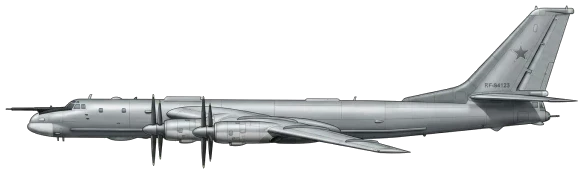
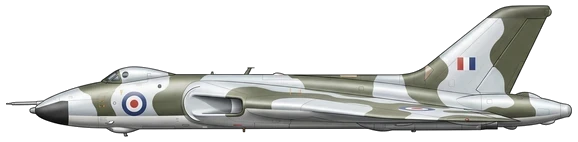
Under Operation Matterhorn, B-29s based in India and China raided Bangkok on 5 June 1944 and Yawata, Japan, on 15 June 1944. From October 1944 operations moved to the Marianas, and 111 aircraft attacked Tokyo on 24 November 1944. The 9–10 March 1945 night raid on Tokyo was the most destructive bombing raid in history. From April 1945, B-29s mined Japanese ports in Operation Starvation. Enola Gay bombed Hiroshima on 6 August 1945, and Bockscar bombed Nagasaki three days later. In Korea, B-29s flew 20,000 sorties, and MiG-15 opposition forced a switch to night missions; 78 aircraft were lost. The RAF flew 87 as the Washington B.1 from 1950 to 1954. Interned B-29s were copied as the Soviet Tupolev Tu-4.
Variants
- B-29A: Renton-built version with a wing one foot longer in span.
- B-29B: Bell-built version, 311 produced, with all defensive armament except the tail removed and AN/APG-15 radar fitted.
- Silverplate: Version with an enlarged bomb bay, fuel injection, and reversible propellers for atomic bomb delivery.
- KB-29: Aerial refuelling tanker conversion introduced in 1948.
- B-29D/B-50: Re-engined development with four Pratt & Whitney R-4360 Wasp Major engines.
Frequently Asked Questions
What type of aircraft is the B-29 Superfortress?
What is the maximum speed of the B-29 Superfortress?
What is the range of the B-29 Superfortress?
When did the B-29 Superfortress first fly?
How many B-29 Superfortress have been built?
Which countries operate the B-29 Superfortress?
How much does a B-29 Superfortress cost?
What is the service ceiling of the B-29 Superfortress?
- OCT 192026 Created Page created: B-29 Superfortress